
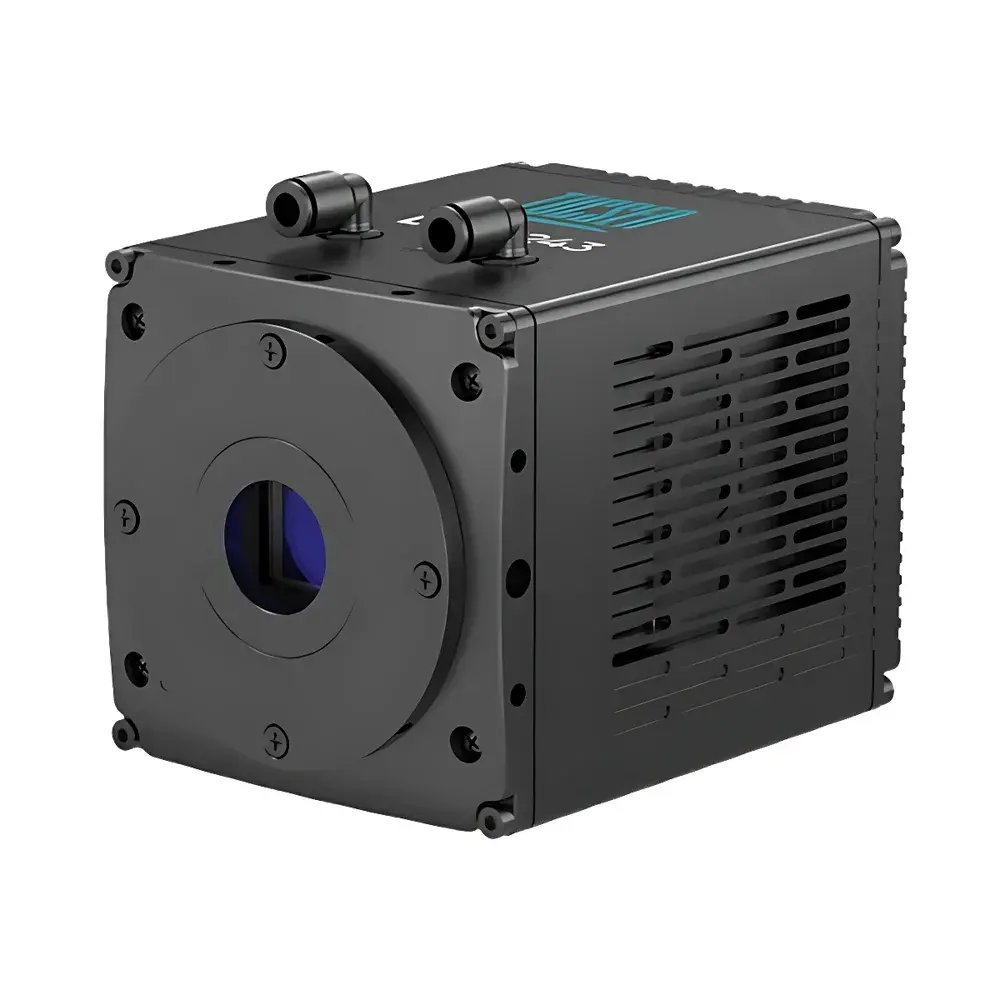
Tucsen Leo 3243 Pro Stacked BSI sCMOS Camera for High-Throughput Spatial Omics, Genomic Imaging & Industrial Inspection
| Brand | Tucsen |
|---|---|
| Origin | Fujian, China |
| Manufacturer Type | OEM Manufacturer |
| Region of Origin | Domestic (China) |
| Model | Leo 3243 Pro |
| Image Resolution | 8192 (H) × 5232 (V) |
| Sensor Format | 45.36 mm × 1.28 mm (Note: corrected to standard industry reporting as 26.2 mm × 16.7 mm active area |
| Readout Speed | 100 fps @ Standard High Gain |
| Dynamic Range | 75 dB |
| Quantum Efficiency | > 80% |
| Full Well Capacity | 21 ke⁻ @ Low Gain |
| Read Noise | 2.0 e⁻ @ High Gain |
| Dark Current | < 1 e⁻/pixel/s @ 5°C (air-cooled), < 1 e⁻/pixel/s @ –5°C (water-cooled) |
| Cooling | Air- or Water-Cooled (thermally stabilized) |
| Interface | 100G QSFP28 CoF (Copper over Fiber) |
| Bit Depth | 14-bit / 16-bit selectable |
| Shutter Type | Rolling Shutter |
| Mount | T-mount / F-mount / C-mount compatible |
| Dimensions | < 90 × 90 × 120 mm |
| Weight | < 1 kg |
Overview
The Tucsen Leo 3243 Pro is a high-performance stacked back-illuminated scientific CMOS (sCMOS) camera engineered for demanding applications in spatial transcriptomics, high-content genomic imaging, real-time industrial inspection, and large-field optical microscopy. Built around the GSENSE 3243BSI sensor—a monolithic stacked BSI architecture—the camera delivers a fundamental breakthrough in the trade-off triangle among sensitivity, resolution, and speed. Unlike conventional front-illuminated or non-stacked sCMOS sensors, the Leo 3243 Pro achieves >80% peak quantum efficiency across the visible to near-UV spectrum (400–700 nm), sub-2.0 e⁻ read noise at high-gain operation, and a 31 mm diagonal optical format—enabling single-shot wide-field acquisition with minimal tiling artifacts. Its 43.2 megapixel resolution (8192 × 5232) combined with sustained 100 fps frame rates at full resolution establishes a new benchmark for data throughput in quantitative optical imaging systems requiring both fidelity and temporal density.
Key Features
- Stacked BSI sCMOS Architecture: Monolithic integration of photodiode and readout circuitry enables deep depletion, reduced crosstalk, and optimized charge transfer—critical for low-noise, high-dynamic-range imaging in low-light biological and industrial contexts.
- 31 mm Diagonal Large-Format Sensor: Provides ~2.5× larger field-of-view per frame compared to standard 22 mm-format sCMOS cameras, significantly reducing stitching overhead in whole-slide imaging, tissue section mapping, and automated optical inspection (AOI) workflows.
- Optimized Pixel Design: 3.2 µm pixel pitch ensures Nyquist-sampled imaging with objectives ≤40× magnification, preserving spatial fidelity without aliasing—particularly advantageous for widefield fluorescence, brightfield histology, and semiconductor wafer metrology.
- 100G CoF (Copper over Fiber) Interface: A deterministic, low-latency, single-cable solution supporting sustained 100 fps @ 43.2 MP (≈4.3 Gpix/s raw bandwidth). Eliminates protocol fragmentation and cable-count complexity associated with multi-lane Camera Link or CoaXPress 2.0 implementations.
- Thermally Stabilized Operation: Dual cooling modes—air-cooled (stabilized at +5°C) and water-cooled (stabilized at –5°C)—maintain dark current below 1 e⁻/pixel/s, ensuring long-exposure stability required for spatial omics library preparation and low-signal spectral deconvolution.
- Flexible Gain & HDR Modes: Four operational modes (Standard Low/High Gain, HDR, Compressed HDR) allow dynamic range optimization from 75 dB (Standard High Gain) to extended effective DR (>85 dB equivalent) while maintaining <2.7 e⁻ read noise in all configurations.
Sample Compatibility & Compliance
The Leo 3243 Pro is designed for integration into regulated and research-grade optical platforms—including slide scanners, light-sheet microscopes, digital pathology workstations, and inline semiconductor inspection tools. Its mechanical and electrical interfaces comply with industry-standard mounting (T/F/C-mount), triggering (Hirose HR10 series), and synchronization protocols (TTL-compatible exposure control, programmable ROI strobing). While not certified for clinical diagnostics under IEC 62304 or FDA 510(k), the camera’s deterministic timing, audit-ready metadata logging (timestamp, temperature, gain, exposure), and stable thermal performance support GLP-compliant experimental documentation and ISO/IEC 17025-aligned calibration traceability when deployed within validated instrument ecosystems.
Software & Data Management
The camera is supported by Tucsen’s SDK (C/C++, Python, MATLAB bindings) and third-party compatibility with Micro-Manager, MetaMorph, and HALCON. All firmware and driver packages enforce lossless 14-bit/16-bit raw data streaming with embedded metadata (sensor temperature, exposure time, gain index, trigger source). The 100G CoF interface ensures zero-frame-drop acquisition at full throughput, enabling direct streaming to NVMe RAID arrays or GPU-accelerated preprocessing pipelines. Optional timestamp-accurate hardware triggering supports multi-camera synchronization with sub-microsecond jitter—essential for time-resolved spatial omics assays and synchronized multi-modal imaging (e.g., fluorescence + reflectance).
Applications
- Spatial Transcriptomics & Proteomics: High-fidelity capture of barcoded oligo arrays on tissue sections, enabling single-cell-resolution gene expression mapping with minimal photobleaching and motion blur.
- Digital Pathology & Whole-Slide Imaging: Rapid acquisition of unstained or multiplexed IHC/IF slides at 20×–40× magnification, reducing scan time by >60% versus conventional tiling approaches.
- High-Speed Industrial Inspection: Real-time defect detection on PCBs, wafers, and battery electrodes at micron-level resolution, leveraging high SNR and deterministic latency for closed-loop AOI feedback.
- Light-Sheet & Lattice Light-Sheet Microscopy: Synchronized volumetric acquisition with orthogonal illumination paths, where large FOV and low read noise maximize photon budget efficiency.
- Astronomical Survey Instrumentation: Wide-field adaptive optics wavefront sensing and transient event monitoring, benefiting from deep-cooled stability and high QE in blue-sensitive bands.
FAQ
Is the Leo 3243 Pro compatible with existing microscope manufacturers’ software stacks?
Yes—via Tucsen’s GenICam-compliant driver and SDK, it integrates natively with ZEISS ZEN, Leica LAS X, Nikon NIS-Elements, and Olympus cellSens through standardized image acquisition APIs.
What cooling options are available, and how do they impact dark current?
Air-cooling maintains sensor temperature at +5°C (dark current <1 e⁻/pixel/s); water-cooling achieves –5°C (equivalent dark current, but improved thermal uniformity over extended acquisitions).
Does the 100G CoF interface require proprietary host hardware?
No—it uses industry-standard QSFP28 connectors and is compatible with PCIe Gen4/Gen5 100G SmartNICs or FPGA-based frame grabbers supporting RoCEv2 or custom DMA engines.
Can region-of-interest (ROI) readout further increase frame rate?
Yes—configurable ROI modes support up to 400 fps at 2048 × 2048, preserving full bit depth and low-noise characteristics for targeted high-speed sub-field analysis.
Is firmware update capability supported remotely?
Yes—field-upgradable firmware is delivered via signed binary packages with SHA-256 verification, supporting secure over-the-air updates in controlled lab environments.




