
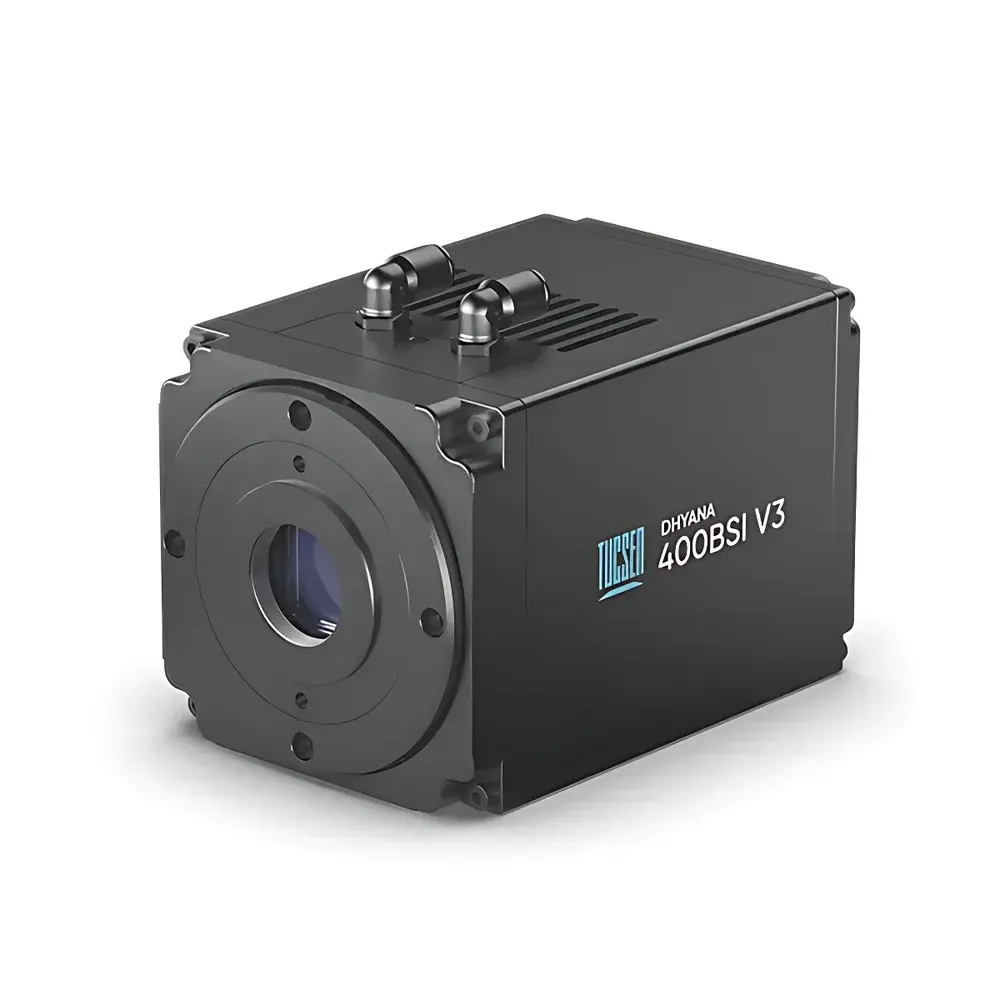
Tucsen Dhyana 400BSI V3 Back-Illuminated Scientific CMOS Camera
| Brand | Tucsen |
|---|---|
| Origin | Fujian, China |
| Manufacturer Type | OEM Manufacturer |
| Origin Category | Domestic (China) |
| Model | Dhyana 400BSI V3 |
| Image Resolution | 2048 (H) × 2048 (V) |
| Pixel Size | 6.5 µm × 6.5 µm |
| Sensor Diagonal | 18.8 mm |
| Readout Speed | 100 fps @ CameraLink |
| Dynamic Range | 90 dB |
| Quantum Efficiency | 95% @ 600 nm |
Overview
The Tucsen Dhyana 400BSI V3 is a high-performance, back-illuminated scientific CMOS (sCMOS) camera engineered for demanding low-light, high-speed imaging applications in microscopy, spectroscopy, and astrophysical research. Built around the Gpixel GSENSE2020BSI sensor—a true back-side illuminated architecture—the camera delivers exceptional photon detection efficiency across the visible to near-UV spectrum, with peak quantum efficiency of 95% at 600 nm. Its 4.2 MP resolution (2048 × 2048) is maintained at a sustained 100 fps under CameraLink interface operation, representing the practical readout limit for full-frame acquisition at this resolution. The camera employs a rolling shutter with programmable row exposure timing and scan-direction synchronization—specifically optimized for light-sheet microscopy and other scanning-based modalities where precise temporal alignment between illumination and sensor integration is critical. Thermal management integrates dual-mode cooling (forced-air and liquid), achieving up to −45 °C ΔT below ambient under water-cooled conditions, enabling sub-0.15 e⁻/pix/s dark current performance at −15 °C. With a compact footprint (85 × 85 × 127 mm), mass of only 995 g, and nominal power draw of 45 W, the Dhyana 400BSI V3 is designed for seamless integration into OEM instruments, automated microscope platforms, and space-constrained observatory systems.
Key Features
- Back-illuminated sCMOS sensor (Gpixel GSENSE2020BSI) with 95% QE at 600 nm and 90 dB dynamic range
- Full-frame readout at 100 fps via CameraLink; 60 fps via USB 3.0—configurable across 11-bit, 12-bit, and 16-bit output modes
- Programmable rolling shutter with adjustable inter-row exposure delay and bidirectional scan synchronization for light-sheet and confocal line-scanning compatibility
- Dual cooling architecture: air-cooled standard; optional water-cooling for deep stabilization (−45 °C ΔT below ambient)
- Ultra-low read noise: 1.1 e⁻ (median) in CMS mode; 1.6 e⁻ (median) in HDR mode
- Flexible region-of-interest (ROI) selection and on-chip binning (2×2, 4×4) for frame-rate scaling and signal-to-noise optimization
- C-mount optical interface, SMA-trigger I/O, and industrial-grade 12 V / 8 A power input for embedded system integration
Sample Compatibility & Compliance
The Dhyana 400BSI V3 supports monochrome imaging across wavelengths from 200 nm to 1100 nm, making it suitable for fluorescence, Raman, hyperspectral, and narrowband astronomical imaging. Its high uniformity—characterized by PRNU < 0.3% and DSNU < 0.2 e⁻—ensures quantitative pixel-level fidelity required in calibrated intensity measurements. The camera complies with CE, FCC, and RoHS directives. While not certified to ISO 13406-2 or ASTM E2847 for medical use, its hardware design and firmware architecture support GLP/GMP-aligned workflows through deterministic trigger behavior, timestamped metadata embedding, and non-volatile configuration storage. Full audit trails for acquisition parameters are enabled when used with compliant host software (e.g., Micro-Manager 2.0 with plugin logging).
Software & Data Management
Native SDKs are provided for C, C++, C#, and Python, enabling direct integration into custom acquisition pipelines. Official drivers and GUI applications—including Mosaic (for multi-channel tiling), SamplePro (for quantitative image analysis), and LabVIEW/VIs—are compatible with Windows and Linux (64-bit). MATLAB support includes native Image Acquisition Toolbox integration. All interfaces preserve full bit-depth fidelity (up to 16-bit linear output) and embed precise exposure timestamps, sensor temperature, and gain settings in TIFF or HDF5 metadata headers. Data streaming over CameraLink supports real-time DMA transfer to RAM or GPU memory, minimizing host CPU overhead during high-throughput acquisition.
Applications
- Light-sheet fluorescence microscopy (LSFM): synchronized rolling shutter enables artifact-free volumetric imaging at >100 Hz frame rates
- Time-resolved spectroscopy: high QE and low read noise facilitate single-photon-level spectral acquisition in UV-Vis-NIR ranges
- Astrophotography and adaptive optics wavefront sensing: deep-cooled operation suppresses thermal background in long-exposure planetary and stellar imaging
- Industrial inline inspection: ROI-accelerated acquisition supports real-time defect detection on moving substrates
- Quantitative phase imaging and digital holography: pixel-level linearity and stability enable interferometric fringe analysis with sub-pixel precision
FAQ
What cooling options are available, and what is the minimum achievable sensor temperature?
The Dhyana 400BSI V3 supports both forced-air and liquid cooling. With water cooling and ambient temperature at 25 °C, the sensor can be stabilized at −20 °C (ΔT = −45 °C), yielding dark current ≤ 0.15 e⁻/pix/s.
Does the camera support hardware triggering with precise timing control?
Yes—it features four configurable TTL-compatible SMA I/O lines for external trigger input, exposure start, readout completion, and ready status, with jitter < 100 ns.
Can I acquire data simultaneously over CameraLink and USB 3.0?
No—interface selection is exclusive; CameraLink and USB 3.0 operate as independent physical and logical channels.
Is the SDK compatible with Linux-based real-time OS deployments?
The C/C++ SDK supports POSIX-compliant Linux distributions (Ubuntu 20.04+, CentOS 8+); real-time scheduling (SCHED_FIFO) and memory locking are supported for deterministic latency.
What is the maximum usable ROI frame rate at 1024 × 1024 resolution?
At 1024 × 1024 ROI and 12-bit output, frame rates exceed 300 fps over CameraLink—scaling approximately inversely with pixel count.




