
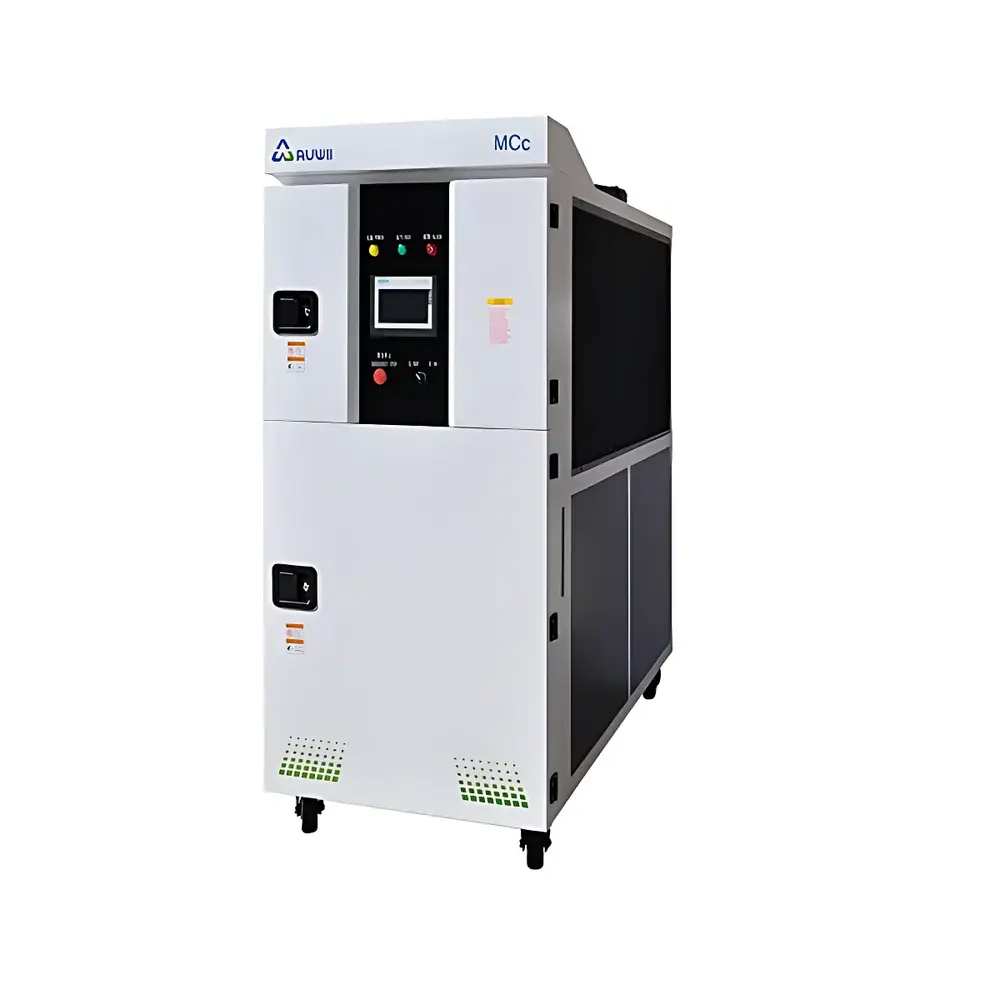
Tongzhou Weipu MCC Series Integrated Circulating Chiller for EV Battery Pack Testing
| Brand | Tongzhou Weipu |
|---|---|
| Origin | Beijing, China |
| Manufacturer Type | Direct Manufacturer |
| Product Category | Domestic |
| Model | MCC |
| Instrument Type | Integrated |
| Cooling Method | Water-Cooled |
| Temperature Control Range | −20 °C to 120 °C |
| Cooling Capacity | 8–45 kW |
| Temperature Stability | ±1 °C |
| Circulating Pump Pressure | 0–300 kPa |
| Circulating Pump Flow Rate | 2.0–20 L/min |
| Reservoir Volume | 100–250 L |
| Operation Mode | Continuous |
Overview
The Tongzhou Weipu MCC Series Integrated Circulating Chiller is an engineered thermal management solution specifically designed for dynamic, high-fidelity testing of electric vehicle (EV) battery packs under controlled environmental conditions. Built upon direct-compression refrigeration architecture and optimized for electrochemical test benches, this chiller delivers precise, stable, and responsive temperature regulation across a wide operational envelope—from cryogenic conditioning at −20 °C to high-temperature soak testing up to 120 °C. Its core function is to maintain thermal equilibrium in battery module test fixtures during charge/discharge cycling, thermal runaway simulation, mechanical stress coupling (e.g., motor-dyno bench integration), and accelerated life cycle validation. Unlike conventional laboratory chillers, the MCC integrates real-time flow-pressure modulation, intelligent fluid recovery, and multi-protocol industrial communication—making it a purpose-built subsystem rather than a generic cooling utility.
Key Features
- Wide-Temperature Dual-Zone Capability: Achieves stable setpoints from −20 °C to 120 °C with ±1 °C uniformity over time, enabled by proprietary high-temperature refrigerant circuit design and variable-speed compressor control.
- High-Dynamic Flow Regulation: Precision-controlled pump system supports selectable flow ranges (2.0–20 L/min standard; optional 4–40 L/min and 4–60 L/min configurations), with flow accuracy better than ±0.2 L/min—critical for consistent heat transfer coefficient across varying cell geometries and cold plate designs.
- Intelligent Fluid Recovery System: Patented auto-purge algorithm activates post-test to evacuate residual coolant from DUT (device under test) channels using regulated compressed air, minimizing cross-contamination and enabling rapid setup turnaround between test cycles.
- Industrial Communication Integration: Native support for RS-485 (Modbus RTU), CAN 2.0B (J1939-compatible), and Ethernet (TCP/IP) interfaces allows seamless synchronization with battery cycler controllers (e.g., Keysight, Digatron, Bitrode), PLC-based test stands, and MES-level data logging systems.
- Modular Internal Architecture: Power supply, refrigeration loop, fluid manifold, and control electronics are housed in independent, hot-swappable modules—facilitating field upgrades, preventive maintenance, and configuration scalability without full-system downtime.
- Containment-Safe Design: Integral leak-detection sump with level sensor and secondary containment barrier meets IEC 61000-6-4 EMC immunity requirements and mitigates risk of coolant spillage onto sensitive test instrumentation or floor-mounted battery racks.
Sample Compatibility & Compliance
The MCC chiller is compatible with standard glycol-water mixtures (e.g., 30/70 or 40/60 v/v ethylene glycol/water) and corrosion-inhibited heat transfer fluids approved for lithium-ion battery thermal management (e.g., Dowtherm J, Syltherm 88). It interfaces directly with common EV battery test fixtures including liquid-cooled cold plates, immersion-style test chambers, and dual-circuit thermal manifolds used in pack-level abuse testing. The system complies with CE marking directives (2014/30/EU EMC, 2014/35/EU LVD), RoHS 2015/863/EU, and conforms to ISO 17025-aligned calibration traceability protocols when operated with certified temperature probes (e.g., Pt100 Class A). For regulated environments, audit-ready operation logs—including timestamped setpoint history, flow/pressure deviations, and alarm events—are retained onboard for GLP/GMP documentation workflows.
Software & Data Management
The MCC operates via an embedded Linux-based controller running a deterministic real-time task scheduler. Local HMI provides touchscreen access to PID tuning parameters, safety interlock thresholds (e.g., low-flow cutoff, high-temp shutdown), and diagnostic event logs. Remote monitoring and configuration are supported through a secure web interface (HTTPS/TLS 1.2) or OPC UA server (compliant with IEC 62541), enabling integration into LabVIEW, Python-based test automation frameworks (e.g., PyVISA), or enterprise SCADA platforms. All operational data—including 10 Hz sampled temperature, pressure, and flow values—is stored internally for ≥30 days and exportable via USB or network transfer in CSV or HDF5 format. Optional FDA 21 CFR Part 11 compliance package includes electronic signature enforcement, role-based access control, and immutable audit trails for regulated battery qualification programs.
Applications
- Dynamic thermal validation of 400 V / 800 V battery modules during constant-current/constant-power cycling
- Thermal shock profiling per ISO 16750-4 and GB/T 31467.3 for automotive traction batteries
- Coupled electromechanical fatigue testing (e.g., motor-battery co-simulation on dyno benches)
- Production line end-of-line (EOL) thermal performance screening with <5-second stabilization time
- Calorimetric measurement support for heat generation quantification (Qgen) in pouch/prismatic cells
- Environmental stress screening (ESS) and HALT/HASS test chambers requiring stable boundary-condition control
FAQ
What refrigerants are used in the MCC chiller?
The system utilizes R-410A or R-513A refrigerant depending on model variant and regional regulatory requirements—both classified as low-GWP alternatives compliant with EU F-Gas Regulation No. 517/2014.
Can the MCC be integrated with third-party battery cyclers?
Yes—standard Modbus RTU over RS-485 enables bidirectional control with major cycler brands; custom protocol mapping is available upon request for proprietary interfaces.
Is external water cooling required for the condenser?
Yes—the MCC is water-cooled and requires a facility-supplied chilled water loop (typically 10–25 °C inlet) meeting ASHRAE Standard 188 guidelines for Legionella risk mitigation.
What is the maximum allowable backpressure at the outlet port?
The system is rated for continuous operation at up to 300 kPa static discharge pressure; exceeding this may trigger automatic pump derating or fault lockout.
Does the MCC support NIST-traceable temperature calibration?
Yes—factory calibration includes dual-point verification against reference thermistors traceable to NIST SRM 1750; on-site recalibration kits and certified service reports are available.



