
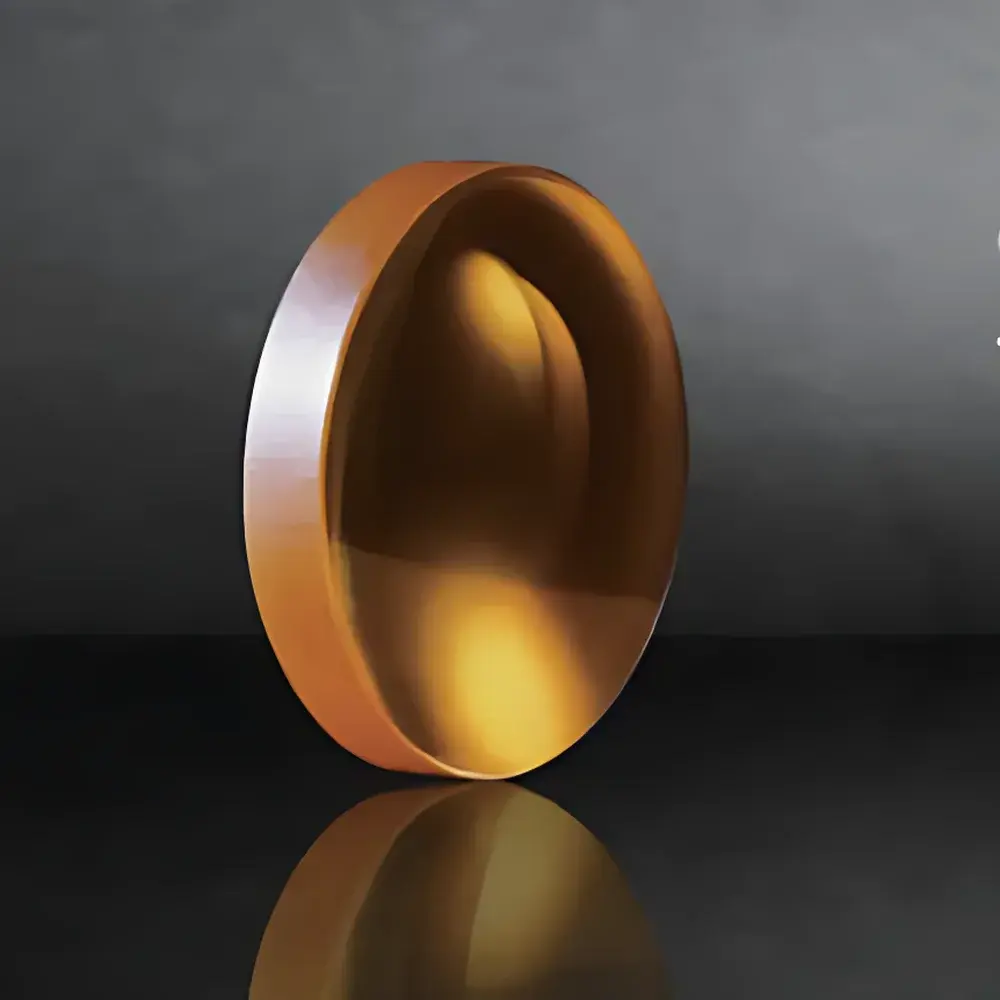
MiXran Meg1029 ZnSe Plano-Concave Lens
| Brand | MiXran |
|---|---|
| Model | Meg1029 |
| Material | Zinc Selenide (ZnSe) |
| Surface Finish | Uncoated or IR2 Broadband Anti-Reflection Coating (Ravg < 1.5% @ 8–12 µm) |
| Diameter | 25.4 mm |
| Focal Lengths (EFL) | –25.4 mm, –50 mm, –75 mm, –100 mm, –200 mm |
| Back Focal Length (BFL) | –26.2 mm to –280.5 mm |
| Radius of Curvature (R1) | –35.6 mm to –140.3 mm |
| Center Thickness (Tc) | 22.3–24.3 mm |
| Edge Thickness | Not specified |
| Mounting Compatibility | Standard 25.4 mm lens mounts (e.g., PN35019-LM254-S series) |
| Compliance | ISO 10110 optical manufacturing standards (surface quality, homogeneity, stress birefringence) |
Overview
The MiXran Meg1029 is a precision-engineered plano-concave lens fabricated from high-purity zinc selenide (ZnSe), optimized for mid-wave to long-wave infrared (MWIR–LWIR) optical systems operating in the 8–12 µm atmospheric transmission window. As a diverging optical element, it introduces controlled negative power to expand collimated beams, correct spherical aberration in multi-element assemblies, or serve as a beam expander component in FTIR spectrometers, thermal imaging relay optics, CO₂ laser beam shaping systems, and infrared gas sensing platforms. ZnSe’s exceptional transmittance (>70% bulk transmission across 0.5–20 µm), low absorption coefficient at 10.6 µm, and isotropic crystalline structure make it a preferred substrate for demanding IR applications where thermal stability and minimal wavefront distortion are critical. Each Meg1029 lens is manufactured under cleanroom conditions in Beijing and conforms to ISO 10110-5 (surface imperfections) and ISO 10110-7 (homogeneity and striae) specifications.
Key Features
- High-purity CVD-grown ZnSe substrate with ≤0.1% absorption at 10.6 µm and refractive index n ≈ 2.40 @ 10.6 µm
- Plano-concave geometry enabling predictable beam divergence with minimal chromatic aberration in IR bands
- Two surface finish options: uncoated (for ultra-low scatter requirements) or double-sided IR2 broadband anti-reflection coating (Ravg < 1.5% over 8–12 µm)
- Precision diamond-turned concave surface with λ/4 surface figure accuracy (PV) and < 20 Å RMS roughness
- Standard 25.4 mm clear aperture compatible with industry-standard kinematic lens mounts (e.g., Thorlabs SM25.4, Newport KM100 series)
- Center thickness tolerance ±0.1 mm; focal length tolerance ±1% (as measured via interferometric verification per ISO 10110-2)
Sample Compatibility & Compliance
The Meg1029 lens is designed for integration into vacuum-compatible, temperature-stable optical benches used in analytical and industrial IR instrumentation. Its ZnSe material exhibits negligible hygroscopicity and maintains mechanical integrity under continuous exposure to ambient humidity—unlike KRS-5 or CsI—making it suitable for non-hermetic optical housings. All lenses undergo spectral verification using FTIR (PerkinElmer Spectrum Two) to confirm coating performance and bulk transmission. Manufacturing traceability includes batch-specific certificates of conformance referencing ISO 9001:2015 quality management protocols. While not inherently FDA-regulated, the lens meets material and dimensional criteria required for Class I optical components in GLP-compliant environmental monitoring systems (e.g., EPA Method 30B analyzers).
Software & Data Management
No embedded firmware or proprietary software is associated with the Meg1029 lens, as it functions as a passive optical component. However, its geometric and material parameters are fully compatible with industry-standard optical design platforms including Zemax OpticStudio (sequential and non-sequential modes), CODE V, and FRED. Manufacturer-provided .zmx and .seq files (available upon request) include accurate dispersion data (Sellmeier coefficients for ZnSe), thermal expansion coefficient (7.6 × 10⁻⁶/K), and thermo-optic coefficient (dn/dT = +62 × 10−6/K). For traceability in regulated environments, each unit ships with a serialized calibration report documenting surface quality (scratch-dig per MIL-PRF-13830B), transmitted wavefront error (TWE), and spectral reflectance curves.
Applications
- Beam expansion and collimation in pulsed and CW CO₂ laser systems (10.6 µm)
- Field flattening and pupil relay optics in cooled MWIR/LWIR camera modules
- Reference elements in Michelson and Mach–Zehnder interferometers for gas-phase molecular spectroscopy
- Input/output coupling optics in quantum cascade laser (QCL)-based trace gas analyzers
- Thermal imaging objective assemblies requiring diffraction-limited performance at f/2–f/4 apertures
- Calibration standards for infrared radiometry and blackbody source characterization
FAQ
What is the damage threshold for the Meg1029 lens under CW CO₂ laser irradiation?
For uncoated ZnSe, the ISO 21254-1 measured LIDT is ≥1.5 GW/cm² (10.6 µm, 10 ns pulse, 10 Hz); for IR2-coated variants, it is ≥0.8 GW/cm² due to localized field enhancement at coating interfaces.
Can the Meg1029 be used in vacuum environments?
Yes—ZnSe exhibits negligible outgassing (per ASTM E595: TML < 0.1%, CVCM < 0.01%) and is rated for UHV-compatible mounting when paired with stainless steel retaining rings.
Is custom focal length or diameter available?
Yes—MiXran offers OEM customization including diameters from 12.7 mm to 100 mm, EFLs from –10 mm to –500 mm, and alternate coatings (e.g., AR @ 3–5 µm or dual-band AR for 3–5 µm + 8–12 µm). Lead time: 6–8 weeks.
How is center thickness verified during QC?
Using non-contact digital micrometry (Mitutoyo Absolute Digimatic) calibrated to NIST-traceable standards, with measurement uncertainty ±0.005 mm (k=2).
Does the IR2 coating affect thermal lensing behavior?
No—the IR2 multilayer stack (ZnS/YF₃ alternating layers) contributes < 0.5% additional absorption at 10.6 µm and does not measurably alter the thermal lensing coefficient relative to uncoated ZnSe.




