
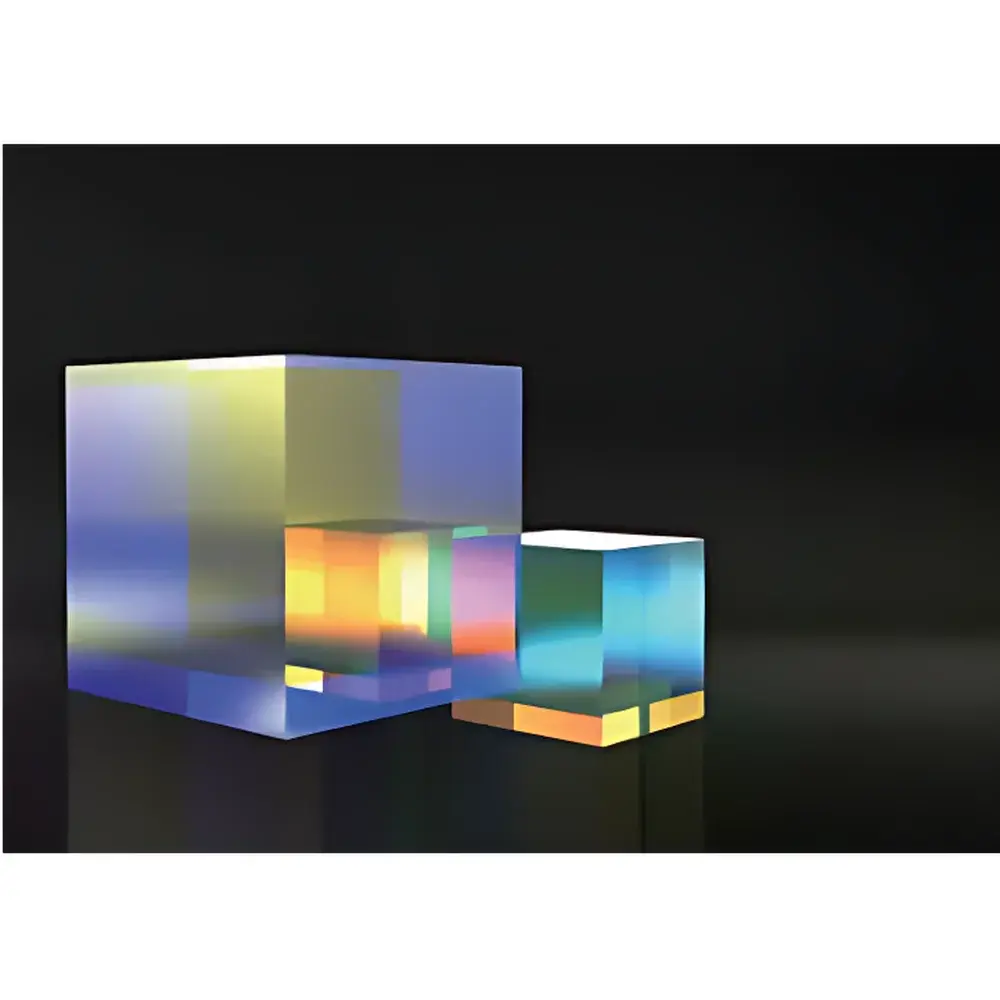
MiXran Meg1099 Cube Beam Splitter
| Brand | MiXran |
|---|---|
| Model | Meg1099 |
| Type | Optical Cube Beam Splitter |
| Dimensions | 5–50 mm (side length) |
| Split Ratio Options | 30R/70T, 50R/50T, 70R/30T |
| Spectral Ranges | VIS (400–700 nm), NIR (700–1100 nm), SWIR (1100–1600 nm) |
| Substrate Material | BK7 or Fused Silica (application-dependent) |
| Coating | Dielectric multilayer, angle-of-incidence optimized at 0° or 45° |
| Surface Flatness | λ/10 @ 633 nm |
| Wavefront Distortion | < λ/8 RMS |
| Extinction Ratio (Polarization) | >1000:1 (for polarizing variants) |
| Damage Threshold | >5 J/cm² @ 1064 nm, 10 ns pulse |
Overview
The MiXran Meg1099 is a precision-engineered cube beam splitter designed for high-stability optical path division in laboratory and industrial photonic systems. Constructed as a cemented or air-spaced cube assembly—depending on spectral and power-handling requirements—it operates on the principle of controlled partial reflection and transmission via dielectric thin-film interference coatings deposited on an internal hypotenuse surface. Unlike plate-type splitters, the Meg1099 eliminates beam offset and ghost reflections, ensuring spatial coherence preservation critical for interferometry, confocal microscopy, laser cavity alignment, and multi-channel detection architectures. Its design conforms to standard optomechanical mounting interfaces (e.g., SM1, C-mount compatible kinematic mounts), enabling seamless integration into OEM instruments and custom optical benches across visible, near-infrared, and short-wave infrared bands.
Key Features
- Three standardized spectral configurations: VIS (400–700 nm), NIR (700–1100 nm), and SWIR (1100–1600 nm), each with spectrally optimized dielectric coatings for minimal absorption and maximal polarization fidelity.
- Multiple split ratio options—including 30R/70T, 50R/50T, and 70R/30T—engineered for balanced signal distribution in dual-path detection, reference arm stabilization, or pump-probe timing synchronization.
- Cube side lengths ranging from 5 mm to 50 mm, supporting both compact micro-optics assemblies and high-power macro-systems; larger apertures (>25 mm) utilize fused silica substrates for improved thermal stability and UV-NIR broadband transmission.
- Surface quality rated at 10-5 scratch-dig, wavefront distortion < λ/8 RMS (measured at 633 nm), and surface flatness λ/10, meeting ISO 10110-7 specifications for precision optical components.
- Coating durability validated per MIL-C-48497A; AR overcoat options available on entrance/exit faces to reduce Fresnel losses (<0.25% per surface) and suppress etalon effects in resonant cavities.
Sample Compatibility & Compliance
The Meg1099 is compatible with collimated and convergent beams up to f/2, provided incident angles remain within ±2° of nominal design incidence (typically 0° or 45°). It supports polarization-sensitive applications when specified with high-extinction-ratio coatings (>1000:1), enabling use in Mach-Zehnder and Michelson interferometers compliant with ISO/IEC 17025 calibration workflows. Non-polarizing versions maintain <±5% deviation in R/T ratio across ±10° angular bandwidth. All units undergo batch-certified spectral transmittance/reflectance verification using NIST-traceable spectrophotometry (PerkinElmer Lambda 1050+), with full QC reports supplied upon request. The component satisfies RoHS 2011/65/EU and REACH SVHC compliance; CE marking applies to assembled optical subsystems integrating Meg1099 elements.
Software & Data Management
While the Meg1099 is a passive optical element requiring no firmware or driver support, its performance parameters are fully integrated into common optical design platforms including Zemax OpticStudio (version 22+), CODE V, and FRED. Manufacturer-provided ZMX files include measured coating dispersion data, substrate birefringence models (for fused silica variants), and thermal expansion coefficients (α = 7.1 × 10⁻⁶ /K for BK7; 0.55 × 10⁻⁶ /K for fused silica). Spectral response datasets (CSV format) covering 350–1700 nm at 1 nm resolution are available for import into MATLAB, Python (via NumPy/Pandas), or LabVIEW-based system modeling environments. Traceability documentation includes lot-specific interferometric surface maps and spectrophotometric validation certificates aligned with ISO/IEC 17025 clause 7.7.
Applications
- Laser-based metrology systems requiring phase-preserving beam division for heterodyne displacement sensing and absolute distance measurement (ISO 20908 compliant).
- Multiplexed fluorescence imaging platforms where spectral channel isolation demands low polarization-dependent loss (PDL < 0.05 dB) and high wavefront fidelity.
- FTIR spectrometer reference arms, OCT sample/reference path balancing, and hyperspectral push-broom sensor illumination splitting.
- Quantum optics experiments involving entangled photon pair routing, where extinction ratio and temporal dispersion control directly impact Bell inequality violation significance.
- Industrial machine vision lighting engines integrating structured light projection and simultaneous camera feedback paths under IEC 62471 photobiological safety guidelines.
FAQ
Is the Meg1099 suitable for ultrafast laser applications (e.g., Ti:sapphire oscillators)?
Yes—when specified with fused silica substrates and low-group-delay-dispersion (GDD) coatings, it supports pulses down to <50 fs without measurable temporal broadening; GDD data is provided per lot.
Can I specify custom split ratios outside the standard 30/50/70 options?
Custom ratios (e.g., 10R/90T, 90R/10T) are available for minimum orders ≥25 units; lead time extends by 4–6 weeks for coating mask fabrication and spectral validation.
Do you provide mounting hardware or kinematic cells for the Meg1099?
Standard SM1-threaded cube mounts (e.g., Thorlabs C4W, KCB1) are mechanically compatible; MiXran offers optional anodized aluminum kinematic bases with ±0.005° tip/tilt adjustability (model KMB-Meg1099).
What is the maximum average power density the Meg1099 can withstand in CW operation?
For BK7-based units: 500 W/cm² @ 532 nm; for fused silica variants: 1.2 kW/cm² @ 1064 nm, assuming active cooling and <1% absorption per interface.
Are environmental test reports (thermal cycling, humidity, vibration) available?
Yes—accelerated life testing per Telcordia GR-1221-CORE is performed on representative lots; full reports (including MIL-STD-810H Method 509.6 humidity exposure) are supplied with Class A certification orders.



