
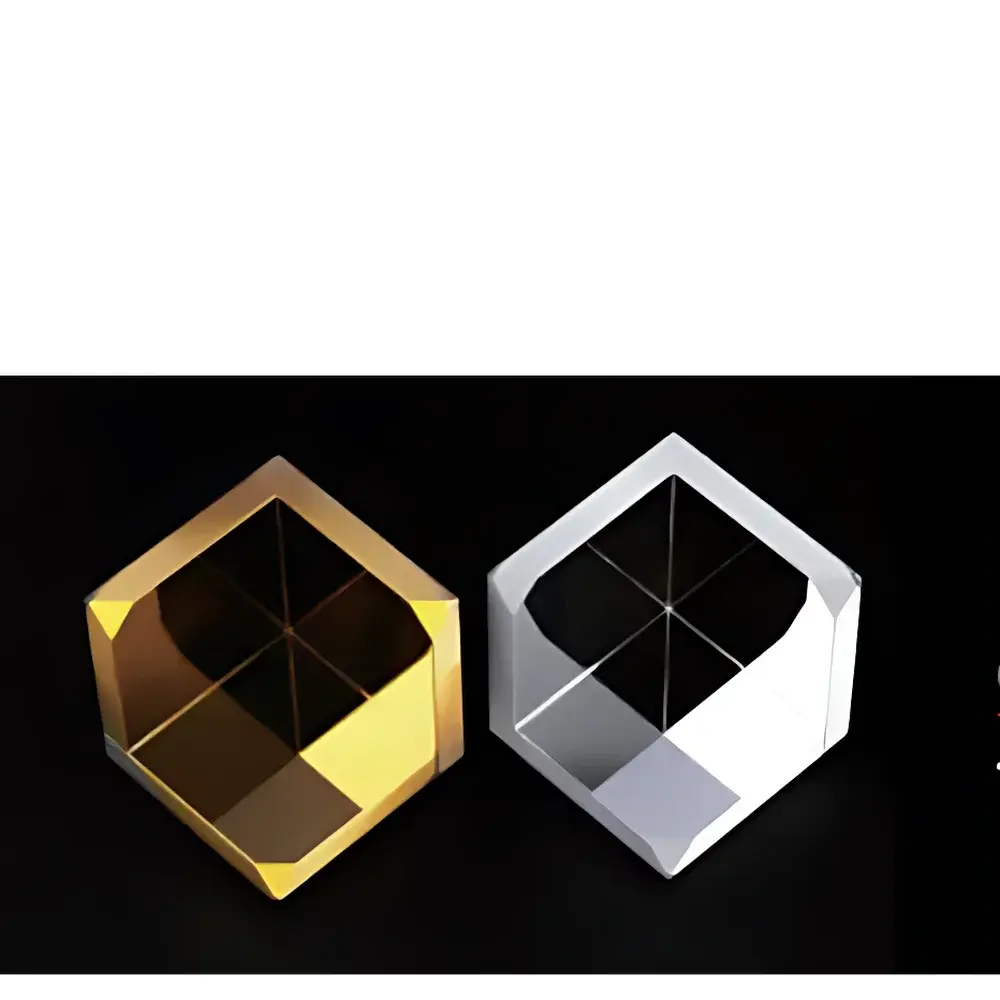
MiXran Meg1053 Hollow Retroreflector Corner Cube Prism
| Brand | MiXran |
|---|---|
| Model | Meg1053 |
| Type | Hollow Corner Cube Retroreflector Prism |
| Material | Fused Silica (UVAL) or Aluminum (AU) Substrate |
| Dimensions (L×L×L×T) | 6.10–61.03 mm cube side length × 1.5–8.0 mm wall thickness |
| Clear Aperture (CA) | 6.5–75 mm |
| Total Deviation Angle Tolerance | <5″ or <30″ |
| Coating | UV-Enhanced Aluminum (AU) or Ultra-Violet Anti-Reflective (UVAL) |
| Compliance | ISO 10110-7, MIL-PRF-13830B surface quality |
Overview
The MiXran Meg1053 Hollow Retroreflector Corner Cube Prism is a precision optical component engineered for high-stability beam return in interferometric metrology, laser ranging, alignment systems, and space-based optical communication platforms. Unlike solid fused silica corner cubes, the Meg1053 employs a hollow monolithic architecture—fabricated from ultra-low-expansion fused silica (UVAL grade) or lightweight aluminum (AU grade) substrates—minimizing thermal mass while maintaining exceptional wavefront fidelity and mechanical rigidity. Its retroreflective function relies on the geometric principle of three mutually perpendicular reflective surfaces, ensuring that incident light is returned parallel to its input path within angular tolerances of <5″ (high-precision variant) or <30″ (standard-grade variant), independent of incident angle over its specified clear aperture. This intrinsic insensitivity to alignment drift makes the Meg1053 particularly suited for applications demanding long-term stability under variable thermal or vibrational conditions.
Key Features
- Hollow monolithic design reduces thermal inertia and weight without compromising structural integrity or optical performance.
- Two coating options: UV-enhanced aluminum (AU) for broadband reflectivity from 250 nm to 2 µm, or ultra-violet anti-reflective (UVAL) coating optimized for minimal residual reflection loss in UV-sensitive interferometers.
- Available in ten standard aperture sizes—from 6.5 mm to 75 mm clear aperture—with corresponding cube dimensions ranging from 6.10 × 6.10 × 6.10 × 1.5 mm to 61.03 × 61.03 × 61.03 × 8.0 mm.
- Manufactured to ISO 10110-7 surface quality specifications (scratch-dig 10–5) and wavefront distortion ≤ λ/10 @ 632.8 nm (for UVAL variants).
- Thermal expansion coefficient matched between substrate and coating layers to mitigate delamination risk under thermal cycling.
- Each unit undergoes individual interferometric verification using Twyman–Green or Fizeau configurations; full test reports—including measured deviation angle, transmitted wavefront error (TWE), and coating spectral reflectance—are available upon request.
Sample Compatibility & Compliance
The Meg1053 is compatible with collimated beams operating across deep-ultraviolet (DUV), visible, and near-infrared (NIR) spectral bands. Its UVAL-coated variants are routinely deployed in excimer laser lithography alignment subsystems and UV Raman spectroscopy setups where low-absorption optics are mandatory. AU-coated versions meet MIL-PRF-13830B standards for laser damage threshold (LDT ≥ 500 mJ/cm² at 1064 nm, 10 ns pulse width) and are qualified for Class 100 cleanroom handling. All units comply with RoHS Directive 2011/65/EU and are traceable to NIST-calibrated interferometric reference standards. Documentation supports GLP/GMP environments through full batch traceability, including substrate lot numbers, coating run IDs, and environmental exposure logs.
Software & Data Management
While the Meg1053 is a passive optical component, MiXran provides optional digital calibration data packages in standardized formats (ASCII .txt, HDF5) containing measured angular deviation maps, spectral reflectance curves (250–2000 nm), and Zernike polynomial coefficients for wavefront error modeling. These datasets integrate seamlessly with Zemax OpticStudio, CODE V, and MATLAB-based optical system simulation workflows. For OEM integration, MiXran supports custom metadata embedding via QR-coded labels compliant with ISO/IEC 15424, enabling automated inventory tracking and audit-ready documentation in FDA 21 CFR Part 11–compliant manufacturing execution systems (MES).
Applications
- Laser interferometer gravitational-wave observatory (LIGO)-style displacement sensing arms requiring zero-phase-shift retroreflection.
- Spacecraft attitude determination systems (e.g., satellite laser ranging retroreflector arrays) where mass efficiency and thermal stability are critical.
- Industrial machine vision alignment jigs for semiconductor wafer steppers and photomask inspection tools.
- Calibration references in national metrology institutes for verifying autocollimator accuracy and angular encoder linearity.
- High-power pulsed laser cavities where thermal lensing in solid prisms would degrade beam quality.
FAQ
What is the difference between UVAL and AU coating options?
UVAL denotes an ultra-violet anti-reflective coating applied to fused silica substrates, minimizing Fresnel losses in UV-optical paths; AU refers to UV-enhanced aluminum reflective coating deposited on aluminum substrates, offering broad-spectrum reflectivity with higher LDT.
Can the Meg1053 be mounted in vacuum environments?
Yes—UVAL variants are vacuum-compatible up to 10⁻⁶ Torr; AU variants require outgassing preconditioning per ASTM E595 and are rated for ultra-high vacuum (UHV) use with appropriate bake-out protocols.
Is wavefront error data provided for each unit?
Yes—interferometric wavefront measurements are performed per unit and documented in the Certificate of Conformance (CoC); Zernike decomposition and PV/RMS values are included.
Do you offer custom aperture sizes or non-standard angles?
Custom geometries—including asymmetric hollow designs and non-orthogonal facet angles—are available under NDA with lead times of 12–16 weeks and minimum order quantities (MOQ) of five units.
How is thermal stability quantified for the Meg1053?
Thermal-induced angular drift is characterized per ISO 10110-10: measured deviation change ≤ 0.15″/°C over −20°C to +60°C for UVAL variants; AU variants exhibit ≤ 0.25″/°C due to higher CTE of aluminum substrate.






