
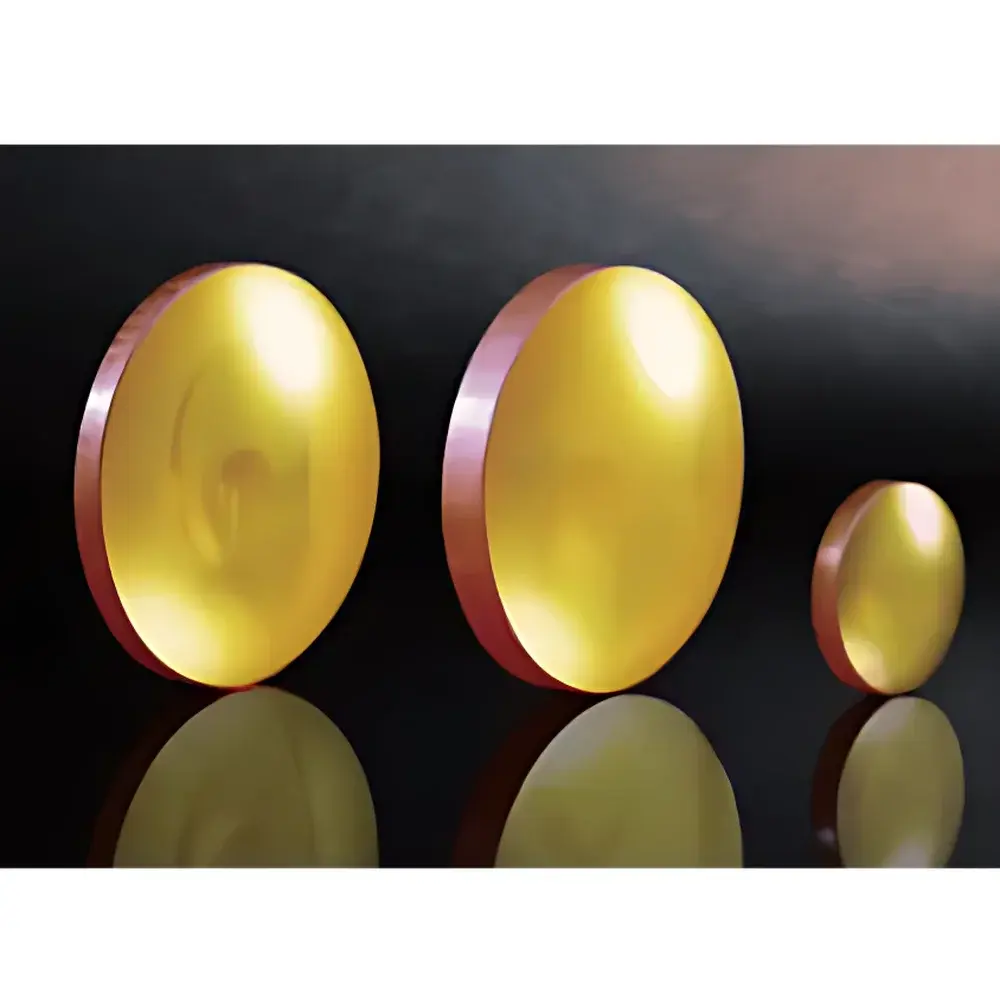
MiXran Meg1031 ZnSe Double-Convex Lens
| Brand | MiXran |
|---|---|
| Model | Meg1031 |
| Material | Zinc Selenide (ZnSe) |
| Lens Type | Uncoated or IR2 Broadband Anti-Reflection Coated (Ravg < 1.5% @ 8–12 µm) |
| Diameter | 12.7 mm / 25.4 mm |
| Focal Length (EFL) | 15–200 mm |
| Surface Radius | R1 = R2 |
| Center Thickness | 2.3–4.3 mm |
| Edge Thickness | 2.6–2.8 mm |
| Compliance | ISO 10110-1, MIL-O-13830A (scratch-dig), RoHS |
Overview
The MiXran Meg1031 is a precision-engineered zinc selenide (ZnSe) double-convex lens designed for demanding mid-wave and long-wave infrared (MWIR/LWIR) optical systems operating in the 8–12 µm spectral band. ZnSe exhibits exceptional transmission (>70% per surface, uncoated) across this atmospheric window, low absorption coefficient, and high thermal stability—making it ideal for thermal imaging, CO₂ laser beam delivery (10.6 µm), FTIR spectrometry, and industrial process monitoring. The Meg1031 lens adheres to ISO 10110-1 surface quality standards and is fabricated using single-point diamond turning and deterministic polishing to ensure wavefront error < λ/4 @ 10.6 µm (typical). Its symmetric biconvex geometry provides minimal spherical aberration for collimated or near-collimated input beams, while maintaining mechanical robustness under moderate thermal cycling.
Key Features
- Zinc selenide substrate with ≥99.995% purity, certified via ICP-MS trace elemental analysis
- Double-convex geometry with matched radii of curvature (R1 = R2) for balanced aberration correction
- Optional broadband anti-reflection coating (IR2): average reflectance <1.5% across 8–12 µm; coating durability tested per MIL-C-48497A
- Surface quality: 20–10 scratch-dig (per MIL-O-13830A); surface roughness <5 Å RMS measured by AFM
- Centering tolerance: ≤1 arcmin; wedge <3 arcsec; focal length tolerance: ±1%
- Thermal expansion coefficient: 7.1 × 10⁻⁶ /°C; suitable for ambient-to-60°C operational range without decentering
Sample Compatibility & Compliance
The Meg1031 lens is compatible with standard kinematic and threaded lens mounts (e.g., SM1, SM2 series), including MiXran’s GL72-series retaining rings and PN350xx-LM mounting adapters. All lenses undergo full metrological validation—including interferometric wavefront testing (Zygo GPI), spectral transmittance verification (PerkinElmer Lambda 950 FTIR), and environmental stress screening (ESD-safe handling, 48-hour 40°C/90% RH humidity exposure). Manufacturing complies with ISO 9001:2015 and RoHS Directive 2011/65/EU. Documentation includes Certificate of Conformance (CoC), spectral transmission report, and surface inspection record—traceable to NIST-traceable calibration standards.
Software & Data Management
While the Meg1031 is a passive optical component, its performance integration into system-level optical design is supported through native compatibility with industry-standard modeling platforms: Zemax OpticStudio (sequential/non-sequential modes), CODE V, and FRED. Material dispersion data (Sellmeier coefficients for ZnSe) and coating stack specifications are provided in .DAT and .COAT file formats. For GMP-regulated applications (e.g., medical IR endoscopy systems), full batch-level documentation—including lot-specific transmittance curves and surface defect maps—is archived for 10 years and available upon request to support FDA 21 CFR Part 11-compliant audit trails.
Applications
- CO₂ laser focusing and beam shaping in material processing (cutting, welding, marking)
- Objective and relay lenses in uncooled microbolometer-based thermal cameras (VOx, a-Si)
- Sample compartment optics in benchtop and portable FTIR spectrometers
- Collimation optics for quantum cascade laser (QCL) sources in gas sensing platforms
- Reference-grade components in NIST-traceable radiometric calibration setups
- Environmental monitoring systems for industrial stack emissions (NH₃, CH₄, CO detection at 8–12 µm)
FAQ
Is the IR2 coating optimized specifically for 10.6 µm CO₂ lasers?
Yes—the IR2 coating is engineered for minimum reflectance at 10.6 µm while maintaining broadband suppression across the full 8–12 µm window, enabling dual-use in both laser and thermal imaging systems.
Can the Meg1031 be used in vacuum environments?
Yes, ZnSe has negligible outgassing (total mass loss <0.5% per ASTM E595); however, uncoated versions are recommended for ultra-high vacuum (UHV) due to potential organic binder volatility in some AR coatings.
What mounting hardware is recommended for thermal stability?
We recommend low-CTE aluminum alloy mounts (e.g., 6061-T6) with controlled preload torque (0.15–0.25 N·m for SM1 threads) to minimize stress-induced birefringence and focal shift.
Do you provide custom focal lengths or diameters beyond the standard catalog?
Yes—custom geometries, aspheric variants, and multi-layer hybrid coatings (e.g., AR + dichroic) are available under NDA with lead times of 8–12 weeks.
How is damage threshold specified for pulsed CO₂ laser use?
For 10.6 µm, 100 ns pulses at 10 Hz repetition rate, the LIDT is 500 MW/cm² (uncoated) and 350 MW/cm² (IR2-coated), measured per ISO 21254-1.





