
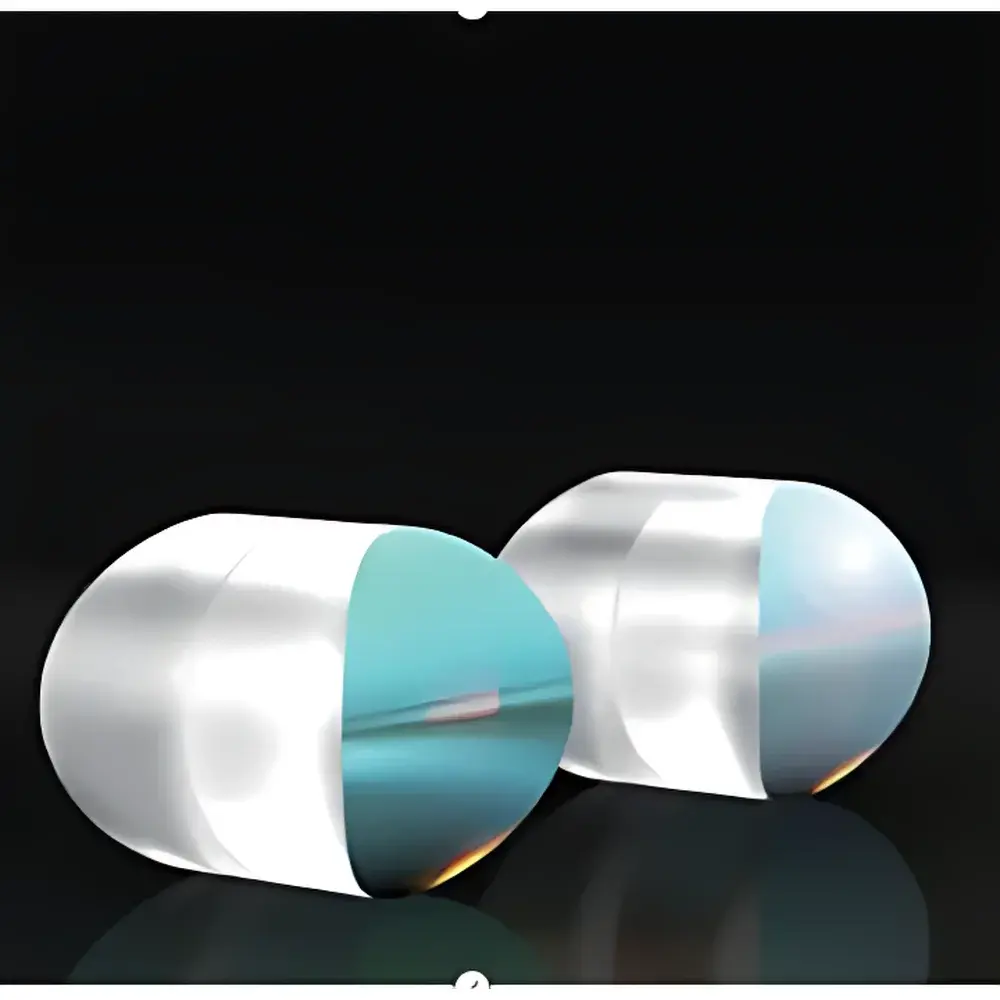
MiXran Meg1020 Achromatic Positive Cylindrical Lens
| Brand | MiXran |
|---|---|
| Model | Meg1020 |
| Optical Component Type | Achromatic Cylindrical Lens |
| Coating | VIS Broadband AR (Rₐᵥg < 0.5% @ 400–700 nm) or NIR Broadband AR (Rₐᵥg < 0.5% @ 650–1050 nm) |
| Substrate Materials | H-K9L / H-ZF2 or H-K9L / H-ZF1 / H-K9L / H-ZF13 |
| Diameter Options | 12.5 mm, 25.4 mm |
| Focal Lengths (EFL) | 25–250 mm |
| Center Thickness | 10.3–19.5 mm |
| Mounting Compatibility | Standard SM1-threaded lens mounts (e.g., PN35031-LM127-D series) |
| Configuration | Unmounted or Pre-mounted |
Overview
The MiXran Meg1020 is a precision-engineered achromatic positive cylindrical lens designed for demanding optical alignment, beam shaping, and anamorphic correction applications in research-grade optical systems. Unlike singlet cylindrical lenses, the Meg1020 employs a two-element cemented design—typically combining H-K9L crown glass with a high-dispersion flint glass such as H-ZF2, H-ZF1, or H-ZF13—to correct both longitudinal and lateral chromatic aberration across its specified spectral band. This achromatization ensures consistent focal line position and minimal color fringing when used with broadband visible (VIS) or near-infrared (NIR) sources. The lens operates on the principle of asymmetric refraction: curvature is applied along only one meridian (cylindrical axis), enabling focusing in a single dimension while preserving collimation in the orthogonal plane. Its performance is optimized for applications requiring high wavefront fidelity, including laser line generation, optical pumping, astigmatism compensation in interferometry, and slit illumination in spectroscopic setups.
Key Features
- Achromatic design minimizes axial and transverse chromatic aberration across VIS (400–700 nm) or NIR (650–1050 nm) bands, with average reflectance < 0.5% per surface due to ion-assisted e-beam deposited broadband anti-reflection coatings.
- Available in two standard diameters: 12.5 mm and 25.4 mm, supporting integration into modular optomechanical platforms including cage systems and kinematic mounts.
- Multiple EFL options (25 mm to 250 mm) provide flexibility for line focus positioning in imaging, scanning, and illumination geometries.
- High-precision centering (< 3 arcmin) and surface quality (λ/4 @ 633 nm, scratch-dig 20–10) ensure low wavefront distortion and compatibility with diffraction-limited systems.
- Pre-mounted variants feature stress-relieved kinematic retention in SM1-compatible aluminum lens cells (e.g., PN35031-LM127-D series), eliminating mounting-induced astigmatism and simplifying system integration.
- Substrate material selection balances dispersion control and thermal stability—H-ZF2 for VIS optimization, H-ZF1/H-ZF13 for extended NIR performance—with all glasses meeting MIL-O-13830A surface quality and ISO 10110-7 cleanliness specifications.
Sample Compatibility & Compliance
The Meg1020 is compatible with standard optical breadboards, cage systems (e.g., Thorlabs 30 mm and 60 mm), and OEM laser modules requiring cylindrical beam conditioning. Its coated surfaces meet ISO 9211-3 for durability (Class 3 adhesion per MIL-C-48497A) and are rated for continuous-wave laser power densities up to 500 W/cm² at 532 nm and 1064 nm (tested per ISO 21254-1). All units undergo 100% inspection for surface defects, coating uniformity, and focal length verification using interferometric null testing and automated collimator-based focal measurement. Documentation includes individual test reports traceable to NIST-calibrated instrumentation. The lens complies with RoHS 2011/65/EU and REACH (EC) No. 1907/2006 requirements; no hazardous substances are employed in substrate fabrication or coating processes.
Software & Data Management
While the Meg1020 is a passive optical component, its metrological data—including measured EFL, BFL, Tc, and coating spectral reflectance curves—is delivered in standardized CSV and PDF formats compliant with ISO/IEC 17025 documentation protocols. Each lens is assigned a unique serial number linked to a digital certificate of conformance, accessible via MiXran’s secure customer portal. For system-level modeling, Zemax OpticStudio™ and CODE V® prescription files (including surface sag, glass catalog references, and coating stack definitions) are available upon request. All optical design files adhere to ANSI Z80.10-2020 conventions for cylindrical element specification and support bidirectional tolerance analysis in manufacturing workflows.
Applications
- Anamorphic beam expansion and circularization of diode laser outputs in fiber coupling and free-space communication systems.
- Line focus generation for laser-induced breakdown spectroscopy (LIBS), photolithography mask alignment, and structured light projection.
- Astigmatism correction in Michelson and Mach–Zehnder interferometers, particularly in gravitational wave detector prototype setups.
- Slit illumination in monochromators and spectrometers where uniform line intensity and minimal spectral smearing are critical.
- Optical pumping of atomic vapor cells in quantum optics experiments requiring polarization-maintaining, chromatically stable line foci.
- OEM integration into medical endomicroscopy probes and industrial machine vision lighting modules operating under regulatory-grade validation protocols (e.g., IEC 60601-2-57).
FAQ
What is the difference between a singlet and an achromatic cylindrical lens?
Achomatic cylindrical lenses like the Meg1020 use two or more elements with complementary dispersion properties to reduce chromatic focal shift across wavelength bands; singlets exhibit significant focal length variation with wavelength, limiting their utility in broadband applications.
Can the Meg1020 be used with femtosecond laser pulses?
Yes—when specified with low-GDD (group delay dispersion) coating stacks and optimized substrate pairings, it supports sub-100-fs pulse transmission with minimal temporal broadening; consult MiXran’s ultrafast optics technical datasheet for GDD values per configuration.
Is custom focal length or coating available?
Yes—MiXran offers custom EFL, diameter, and spectral band options (e.g., UV-VIS, SWIR) under NRE-supported engineering services, with lead times aligned to ISO 9001-certified production scheduling.
How is centration error measured and guaranteed?
Centration is verified interferometrically using a Zygo Verifire™ MST with a reference cylindrical null lens; maximum allowable decenter is ≤ 3 arcmin, certified per ISO 10110-8 Clause 5.2.
Do pre-mounted versions include alignment adjustment capability?
No—the pre-mounted variants use kinematically constrained, epoxy-free retention to preserve wavefront integrity; fine tip/tilt adjustment requires external kinematic mounts such as KM100 or KCB1.





