
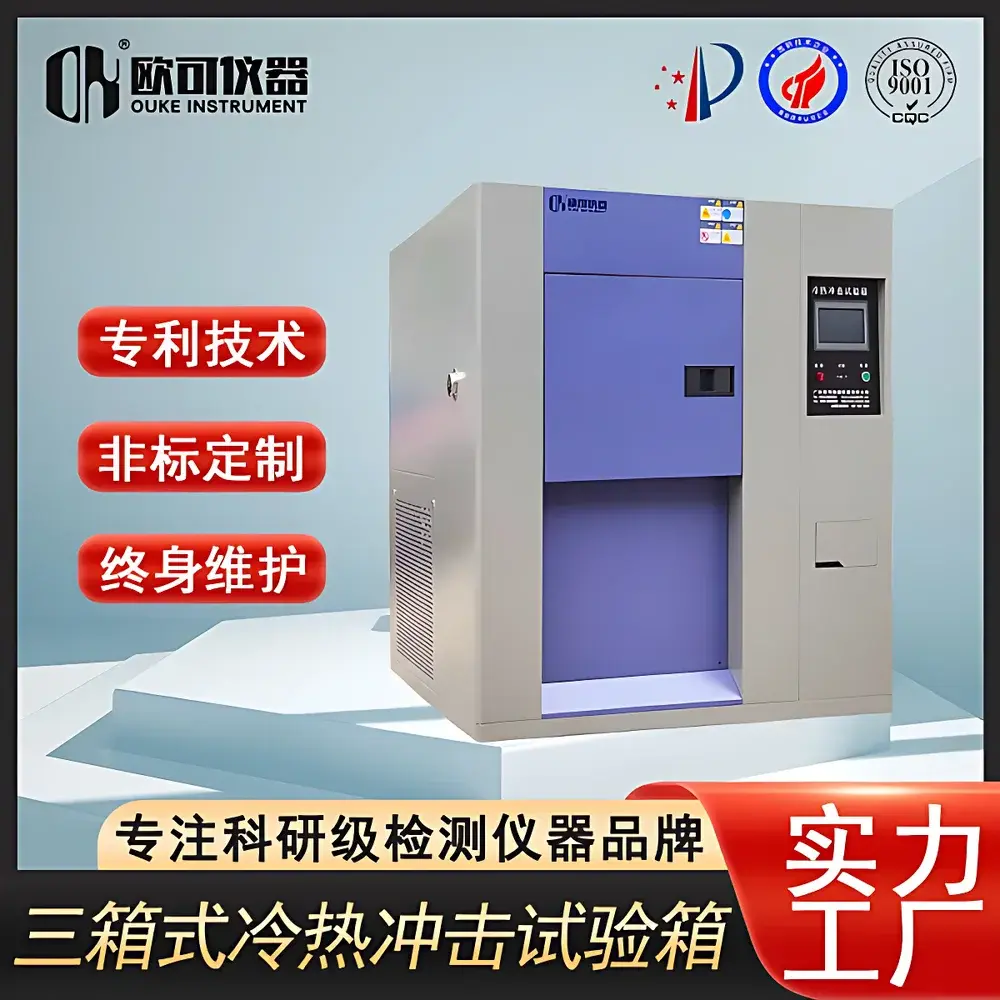
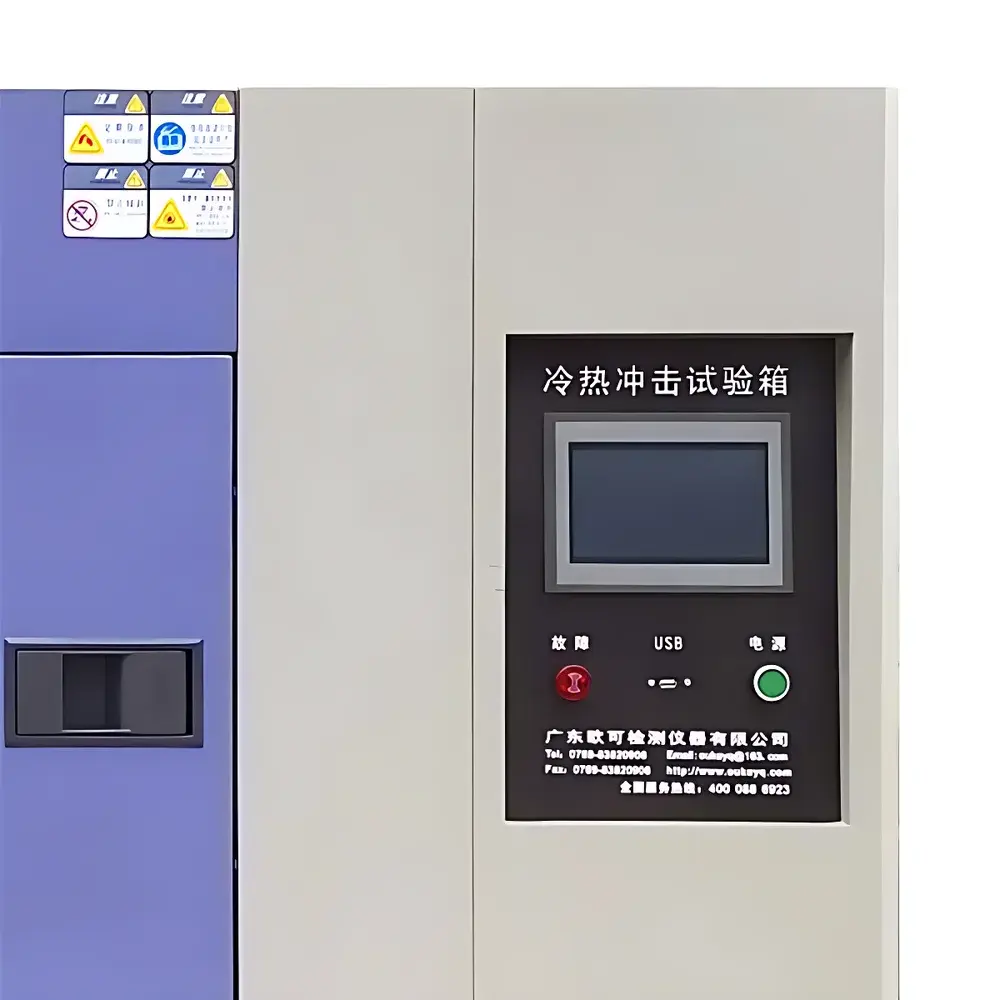
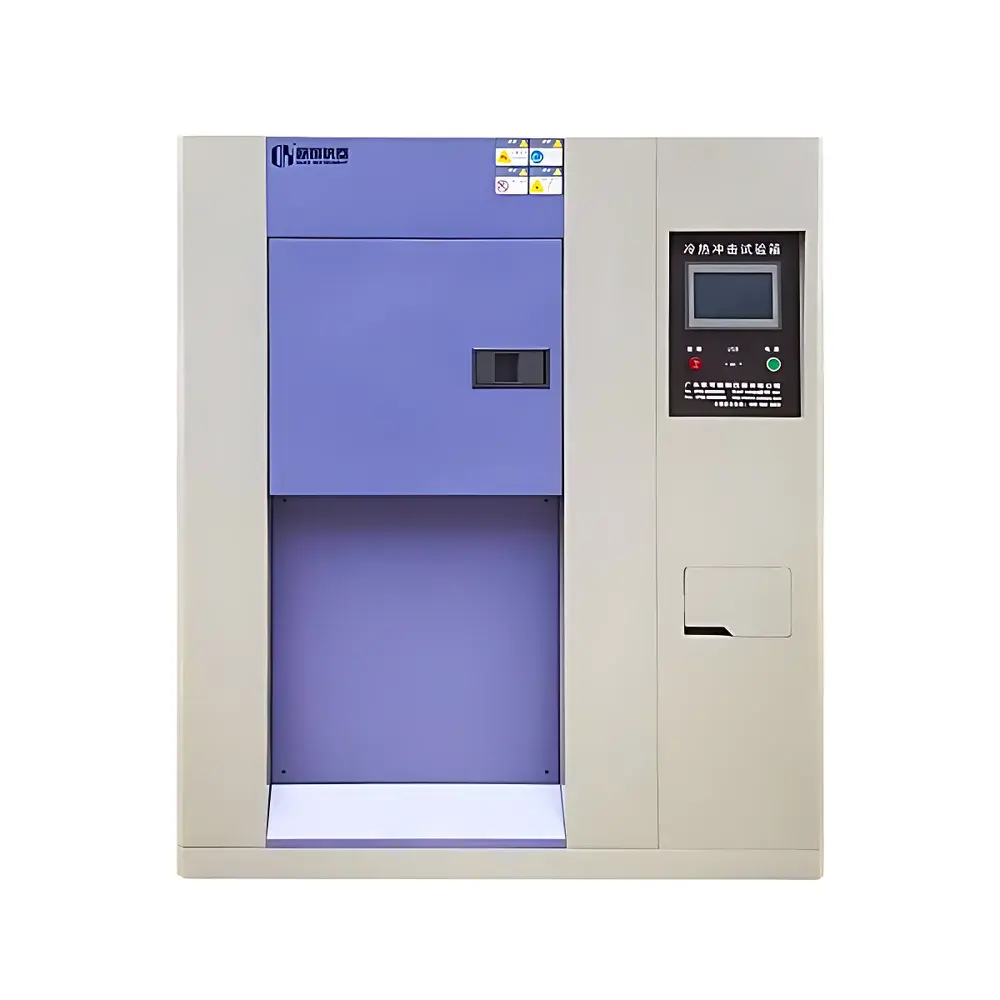
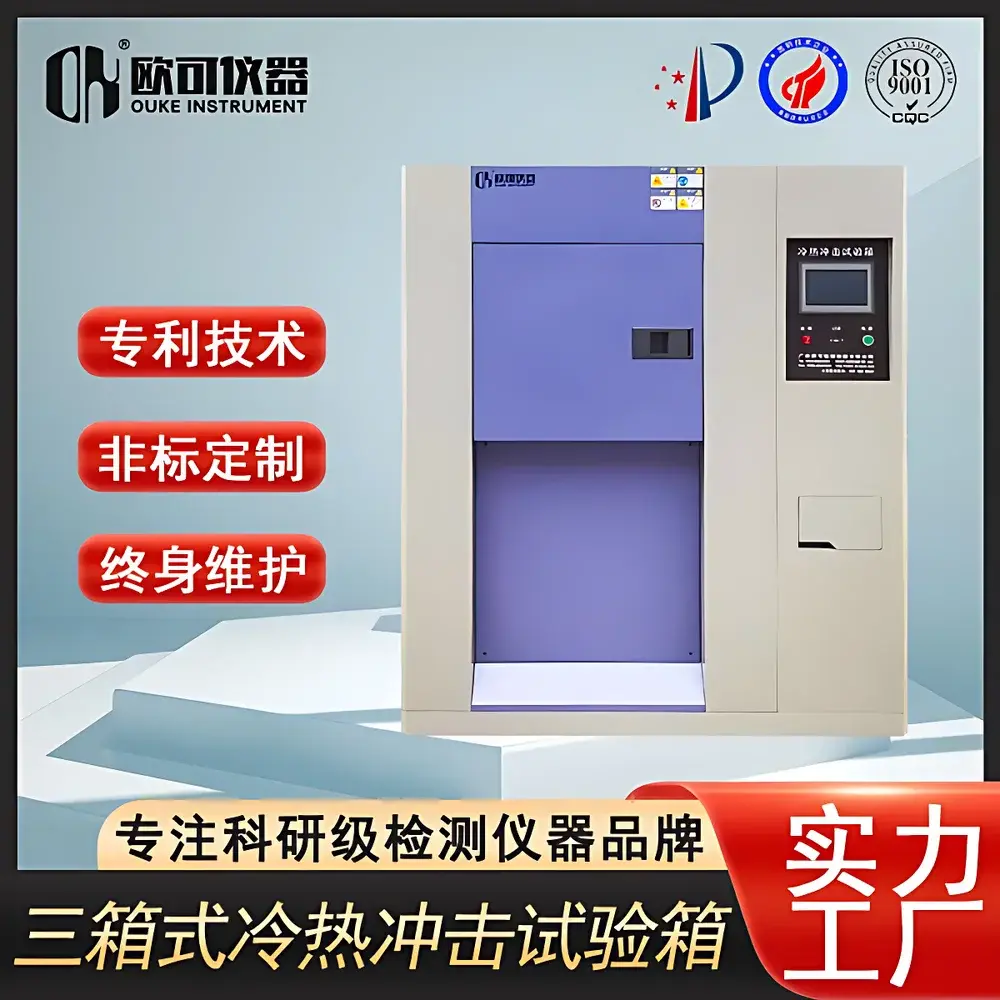
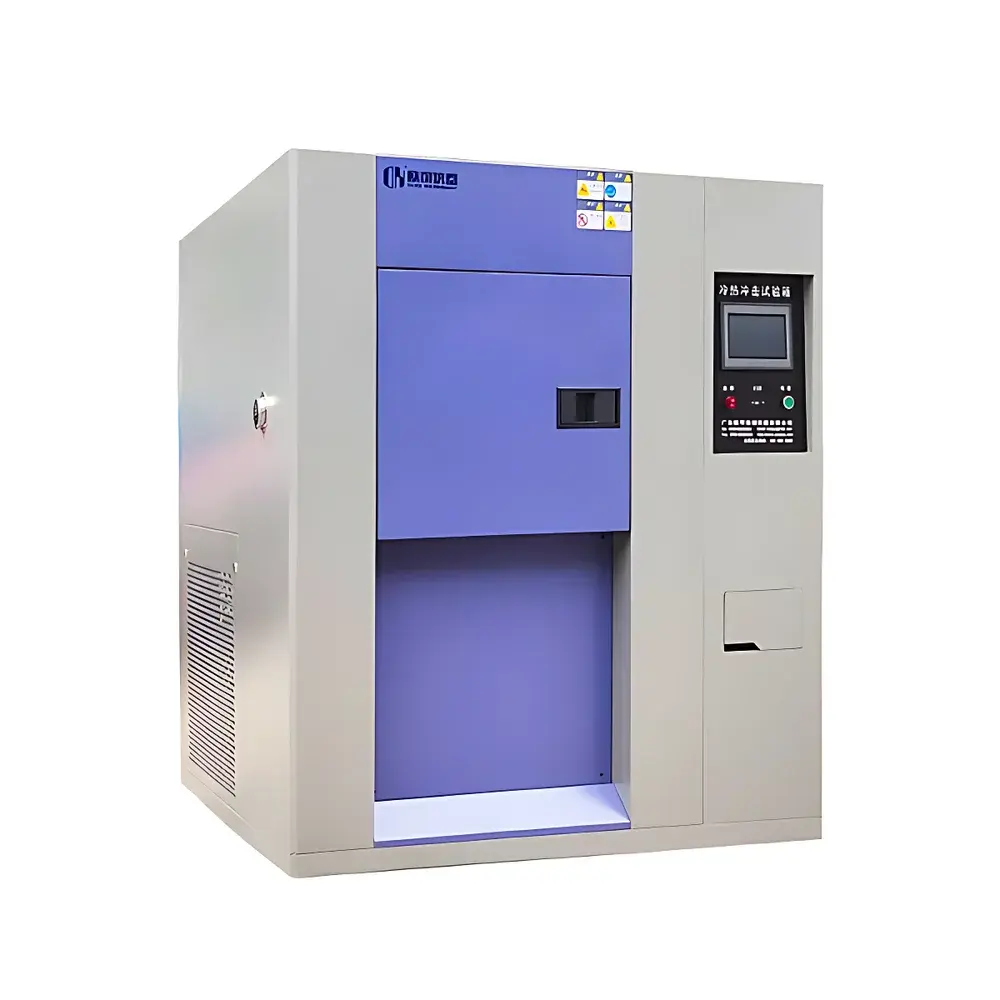
OK 0K-TS-48 Three-Zone Thermal Shock Test Chamber
| Brand | OK |
|---|---|
| Origin | Guangdong, China |
| Manufacturer Type | Manufacturer |
| Product Category | Domestic |
| Model | 0K-TS-48 |
| Price | USD 11,200 (FOB) |
| High-Temperature Range | +150 °C |
| Low-Temperature Range | −50 °C |
| Thermal Shock Range | −50 °C to +150 °C |
| Temperature Stability | ±2 °C |
| Heating Rate | 5 °C/s |
| Cooling Rate | 5 °C/s |
Overview
The OK 0K-TS-48 Three-Zone Thermal Shock Test Chamber is an engineered solution for accelerated reliability assessment under extreme thermal transients. Unlike two-chamber (basket-transfer) systems, this chamber employs a true three-zone architecture—comprising independent high-temperature storage, low-temperature storage, and a stationary test compartment—enabling rapid, repeatable thermal shock cycles without mechanical sample movement. Its core operational principle relies on precision-controlled airflow redirection via high-speed pneumatic dampers, allowing conditioned air from pre-stabilized reservoirs to be injected into the static test zone within ≤2 seconds. This design isolates thermal stress from extraneous mechanical vibration, ensuring that failure modes observed are attributable solely to thermally induced expansion/contraction, interfacial delamination, solder joint fatigue, or material phase transitions—critical for qualifying automotive ECUs, avionics modules, battery management systems, and high-density PCBAs under IEC 60068-2-14, MIL-STD-810H Method 503.5, and JEDEC JESD22-A104E protocols.
Key Features
- Three-zone segregated architecture: Independent +150 °C heating reservoir, −50 °C cooling reservoir, and thermally isolated test chamber with fixed sample mounting.
- Sub-2-second damper switching: Pneumatically actuated stainless-steel dampers ensure rapid transition between thermal reservoirs while maintaining structural integrity over >100,000 cycles.
- Stationary sample configuration: Eliminates acceleration-induced stress; supports continuous power delivery, signal monitoring, fluid loop integration, and real-time functional testing during thermal transients.
- High-fidelity thermal control: Dual PID-regulated refrigeration/heating circuits with redundant platinum RTD sensors (Class A tolerance) in each reservoir and test zone.
- Low frost migration design: Physical separation of the cryogenic reservoir from the test chamber minimizes moisture ingress, enabling uninterrupted multi-thousand-cycle testing without manual defrost intervention.
- Robust chamber construction: 304 stainless-steel inner chamber, 100 mm polyurethane insulation (λ = 0.022 W/m·K), and double-glazed observation window with anti-fog heater.
Sample Compatibility & Compliance
The 0K-TS-48 accommodates samples up to 450 L volume and unrestricted mass—ideal for large-format battery packs, engine control units, radar assemblies, and server power supplies. Its static loading configuration permits permanent cabling (e.g., CAN bus, LVDS, 4–20 mA loops) and active thermal interface management (e.g., liquid cold plate coupling). The system complies with ISO/IEC 17025 calibration traceability requirements and supports audit-ready documentation per GLP and GMP environments. It meets electromagnetic compatibility standards per EN 61326-1 and safety certification per IEC 61010-1. Optional validation packages include IQ/OQ documentation aligned with FDA 21 CFR Part 11 data integrity expectations.
Software & Data Management
Equipped with OK’s proprietary TSC-Manager v4.2 software, the chamber delivers deterministic cycle sequencing, real-time multi-channel temperature logging (up to 16 external thermocouples), and programmable dwell times, ramp profiles, and loop counts. All test logs—including damper position timestamps, reservoir temperature deviations, and alarm history—are stored in encrypted SQLite databases with SHA-256 hashing. Export formats include CSV, PDF test reports (with digital signature support), and XML for LIMS integration. Audit trail functionality records user actions, parameter changes, and system events with immutable timestamps—fully compliant with ALCOA+ principles for regulated industries.
Applications
- Automotive electronics: Functional validation of ADAS domain controllers, 48 V DC-DC converters, and traction inverter gate drivers under repeated −40 °C ↔ +125 °C transitions.
- Aerospace components: Qualification of flight-critical communication transceivers and inertial measurement units per DO-160 Section 4.9 (Temperature Shock).
- Energy storage systems: Assessment of thermal runaway propagation thresholds in lithium-ion module enclosures subjected to asymmetric thermal gradients.
- Semiconductor packaging: Evaluation of die attach integrity and wire bond lift-off in QFN and BGA packages under JEDEC-defined shock profiles.
- Industrial IoT gateways: Long-duration cycling (≥2,000 cycles) to detect latent failures in conformal-coated assemblies exposed to condensing humidity environments.
FAQ
How does the three-zone architecture improve test fidelity compared to basket-type chambers?
It eliminates mechanical shock and vibration artifacts introduced by sample translation, isolating thermal stress as the sole accelerating factor—essential for root-cause analysis in failure mode studies.
Can the chamber maintain ±2 °C stability during dynamic shock transitions?
Yes—the specification refers to steady-state stability in each reservoir; transient overshoot in the test zone is actively compensated via feedforward airflow modulation and adaptive PID tuning.
Is remote monitoring and cycle interruption supported?
Yes—Ethernet/IP interface enables full SCADA integration; users may pause/resume cycles, adjust setpoints, or trigger emergency venting via web-based HMI or Modbus TCP.
What maintenance intervals are recommended for long-term unattended operation?
Compressor oil and refrigerant filter replacement every 12 months; damper seal inspection every 6 months; annual calibration of all RTD sensors against NIST-traceable references.
Does the system support custom thermal profiles beyond standard MIL-STD or IEC templates?
Yes—TSC-Manager allows user-defined multi-step profiles with variable ramp rates, non-linear dwell durations, conditional branching, and external trigger inputs (e.g., TTL sync with oscilloscope or power analyzer).



