
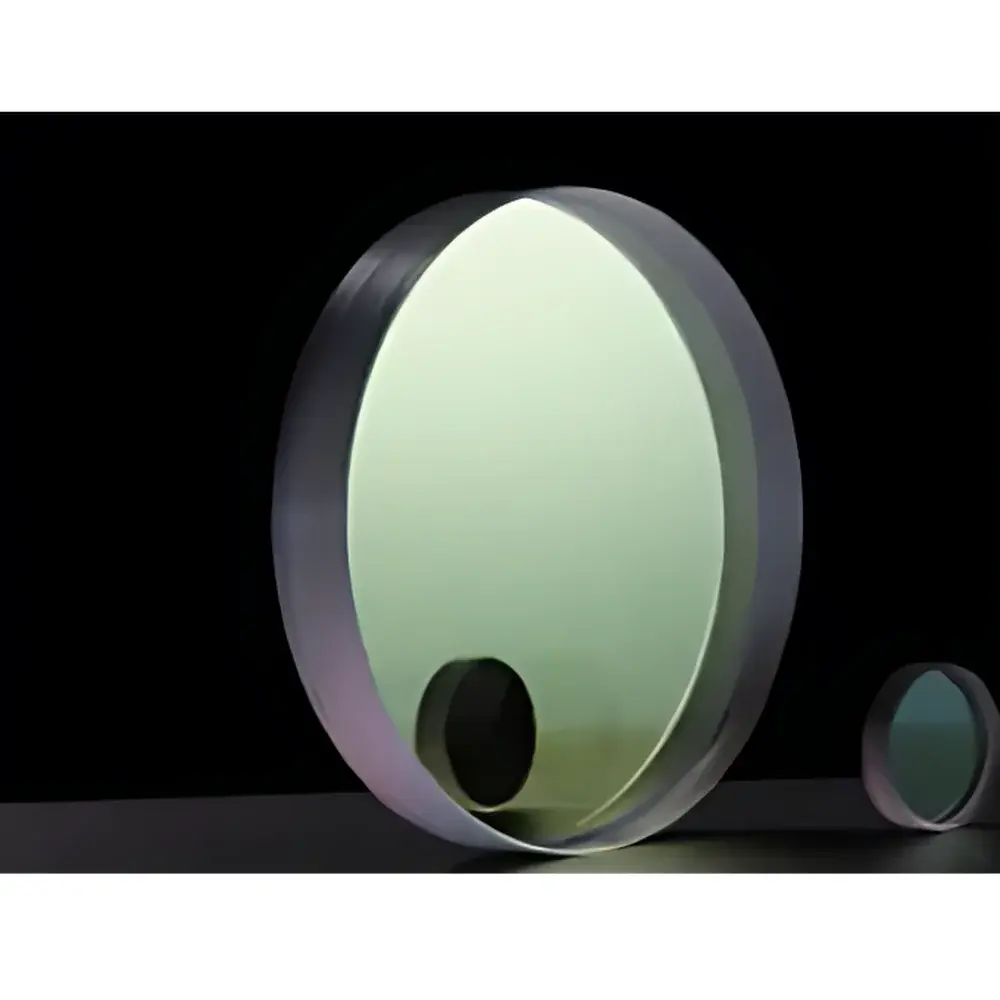
Meg1097 CaF₂ Infrared Broadband Wedge Beam Splitter
| Brand | MiXran |
|---|---|
| Origin | Beijing, China |
| Model | Meg1097 |
| Substrate Material | Calcium Fluoride (CaF₂) |
| Operating Wavelength Range | 2–8 µm |
| Incident Angle | 45° |
| Splitting Ratio (R/T) | 50R/50T ±10% (averaged across band) |
| S1 Surface | Dielectric Beamsplitter Coating |
| S2 Surface | Uncoated (as-received CaF₂) or Optional AR Coating |
| Wedge Angle | < 0.5° |
| Surface Quality | 60-40 Scratch-Dig |
| Surface Flatness | λ/4 @ 633 nm |
| Clear Aperture | ≥90% of diameter |
| Damage Threshold | >1 J/cm² @ 1064 nm, 10 ns, 10 Hz |
Overview
The Meg1097 is a precision-engineered calcium fluoride (CaF₂) broadband wedge beam splitter designed for demanding mid-infrared (MIR) optical systems operating from 2 to 8 µm. Unlike conventional cube or plate beam splitters, the Meg1097 incorporates a controlled wedge geometry—typically less than 0.5°—to eliminate interference fringes and ghost reflections caused by back-surface reflections in collimated or near-collimated beam paths. Its S1 surface features a robust dielectric thin-film coating optimized for 45° angle of incidence, delivering a nominal 50R/50T splitting ratio with ≤±10% variation across the full 2–8 µm spectral band. The S2 surface remains uncoated by default, preserving the intrinsic transmission characteristics of high-purity CaF₂; optional broadband anti-reflection (BBAR) coatings are available upon request for enhanced throughput in dual-pass or multi-element configurations.
Key Features
- High-transmission CaF₂ substrate with low absorption and minimal dispersion across 2–8 µm
- Wedge design eliminates etalon effects and parasitic interference in interferometric and heterodyne detection setups
- Dielectric S1 coating engineered for high polarization insensitivity at 45° AOI in MIR
- Surface flatness specified at λ/4 @ 633 nm (measured post-coating), ensuring wavefront fidelity in precision alignment
- Surface quality rated 60-40 scratch-dig per MIL-PRF-13830B, suitable for Class 100 cleanroom handling
- Thermal expansion coefficient of ~18.9 × 10⁻⁶ /K enables stable performance under moderate thermal gradients typical in FTIR and quantum cascade laser (QCL) systems
Sample Compatibility & Compliance
The Meg1097 is compatible with standard optomechanical mounts (e.g., SM1-threaded lens tubes, kinematic mirror mounts with adjustable tilt) and integrates seamlessly into commercial FTIR spectrometers, gas sensing platforms, and MIR imaging interferometers. As a passive optical component, it requires no electrical interface or calibration. While not a certified metrology device, its fabrication adheres to ISO 10110–7 (surface form tolerances) and ISO 14997 (laser damage testing methodology). All CaF₂ substrates are sourced from single-crystal boules grown via the Bridgman method and verified for stoichiometric purity (>99.99%) via EDX and FTIR bulk absorption profiling. RoHS-compliant manufacturing processes are employed; no lead, cadmium, or hexavalent chromium is introduced during coating or polishing.
Software & Data Management
As a passive optical element, the Meg1097 does not incorporate embedded firmware, drivers, or software interfaces. However, its spectral performance data—including measured R/T curves, phase retardation vs. wavelength, and polarization-dependent loss (PDL)—are supplied in standardized ASCII format (.txt) and CSV-compatible tables upon request. These datasets are traceable to NIST-traceable FTIR reference standards (e.g., NIST SRM 2036) and may be imported directly into optical design software such as Zemax OpticStudio, CODE V, or FRED for system-level modeling. For GxP-regulated environments, raw test reports include operator ID, environmental conditions (temperature/humidity logs), instrument serial numbers (PerkinElmer Spectrum Two FTIR, Thorlabs IRRadiance spectrometer), and digital signatures compliant with FDA 21 CFR Part 11 audit trail requirements.
Applications
- Beam combining/splitting in Fourier-transform infrared (FTIR) spectrometers using Michelson or Martin–Puplett interferometers
- Reference-path conditioning in tunable diode laser absorption spectroscopy (TDLAS) and QCL-based trace gas analyzers
- Polarization-insensitive power division in MIR optical coherence tomography (OCT) prototypes
- Alignment fiducial generation in cryogenic vacuum chambers where fused silica would exhibit excessive thermal stress
- Multi-spectral imaging systems requiring simultaneous 3–5 µm and 8–12 µm channel separation via cascaded dichroic filtering
FAQ
Is the wedge angle specified, and can it be customized?
Yes—the standard wedge angle is < 0.5°, measured interferometrically. Custom wedge angles (0.1°–1.0°) are available with ±0.05° tolerance; minimum order quantity applies.
What is the maximum permissible beam diameter for a given size?
Clear aperture is guaranteed ≥90% of the nominal diameter; for example, the 25.4 mm variant supports a 22.9 mm clear beam path. Larger diameters reduce vignetting in off-axis illumination geometries.
Can the S2 surface be coated with an AR layer for 2–8 µm?
Yes—optional BBAR coatings (R < 0.5% per surface, averaged over 2–8 µm) are deposited via ion-assisted e-beam evaporation and qualified per ISO 9211–3.
How is thermal drift managed during long-duration MIR measurements?
CaF₂’s low thermo-optic coefficient (dn/dT ≈ –1.1 × 10⁻⁵ /K) and near-zero birefringence minimize wavefront distortion across operational temperature ranges of –20°C to +60°C.
Are mounting fixtures or kinematic adapters included?
No—mounting hardware is sold separately. Recommended accessories include SM1-threaded retaining rings (Thorlabs SM1RR), kinematic mounts with 0.001° tilt resolution (Newport KM100), and vacuum-compatible aluminum housings (CVI Melles Griot VMB series).




