
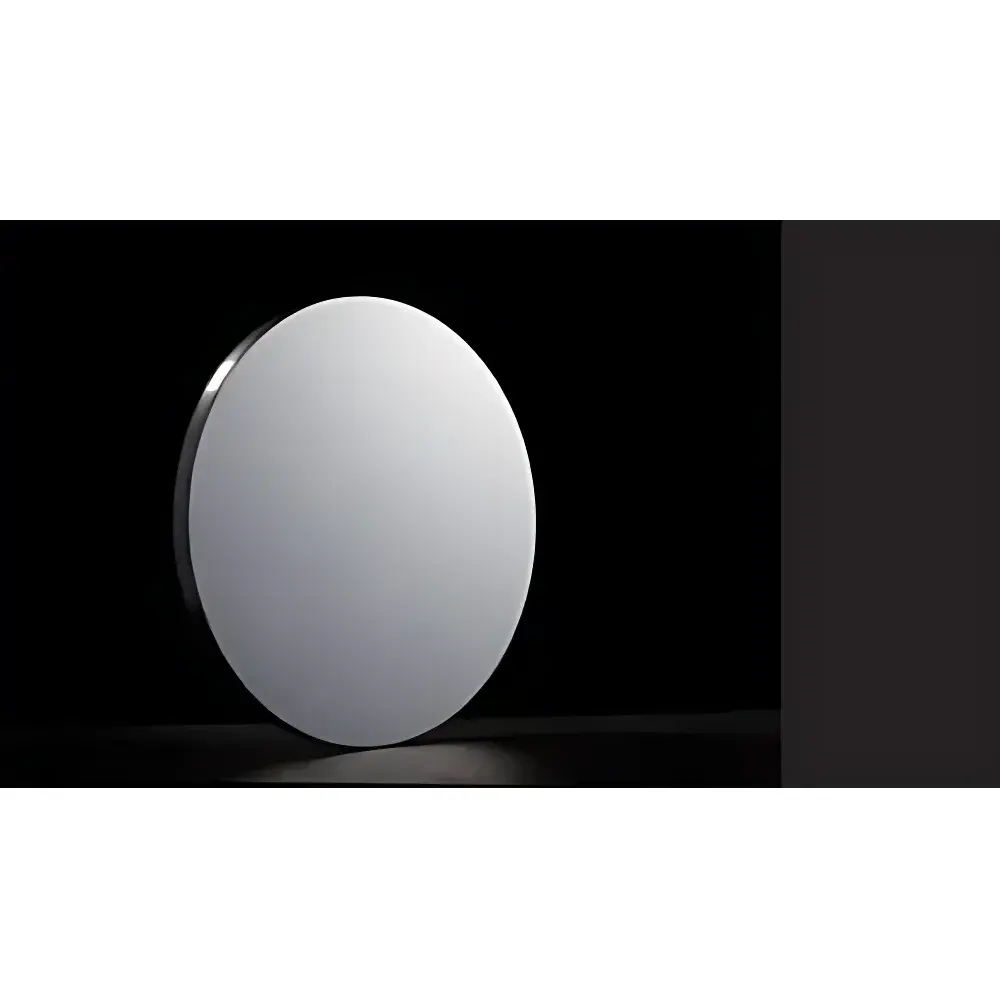
MiXran Meg1034 Silicon (Si) Plano-Convex Lens
| Brand | MiXran |
|---|---|
| Model | Meg1034 |
| Material | Single-Crystal Silicon (Si) |
| Coating Options | Uncoated or IR1 Broadband Anti-Reflection Coating (Ravg < 1.5% @ 3–5 µm) |
| Diameter | 12.7 mm / 25.4 mm |
| Focal Length (EFL) | 15–1000 mm |
| Surface Quality | 40–20 scratch-dig |
| Clear Aperture | ≥90% of diameter |
| Operating Temperature Range | –60 °C to +150 °C |
| Transmission Range | 1.2–7 µm (uncoated), optimized 3–5 µm (IR1-coated) |
Overview
The MiXran Meg1034 is a precision-engineered silicon (Si) plano-convex lens designed for mid-wave infrared (MWIR) optical systems operating in the 3–5 µm spectral band. Fabricated from high-purity, single-crystal silicon wafers with low absorption coefficient and excellent thermal conductivity, this lens leverages silicon’s intrinsic transparency in the MWIR region—where conventional fused silica or BK7 glass become opaque. Its plano-convex geometry provides minimal spherical aberration for collimated or near-collimated beam focusing, making it ideal for thermal imaging, laser beam delivery, FTIR spectrometer coupling, and gas sensing platforms. Unlike germanium or zinc selenide optics, silicon offers superior mechanical hardness (Mohs 6.5), chemical inertness against most solvents, and negligible moisture absorption—critical for long-term stability in industrial or field-deployable instrumentation.
Key Features
- Single-crystal silicon substrate with orientation, polished to λ/4 surface flatness on plano side and λ/2 transmitted wavefront error (TWE) over clear aperture
- Two coating configurations: uncoated for broad MWIR use or IR1 broadband anti-reflection coating (Ravg < 1.5% across 3–5 µm) per MIL-C-48497A specifications
- High thermal conductivity (149 W/m·K) and low thermo-optic coefficient (dn/dT ≈ 1.8 × 10⁻⁴ K−1), enabling stable performance under thermal cycling
- Available in two standard diameters (12.7 mm and 25.4 mm) with 11 discrete focal lengths ranging from 15 mm to 1000 mm—each optimized for paraxial performance at f/number ≥ 2.5
- Edge thickness tolerance ±0.05 mm; center thickness tolerance ±0.02 mm; radius of curvature tolerance ±0.2%
- Compliant with ISO 10110-1 (optical element drawing standards) and ISO 10110-7 (surface imperfection specification)
Sample Compatibility & Compliance
The Meg1034 lens is compatible with industry-standard lens mounts including SM1 (1.035″-40), C-mount, and custom kinematic cells. Its 12.7 mm variants pair with GL81-012 series retaining rings (e.g., GL81-012-015 for 15 mm EFL), while 25.4 mm versions interface with GL81-025 series rings (e.g., GL81-025-050 for 50 mm EFL). All lenses are supplied with individual calibration certificates traceable to NIM (National Institute of Metrology, China) for radius of curvature and focal length verification. The IR1 coating process adheres to ISO 9211-3 for optical coating durability (adhesion, abrasion, humidity resistance) and meets MIL-C-675C Class I environmental testing requirements. No hazardous substances exceed EU RoHS Directive 2011/65/EU limits. Full material test reports (MTRs), including XRF elemental analysis and FTIR transmission spectra, are available upon request for GxP-regulated applications.
Software & Data Management
While the Meg1034 is a passive optical component, its metrological data—including measured focal length deviation, surface figure error (via interferometric ZYGO Verifire report), and spectral transmittance curves—is digitally archived and accessible via MiXran’s secure customer portal. Each lens carries a unique serialized QR code linking to its as-built performance dossier, supporting audit-ready documentation for ISO/IEC 17025-accredited laboratories. For system integrators, Zemax OpticStudio and CODE V prescription files (.zmx, .seq) are provided for all standard configurations, pre-validated against measured MTF and spot diagram data at 4.26 µm (CO2 laser line). All optical design files include thermal expansion coefficients and dn/dT values for rigorous multi-environment simulation.
Applications
- MWIR thermal imaging systems: Objective lenses for uncooled microbolometer arrays (e.g., FLIR Boson, Teledyne DALSA)
- Laser material processing: Focusing optics for 3.8 µm Er:YAG or 4.5 µm Fe:ZnSe lasers in medical ablation and polymer welding
- Gas detection: Collimating/focusing elements in NDIR sensors targeting CH4, CO, NOx, and SF6 absorption bands
- FTIR spectrometry: Input/output coupling lenses for Michelson interferometers and photoconductive MCT detectors
- Defense & aerospace: Ruggedized beam conditioning optics for UAV-mounted EO/IR payloads compliant with MIL-STD-810H shock/vibration profiles
- Research-grade setups: Alignment references in quantum cascade laser (QCL) cavity experiments requiring sub-micron wavefront stability
FAQ
Is the IR1 coating durable enough for cleaning with ethanol or IPA?
Yes—the IR1 multilayer stack (Ta2O5/SiO2 based) passes MIL-C-48497A abrasion testing and withstands repeated solvent wiping using lens tissue and spectroscopic-grade isopropanol without measurable reflectance shift.
Can Meg1034 lenses be used below 3 µm or above 5 µm?
Uncoated Si exhibits significant Fresnel reflection (~30%) and rising multiphonon absorption beyond 5 µm; transmission drops sharply below 1.2 µm due to interband transitions. Use only within specified 3–5 µm band for optimal throughput.
What is the maximum power density this lens can handle?
For continuous-wave (CW) operation at 4.26 µm, the damage threshold exceeds 1.5 kW/cm² (10.6 µm reference scaled per wavelength); pulsed operation (10 ns, 10 Hz) supports >500 MW/cm². Thermal lensing is negligible up to 500 W incident power due to Si’s high thermal conductivity.
Are custom diameters, focal lengths, or coatings available?
Yes—MiXran offers OEM services including non-standard diameters (up to 100 mm), aspheric corrections, dual-band AR coatings (e.g., 3–5 µm + 8–12 µm), and vacuum-compatible gold overcoat options. Lead time: 6–8 weeks after design freeze.




