
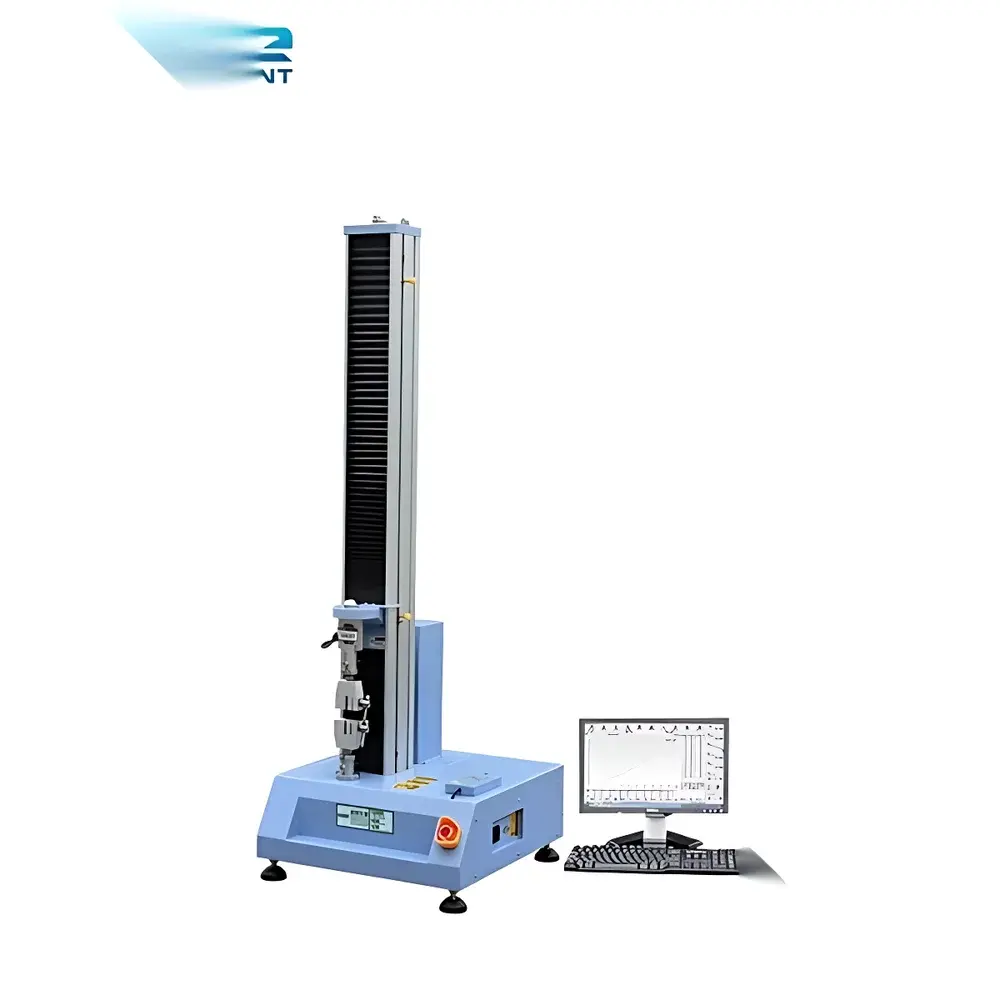
Horizontally Oriented Tensile Testing Machine – OK-NL Series
| Key | Brand: OEM |
|---|---|
| Origin | Imported |
| Manufacturer Type | Authorized Distributor |
| Price | USD 3,500 (FOB) |
| Load Capacity Options | 50 / 100 / 200 / 500 / 1000 kgf |
| Force Resolution | 1/100,000 (1/250,000 for ≤10 kN models) |
| Force Accuracy | ≤0.5% FS (≤0.25% FS for ≤10 kN models) |
| Crosshead Travel | 1000 mm (excl. grips) |
| Test Speed Range | 5–300 mm/min (software-controlled, stepless) |
| Drive System | Panasonic AC servo motor + servo driver |
| Transmission | Precision ground ball screw + timing belt + Liming gearbox |
| Load Cell | Explosion-proof high-precision strain-gauge transducer with auto-thermal compensation, zero drift <0.01% FS/°C, repeatability ±0.03% FS, overload capacity 150% FS |
| Position Feedback | 2500 PPR optical encoder |
| Safety Features | Mechanical stroke limiter, software-based load upper-limit alarm, automatic halt on specimen rupture |
| Data Acquisition | PC-based real-time control and analysis, curve plotting (stress–strain, load–displacement), peak hold, auto-stop on break, unit switching (g/kg/N/kN/lbf), report generation & export (PDF/Excel) |
Overview
The OK-NL Series Horizontally Oriented Tensile Testing Machine is an electromechanical universal testing system engineered for high-fidelity mechanical property characterization of both metallic and non-metallic materials under uniaxial loading conditions. Unlike vertically oriented frames, its horizontal configuration provides enhanced stability during high-force tensile, compression, bending, peel, shear, and tear tests—particularly advantageous for long or flexible specimens (e.g., cables, hoses, belts, textile rolls, and extruded profiles) where gravitational sag or alignment drift may compromise measurement integrity. The system operates on the fundamental principle of controlled displacement actuation via a servo-driven ball screw mechanism, with force quantified through a calibrated, temperature-compensated load cell compliant with ISO 7500-1 Class 0.5 (or Class 0.25 for sub-10 kN configurations). Designed for laboratory, QC, and R&D environments, it delivers traceable, reproducible results aligned with international mechanical testing standards—including ASTM, ISO, EN, GB/T, JIS, and DIN methodologies.
Key Features
- Panasonic AC servo motor and matched drive system ensures precise speed regulation (5–300 mm/min), low acoustic emission (<65 dB), and consistent torque delivery across full travel range.
- High-precision ground ball screw (C5 grade) combined with hardened linear guide rails guarantees smooth, backlash-free motion and positional repeatability within ±0.02 mm over 1000 mm stroke.
- Explosion-rated load cell with integrated thermal drift compensation enables stable force measurement across ambient temperature fluctuations (10–40°C), achieving ±0.03% FS repeatability and 150% transient overload tolerance.
- Dual-safety architecture: hardware-based mechanical stroke limiters prevent over-travel damage to the load cell; software-enforced upper-load threshold triggers immediate deceleration and stop—fully configurable per test method.
- Real-time PC-based control interface supports dynamic curve acquisition at ≥1 kHz sampling rate, with resolution up to 1/250,000 of full scale (for models ≤10 kN), enabling accurate yield point, modulus, and elongation-at-break determination.
- Automatic rupture detection halts crosshead movement within 20 ms of specimen failure—preserving data integrity and minimizing post-fracture artifact in stress–strain curves.
Sample Compatibility & Compliance
The OK-NL platform accommodates a broad spectrum of specimen geometries and material classes: polymer films (ASTM D882), elastomeric compounds (ISO 37), fiber-reinforced composites (ASTM D3039), metal wires (ISO 6892-1), safety harness webbing (EN 364), adhesive tapes (PSTC-7), geomembranes (ASTM D5397), and biomedical polymers (ISO 5832-1). Its modular grip system—supplied standard with wedge-action pneumatic and manual vise grips—supports flat, round, and irregular cross-sections from 0.1 mm to 50 mm width/diameter. All mechanical and electrical subsystems conform to IEC 61000-6-2 (EMC immunity) and IEC 61000-6-4 (EMC emissions) requirements. Force calibration is traceable to NIST-equivalent national metrology institutes, and system validation complies with ISO/IEC 17025 documentation practices for accredited testing laboratories.
Software & Data Management
The embedded Windows-based control suite (OK-TestSuite v4.x) provides full GLP-compliant operation: user-level access control (admin/operator/guest), electronic signature support, audit trail logging (per FDA 21 CFR Part 11 requirements), and encrypted raw data storage (.tdms binary format). Test methods are pre-configured per ASTM D412 (rubber), ISO 527-2 (plastics), EN ISO 1421 (flexible sheeting), and GB/T 1040.1–2018 (tensile testing of plastics), with customizable parameters for preload, dwell time, strain rate ramping, and conditional stopping logic. Real-time visualization includes dual-axis plots (load vs. displacement, stress vs. strain), derivative modulus calculation (secant/tangent), and statistical batch reporting (mean, SD, CV%, min/max). Export options include PDF test certificates, CSV time-series logs, and Excel-compatible summary tables—all embeddable with lab-specific headers, logos, and QA stamps.
Applications
This system serves as a primary mechanical characterization tool across regulated and industrial sectors: quality assurance of automotive sealing systems (door gaskets, brake hoses); validation of medical device tubing compliance with ISO 8536-4; tensile strength verification of lithium-ion battery electrode coatings (ASTM F3030); peel adhesion assessment of pressure-sensitive labels (ASTM D3330); elongation testing of geotextiles per GRI-GT12; and tensile fatigue pre-screening of orthopedic implant alloys (ASTM F2129). Its horizontal layout is especially suited for evaluating continuous-length materials—such as conveyor belting, wire rope, and fiber optic cable sheathing—where vertical frame constraints would necessitate specimen shortening or unsupported mid-span loading.
FAQ
What load capacities are available, and how should I select the appropriate one?
Standard configurations span 50 kgf to 1000 kgf (0.5–10 kN). Select a capacity where the expected ultimate load falls between 20% and 80% of full scale—for optimal resolution and accuracy. For example, a 500 kgf machine is recommended for specimens failing between ~100–400 kgf.
Is the system compatible with third-party environmental chambers or extensometers?
Yes. The control architecture supports analog and digital I/O expansion modules for integration with temperature/humidity chambers (e.g., ESPEC, Angelantoni), video extensometers (e.g., EDC, GOM), and hydraulic grips—via standardized 0–10 V or RS-485 interfaces.
Does the software support automated multi-step test protocols?
Yes. OK-TestSuite allows scripting of sequential operations—including preload application, strain-rate transitions, cyclic loading, dwell periods, and conditional branching—enabling ISO 6892-2 low-cycle fatigue or ASTM D790 flexural creep routines.
How is force calibration maintained over time?
The system includes built-in calibration verification routines using certified deadweight standards (Class M1 or better). Annual recalibration by an ISO/IEC 17025-accredited provider is recommended, with certificate-of-conformance archiving directly within the software audit trail.
Can test reports be generated in multiple languages and formats?
Yes. Report templates are fully editable in Word-compatible XML format and support bilingual (e.g., English/Chinese) output. Export formats include PDF/A-1a (archival), XLSX, CSV, and XML for LIMS integration.



