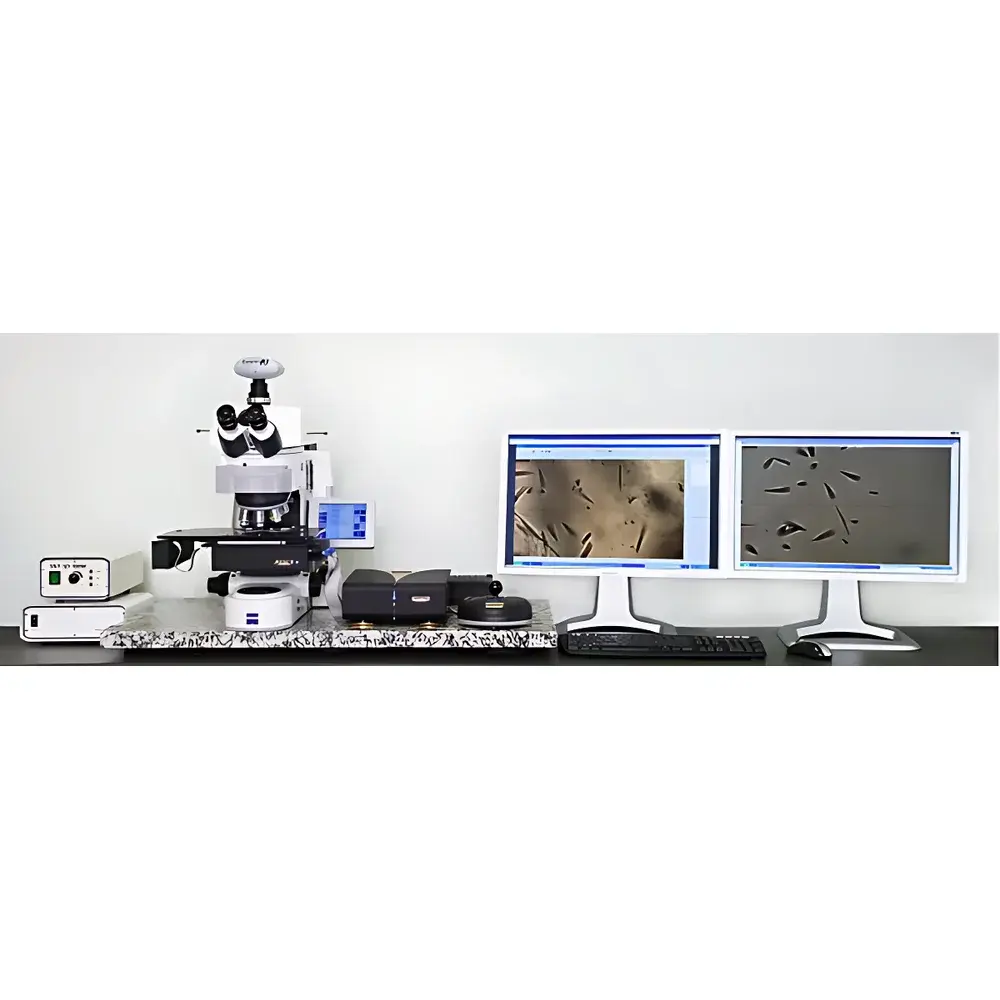

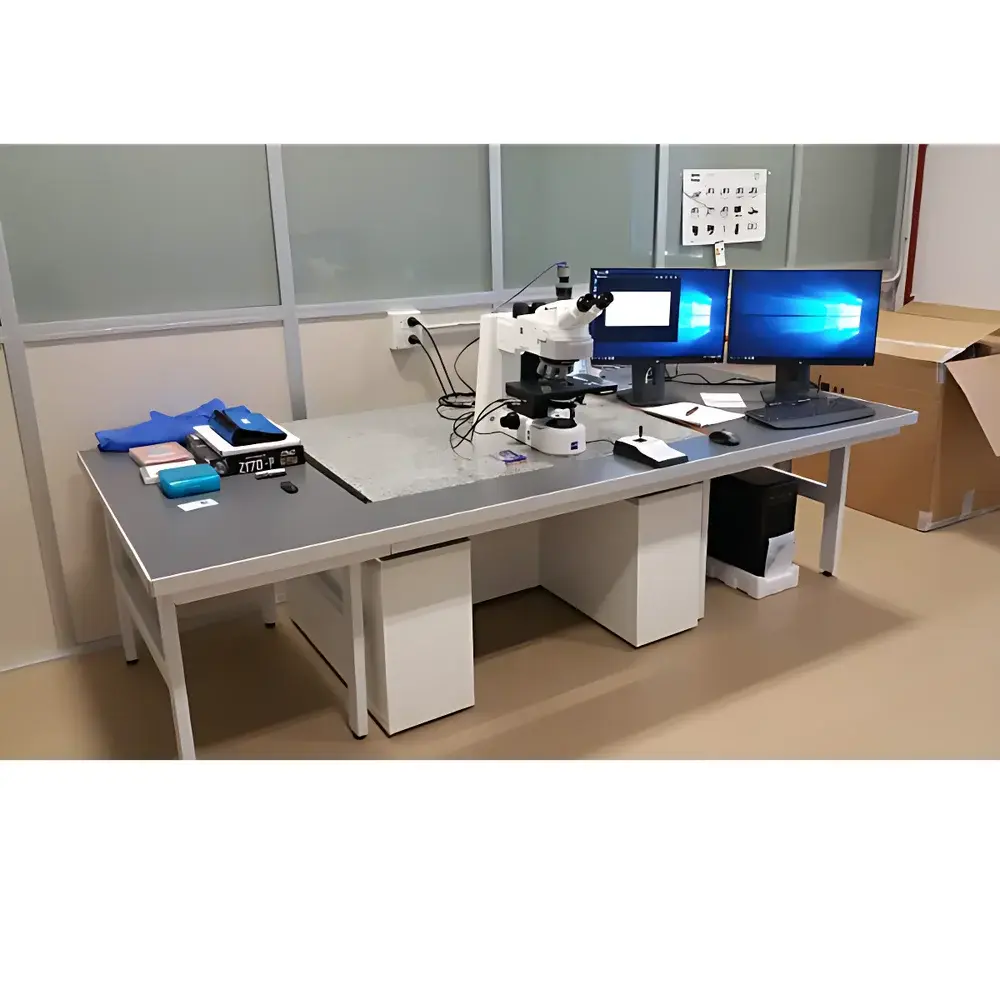
Autoscan FastTracks 3 Fission Track Dating System
| Brand | AUTOSCAN |
|---|---|
| Model | FastTracks 3 (v.3) |
| Measurement Principle | Optical microscopy-based fission track counting and length analysis on etched mineral surfaces (apatite, zircon) |
| Imaging Resolution | 0.1 µm step resolution, sub-micron feature detection capability |
| Motorized Stage | 75 mm (X) × 50 mm (Y) × 3 mm (Z), repeatability ±2 µm |
| Camera | Monochrome CCD, 768 × 576 pixels, 40 fps full-resolution acquisition |
| Software Suite | TrackWorks 3 + FastTracks 3 v.3, GLP-compliant audit trail support |
| Compliance | Designed for ISO/IEC 17025-accredited thermochronology labs |
| Sample Compatibility | Standard petrographic thin sections (25 × 75 mm), polished grain mounts, apatite/zircon separates on epoxy resin stubs |
| Automation Level | Fully automated grain search, track identification, constrained/unconstrained track counting, 3D semi-track length measurement, Dpar/Dper calculation, c-axis orientation mapping |
| Training Module | Integrated pedagogical overlay with instructor-reference overlay and change-diff annotation |
Overview
The Autoscans FastTracks 3 Fission Track Dating System is a purpose-built, research-grade optical instrumentation platform engineered for quantitative thermochronological analysis of fission tracks in insulating minerals—primarily apatite and zircon. It operates on the fundamental principle of optical detection and morphometric characterization of radiation damage trails (fission tracks) induced by spontaneous fission of 238U and revealed through controlled chemical etching. The system integrates high-precision motorized microscopy, calibrated digital imaging, and algorithmically validated track recognition to deliver reproducible, auditable track density and length distributions—key inputs for thermal history inversion modeling (e.g., QTQt, HeFTy). Unlike generic image analysis tools, FastTracks 3 embeds domain-specific physics: track geometry filters (aspect ratio, contrast thresholding, curvature constraints), crystallographic orientation-aware grain boundary detection, and etch-pit morphology classification aligned with IUGS-recommended criteria. Its architecture meets the metrological requirements of thermochronology laboratories pursuing publication-grade data or regulatory submission under geological survey standards.
Key Features
- Fully automated grain localization and fission track enumeration across standard 25 × 75 mm petrographic slides, with configurable detection sensitivity for etched apatite (low-background) and zircon (high-contrast) surfaces
- 3D semi-track length measurement via serial optical sectioning—enabled by synchronized Z-axis stepping and multi-plane focus stacking, supporting kinetic annealing model calibration
- Integrated Dpar/Dper parameter computation from crystallographic c-axis orientation maps, derived from birefringence vector analysis under conoscopic illumination
- Polish scratch suppression algorithm that identifies and excludes mechanically induced linear artifacts—critical for weathered apatite grains where surface abrasion mimics etch pits
- Multi-slide batch processing (up to 8 slides per session) with auto-calibrated stage homing, coordinate-preserving mosaic stitching, and HDR-enabled low-light coal matrix imaging
- GLP-compliant software environment featuring electronic signatures, version-controlled analysis protocols, immutable raw image archiving (LZW-compressed TIFF), and full audit trail export per 21 CFR Part 11 Annex 11 guidelines
Sample Compatibility & Compliance
The FastTracks 3 system accommodates standard geochronological sample formats: doubly polished thin sections, grain mounts embedded in epoxy resin, and ion-milled grain arrays. It supports both external detector (mica) and internal track counting configurations, with automatic mica ROI registration and rotation-invariant interest point referencing. Hardware complies with IEC 61000-6-3 (EMC) and IEC 61000-6-2 (immunity) standards. Software design follows ISO/IEC 17025:2017 Clause 7.7 (data control) and aligns with ASTM D7799–19 (Standard Guide for Fission Track Analysis in Apatite). All calibration procedures—including stage positional accuracy verification (±2 µm), pixel-to-micron scaling (via NIST-traceable stage micrometers), and contrast transfer function validation—are documented in the supplied Certificate of Conformance.
Software & Data Management
TrackWorks 3 serves as the unified control interface for microscope hardware (LUDL stages, AS3000B triaxial platform, EL300 electronics), real-time autofocus, and synchronized image capture. FastTracks 3 v.3 implements a modular analysis pipeline: grain segmentation → track candidate extraction → morphology-based classification → length vector projection → statistical binning (track density, mean confined length, standard deviation). Raw images are stored with embedded EXIF metadata (exposure time, magnification, filter position, Z-stack parameters). The training module enables supervised learning workflows: novice analysts overlay interpretations on reference datasets, with differential highlighting of discrepancies and instructor-annotated feedback layers. Export options include CSV (for QTQt/HeFTy import), XML (for LabArchives ELN integration), and PDF analytical reports with embedded traceability hashes.
Applications
This system is deployed in academic and government geochronology facilities for reconstructing exhumation histories, quantifying long-term erosion rates (e.g., in orogenic belts like the Himalayas or Andes), constraining hydrocarbon basin thermal maturity models, and refining timing of mineralization events in porphyry and epithermal systems. Its capacity for Dpar/Dper mapping directly informs anisotropic annealing corrections in low-temperature thermochronology. In applied settings, it supports regulatory submissions for nuclear waste repository site characterization (e.g., clay host rock stability assessment) and forensic provenance studies of detrital zircons in sedimentary basins. The 3D length measurement capability is particularly valuable for calibrating multi-domain kinetic models such as the Laslett et al. (1987) and Ketcham et al. (2007) parameterizations.
FAQ
What mineral phases can be analyzed with FastTracks 3?
Apatite, zircon, titanite, and sphene—provided they are properly etched and mounted on optically flat substrates compatible with transmitted/reflected light microscopy.
Does the system support both confined and projected track measurements?
Yes. It performs fully automated confined track counting and length measurement on vertical grain mounts, and supports manual or semi-automated projected track analysis on horizontal sections using external detectors.
Is the software validated for regulated environments (e.g., EPA, ISO 17025)?
The FastTracks 3 v.3 software includes built-in validation documentation templates, electronic signature workflows, and audit log exports compliant with ISO/IEC 17025:2017 and FDA 21 CFR Part 11 requirements.
Can the system integrate with existing laboratory information management systems (LIMS)?
Yes—via standardized CSV and XML export formats, and optional API extensions for direct LIMS synchronization (available under enterprise licensing).
What level of technical support and calibration services are provided?
Autoscan offers annual hardware calibration certification (traceable to NMI Australia), remote software updates, and on-site application specialist training programs accredited by the Australian Institute of Geoscientists.