
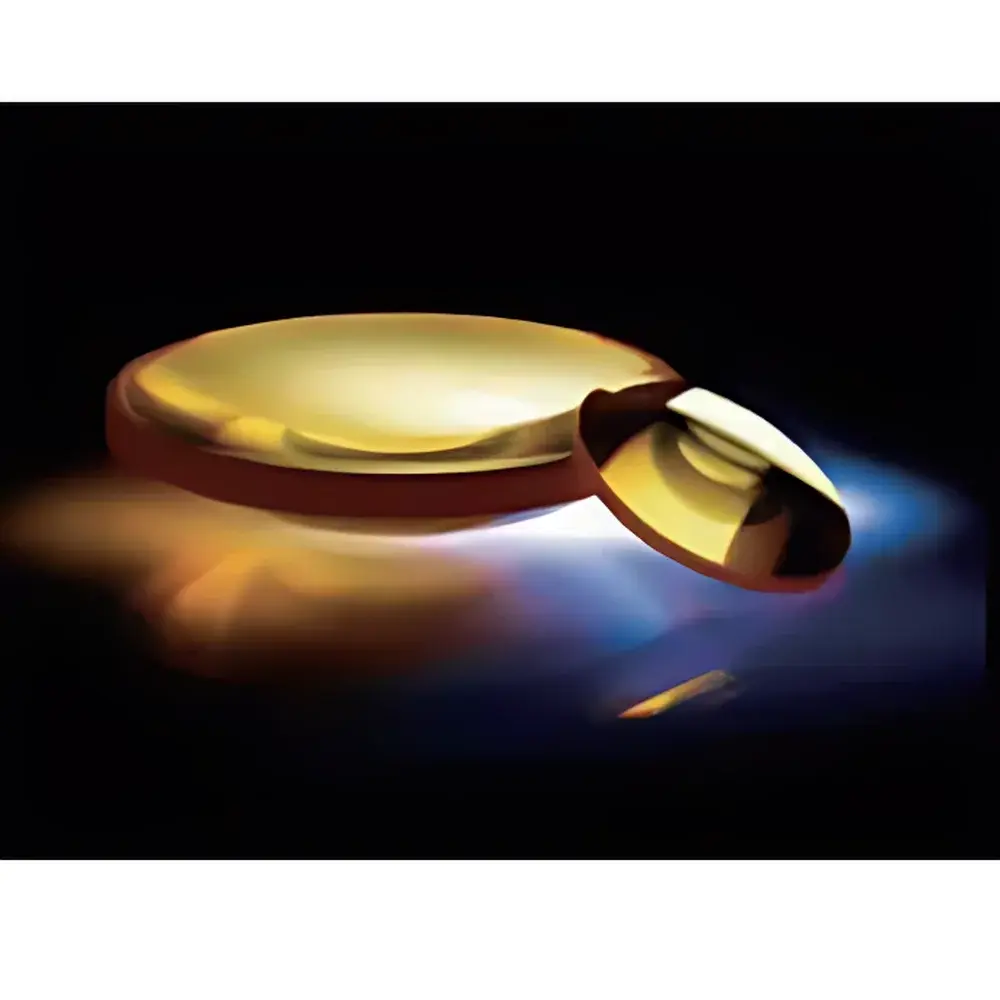
MiXran Meg1033 ZnSe Aspheric Lens
| Brand | MiXran |
|---|---|
| Model | Meg1033 |
| Material | Zinc Selenide (ZnSe) |
| Diameter | 25.4 mm |
| Focal Lengths | 12.7 mm, 25 mm, 50 mm |
| Design Wavelength | 3–5 µm (IR1) or 8–12 µm (IR2) |
| Coating Options | Uncoated or Broadband AR (Rₐᵥg < 1.5% @ 3–5 µm / 8–12 µm) |
| Surface Accuracy | λ/4 @ 633 nm (typ.) |
| Clear Aperture | ≥90% of diameter |
| Center Thickness | 6.2–7.0 mm (varies by focal length) |
| Back Focal Length (BFL) | 9.88–47.95 mm |
| Numerical Aperture (NA) | 0.42–0.67 |
| Compliance | ISO 10110-1, ISO 10110-7 |
Overview
The MiXran Meg1033 ZnSe Aspheric Lens is a precision optical component engineered for high-performance infrared (IR) imaging, laser beam shaping, and thermal detection systems operating in the mid-wave infrared (MWIR: 3–5 µm) and long-wave infrared (LWIR: 8–12 µm) spectral bands. Fabricated from high-purity, CVD-grown zinc selenide (ZnSe), this lens exhibits exceptional transmission (>70% per surface, uncoated) across both atmospheric IR windows, with low absorption and minimal dispersion. Its aspheric surface profile eliminates spherical aberration inherent in equivalent spherical lenses—enabling diffraction-limited focusing, improved signal-to-noise ratio in thermal cameras, and tighter spot sizes in CO₂ laser (10.6 µm) or quantum cascade laser (QCL) delivery systems. Unlike plano-convex or biconvex alternatives, the Meg1033’s monolithic aspheric design reduces system complexity by eliminating the need for multi-element correction, making it ideal for compact, alignment-insensitive optical paths in FTIR spectrometers, gas analyzers, and industrial pyrometry setups.
Key Features
- Optimized ZnSe substrate: Low bulk absorption coefficient (<0.0005 cm⁻¹ @ 10.6 µm), high thermal conductivity (18 W/m·K), and excellent resistance to thermal shock—critical for high-power IR laser applications.
- Aspheric surface figure accuracy: λ/4 RMS @ 633 nm (per ISO 10110-5), verified via interferometric metrology; ensures wavefront error <0.25λ across full clear aperture.
- Dual broadband anti-reflection coating options: IR1 (Rₐᵥg < 1.5% over 3–5 µm) and IR2 (Rₐᵥg < 1.5% over 8–12 µm), deposited via ion-assisted e-beam evaporation for environmental durability (per MIL-C-48497A).
- Standardized mechanical interface: 25.4 mm outer diameter with precision-ground mounting edge (tolerance ±0.02 mm), compatible with industry-standard SM1-threaded lens tubes and kinematic mounts.
- Traceable manufacturing: Each lens bears a unique serial number and is supplied with a certificate of conformance including measured surface irregularity, centration error (<3 arcmin), and transmitted wavefront distortion data.
Sample Compatibility & Compliance
The Meg1033 is designed for integration into optomechanical assemblies compliant with ISO 10110 optical drawing standards and RoHS 2015/863/EU material restrictions. Its ZnSe composition meets ASTM F2617-20 specifications for IR-transmitting materials used in medical and industrial diagnostics. When deployed in regulated environments—including FDA-cleared thermal imaging platforms or EPA Method 30B-compliant emissions monitors—the lens supports GLP/GMP-aligned documentation packages (available upon request), including raw interferogram data, coating spectral reflectance curves (200–14,000 cm⁻¹), and batch-level material certification from the CVD crystal grower. No hazardous substances are introduced during polishing or coating; all processes adhere to ISO 14001 environmental management protocols.
Software & Data Management
While the Meg1033 is a passive optical element, its performance parameters are fully integrated into common optical design platforms. Zemax OpticStudio™ and Synopsys Code V™ libraries include native prescription files (.zmx, .seq) for all three focal lengths (12.7 mm, 25 mm, 50 mm), incorporating measured refractive index dispersion (Sellmeier coefficients valid from 0.6–16 µm) and surface sag tables. Users may import these models directly for tolerance analysis, stray light simulation, or thermal deformation prediction under operational temperature gradients (−40°C to +80°C). For traceability, MiXran provides downloadable CSV datasets containing measured MTF at 20, 40, and 60 lp/mm (at design wavelength), along with polarization-dependent transmission profiles for s- and p-polarized incidence up to 45° AOI.
Applications
- MWIR/LWIR thermal imaging: Objective lenses for uncooled microbolometer arrays (e.g., FLIR Boson, Teledyne DALSA) requiring high étendue and low f-number optics.
- CO₂ laser processing: Focusing optics in cutting, welding, and marking systems where ZnSe’s high damage threshold (>500 MW/cm², 10 ns pulse) and low thermal lensing are essential.
- FTIR spectroscopy: Collimating and focusing elements in Michelson interferometers, particularly in portable or field-deployable gas analyzers targeting CH₄, CO₂, or NOₓ absorption lines.
- Quantum cascade laser (QCL) beam conditioning: Coupling optics for free-space QCL output into multi-pass cells or photoacoustic detection chambers.
- Defense & aerospace EO/IR systems: Lightweight, athermalized components in gimbal-mounted surveillance payloads where mass and thermal stability are constrained.
FAQ
What is the maximum permissible power density for continuous-wave (CW) operation at 10.6 µm?
For uncoated Meg1033 lenses, the CW laser-induced damage threshold (LIDT) is 15 kW/cm² (tested per ISO 21254-2); with IR2 coating, LIDT increases to 25 kW/cm² due to reduced surface absorption.
Can the lens be mounted in vacuum environments?
Yes—ZnSe has negligible outgassing (total mass loss <0.5% per ASTM E595), and the AR coatings are qualified for UHV compatibility (pressure <1×10⁻⁷ Torr) without delamination.
Is custom focal length or diameter available?
Yes—MiXran offers OEM aspheric lens fabrication with diameters from 12.7 mm to 100 mm and EFLs from 5 mm to 200 mm, subject to minimum order quantity and lead time validation.
How is centration error measured and specified?
Centration is quantified as the angular deviation between the mechanical axis (defined by outer diameter) and optical axis (defined by vertex normals), measured via autocollimation; standard specification is <3 arcmin, with <1 arcmin available under tight-tolerance ordering.
Do you provide mounting hardware or cell designs?
Standard SM1-compatible retaining rings and kinematic lens mounts are available as accessories; full optomechanical cell CAD models (STEP, IGES) can be supplied for integration into system-level assemblies.







