
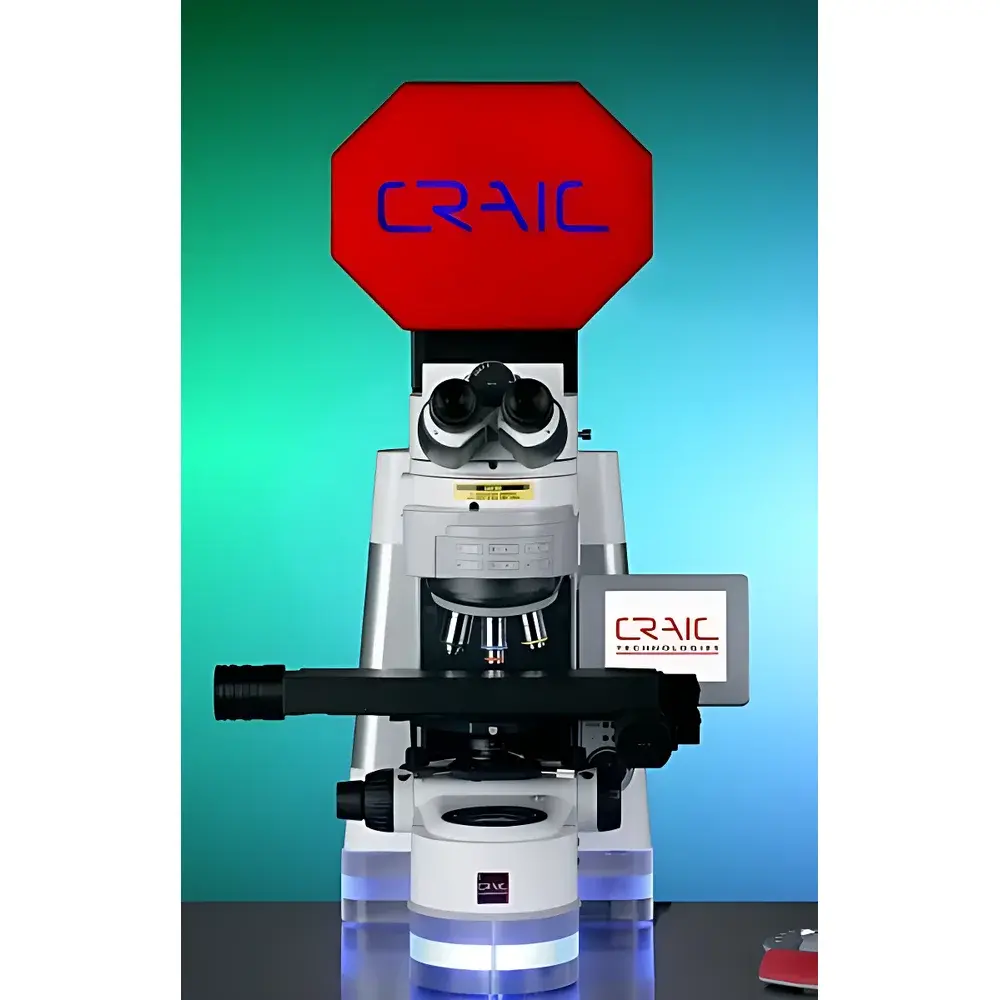
CRAIC 20/30PV™ UV-Visible-NIR Microspectrophotometer and Imaging System
| Brand | CRAIC |
|---|---|
| Origin | USA |
| Model | 20/30PV™ |
| Wavelength Range | 200–2100 nm |
| Minimum Scan Speed | 4 ms |
| Spatial Sampling Interval | 1 µm |
| Measurement Mode | Automated |
| Software | LambdaFire™ |
| Detector Type | TE-Cooled Array Detectors |
| Sample Stage | Precision Motorized with Sub-Micron Positioning |
| Polarization Capability | Full UV-Vis-NIR Polarimetric Imaging |
| Optional Modules | Apollo™ Raman, rIQ™ Refractive Index Mapping, Spectral Surface Imaging |
Overview
The CRAIC 20/30PV™ UV-Visible-NIR Microspectrophotometer and Imaging System is a fully integrated research-grade instrument engineered for non-destructive, spatially resolved spectral analysis of microscopic samples. Operating on the principle of microspectrophotometry—combining high-magnification microscopy with calibrated spectroscopic detection—the system acquires quantitative optical spectra (transmission, absorbance, reflectance, fluorescence, and emission) from sample regions as small as 0.5 µm in diameter across a continuous spectral range from deep ultraviolet (200 nm) to short-wave near-infrared (2100 nm). Unlike conventional spectrometers coupled to microscopes via fiber optics or external ports, the 20/30PV™ integrates optical pathways, illumination sources, and detectors into a monolithic optical train optimized for stray-light suppression, photometric accuracy, and spectral fidelity. Its architecture supports simultaneous acquisition of high-resolution digital images and corresponding microspectra—enabling correlative morphological and spectral analysis without stage repositioning or optical realignment. The system is NIST-traceable certified and designed to meet stringent requirements for quantitative microanalysis in regulated environments, including GLP-compliant laboratories and academic core facilities.
Key Features
- UV-Vis-NIR microspectrophotometry (200–2100 nm) with <1 µm spatial resolution and sub-pixel spectral sampling
- Lightblades™ illumination technology enabling uniform, collimated, and polarization-controlled excitation across full spectral range
- TE-cooled scientific-grade array detectors (CCD and InGaAs) for low-noise, high-dynamic-range spectral acquisition
- Motorized precision XYZ stage with sub-micron repeatability and programmable mapping routines
- Integrated polarization optics for quantitative birefringence, dichroism, and anisotropy measurements
- Modular expandability: Apollo™ Raman module (532/785 nm lasers, high-throughput spectrometer), rIQ™ refractive index mapping, and Spectral Surface Imaging for 3D hyperspectral data cubes
- Ergonomic touchscreen interface powered by LambdaFire™ software with real-time spectral preview and live image overlay
- Thermally stabilized sample chamber with optional Peltier-based temperature control (−20 °C to +80 °C)
Sample Compatibility & Compliance
The 20/30PV™ accommodates diverse solid-state and thin-film specimens—including semiconductor wafers, MEMS devices, protein crystals, forensic trace evidence, OLED layers, photonic crystals, geological thin sections, and pharmaceutical tablets—without requiring conductive coating or vacuum conditions. Its non-contact, non-destructive methodology preserves sample integrity for longitudinal studies or archival analysis. The system complies with ASTM E2821 (Standard Practice for Microspectrophotometry), ISO 13694 (Optics and photonics — Determination of transmittance and reflectance), and supports audit-ready workflows aligned with FDA 21 CFR Part 11 requirements when configured with LambdaFire™’s electronic signature and secure audit trail features. All calibration standards are NIST-traceable, and spectral responsivity is validated per manufacturer’s Certificate of Calibration.
Software & Data Management
LambdaFire™ is a modular, Windows-based application providing unified control of hardware, acquisition, processing, and reporting. It includes real-time spectral visualization, multivariate curve resolution (MCR), spectral library matching (with customizable reference databases), pixel-by-pixel spectral unmixing, and quantitative thickness modeling for transparent films using interference fringe analysis. Data export conforms to ASTM E131 and JCAMP-DX formats; TIFF, HDF5, and CSV outputs ensure compatibility with third-party tools such as MATLAB, Python (SciPy/NumPy), and commercial chemometrics platforms. The software supports automated batch acquisition, region-of-interest (ROI) scripting, and GMP/GLP-compliant report generation with embedded metadata (instrument parameters, calibration logs, user ID, timestamp).
Applications
- Semiconductor metrology: Thin-film thickness, composition, and bandgap mapping of SiO₂, SiNₓ, ITO, perovskites, and 2D materials
- Life sciences: Fluorescence lifetime-independent spectral fingerprinting of cellular organelles, tissue sections, and labeled biomolecules
- Forensic science: Non-destructive analysis of ink, paper, fibers, and counterfeit currency under multi-spectral illumination
- Materials science: Quantitative characterization of plasmonic resonances, photonic band structures, and excitonic transitions
- Pharmaceutical development: Polymorph identification, API distribution homogeneity, and coating thickness validation
- Geosciences: Mineral identification via absorption edge analysis and cathodoluminescence spectral correlation
FAQ
What spectral resolution can be achieved with the 20/30PV™?
Spectral resolution is configuration-dependent and determined by grating selection and detector pixel binning; typical full-width-at-half-maximum (FWHM) values range from 0.5 nm (UV-Vis) to 4 nm (NIR), as specified in the instrument’s calibration certificate.
Is the system compatible with vacuum or controlled-atmosphere stages?
Yes—custom vacuum-compatible stages and environmental chambers (e.g., humidity- and gas-controlled) can be integrated upon request, subject to optical port alignment verification.
Can LambdaFire™ perform chemometric analysis such as PCA or PLS regression?
LambdaFire™ includes built-in multivariate analysis tools (PCA, cluster analysis, spectral deconvolution); advanced PLS regression requires export to dedicated chemometrics software, though all raw data formats are natively supported.
Does the 20/30PV™ support time-resolved fluorescence measurements?
While not a time-correlated single-photon counting (TCSPC) system, it enables gated fluorescence intensity mapping using pulsed LED or laser excitation synchronized to detector integration timing—suitable for steady-state lifetime discrimination in heterogeneous samples.
How is NIST traceability maintained across instrument lifetime?
CRAIC provides annual recalibration services using NIST-traceable standard reference materials (SRMs), with full documentation including uncertainty budgets and measurement assurance protocols compliant with ISO/IEC 17025.





