
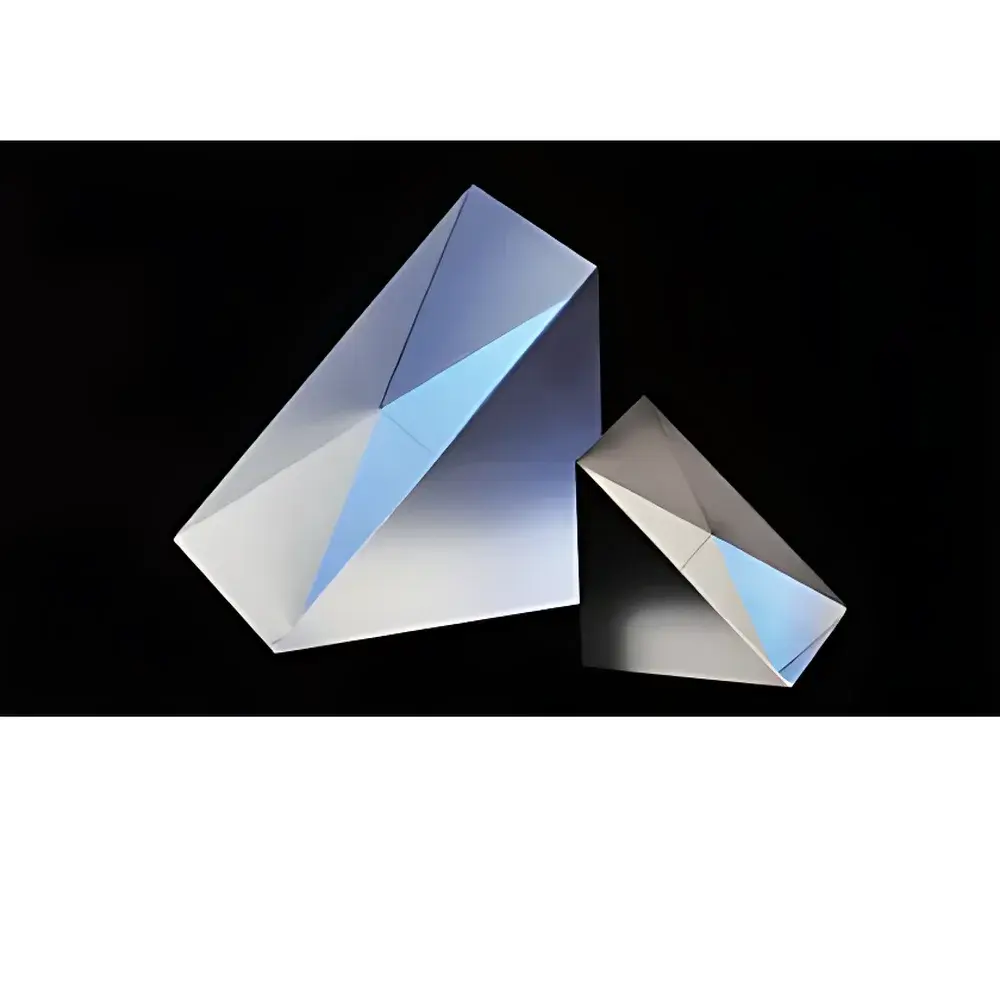
MiXran Meg1041 High-Precision Right-Angle Prism
| Brand | MiXran |
|---|---|
| Model | Meg1041 |
| Category | Optical Instrument Component |
| Dimensions (mm) | 1–50 mm (A=B=C) |
| Angular Tolerance | ±15″ to ±30″ |
| Coating Options | Uncoated |
| Material | Optical Grade BK7 or Fused Silica (standard) |
| Surface Quality | 20–10 scratch-dig (per MIL-PRF-13830B) |
| Flatness | λ/4 @ 633 nm |
Overview
The MiXran Meg1041 High-Precision Right-Angle Prism is a monolithic optical component engineered for accurate 90° beam deviation with minimal wavefront distortion and high polarization fidelity. Based on the principle of total internal reflection (TIR) at the hypotenuse face—or, when coated, specular reflection via protected aluminum—the Meg1041 delivers consistent angular accuracy across visible (VIS: 400–700 nm) and near-infrared (NIR: 700–1100 nm) spectral bands. Its geometry adheres strictly to the right-angle triangular cross-section (A = B = C), where all three edges are equal in length and the two acute angles are precisely 45°, enabling deterministic ray reversal in interferometric setups, periscopic imaging paths, and laser cavity folding configurations. Manufactured from certified optical-grade BK7 glass (with fused silica variants available upon request), each prism undergoes precision lapping, polishing, and interferometric verification to meet stringent angular tolerance specifications—ranging from ±15 arcseconds for larger apertures (≥6.3 mm) to ±30 arcseconds for miniature variants (1–5 mm). This dimensional and angular stability ensures repeatable alignment in OEM instrumentation, metrology subassemblies, and academic optics laboratories requiring traceable optical path integrity.
Key Features
- Precision-ground 45°–45°–90° geometry with angular tolerance options of ±15″ or ±30″, verified via autocollimation and digital theodolite measurement
- Multiple coating configurations optimized for system-level performance: uncoated (for TIR-based VIS applications), aluminized hypotenuse + AR-coated legs (for broadband reflectivity >90% in VIS/NIR), or aluminized legs + AR-coated hypotenuse (for retroreflection-critical paths)
- Surface quality rated at 20–10 scratch-dig per MIL-PRF-13830B; surface flatness λ/4 @ 633 nm measured by phase-shifting interferometry
- Material options include Schott BK7 (standard), H-K9L, or synthetic fused silica (for UV-VIS-NIR broadband use and thermal stability)
- Edge conditioning applied to all perimeters to prevent chipping during handling and mounting; optional black anodized aluminum mounts or kinematic cage-compatible adapters available separately
Sample Compatibility & Compliance
The Meg1041 is compatible with standard optomechanical platforms including Thorlabs, Newport, and Edmund Optics cage systems and lens tubes. Its dimensional consistency supports integration into ISO-standard optical breadboards (M6 threaded holes) and modular laser alignment fixtures. All prisms comply with RoHS 2011/65/EU directives and are manufactured under documented cleanroom protocols (ISO Class 7). While not individually certified to ISO 10110 or DIN EN 1047 standards, batch-level certification—including interferometric test reports, spectral transmittance/reflectance curves (measured on Agilent Cary 5000 UV-VIS-NIR spectrophotometer), and material certificates of conformance—is provided upon request for GMP-aligned production environments. The AR coatings conform to ISO 9211-3 for durability (rub test, adhesion, humidity cycling) and spectral performance.
Software & Data Management
No embedded firmware or proprietary software is associated with the Meg1041, as it is a passive optical element. However, full optical prescription data—including nominal dimensions, refractive index (nd = 1.5168 @ 587.6 nm for BK7), Abbe number (νd = 64.2), coefficient of thermal expansion (CTE = 7.1 × 10⁻⁶/K), and coating spectral curves—is delivered in standardized Zemax .ZAR and CODE V .DAT formats for seamless integration into optical design workflows. Traceability documentation includes unique product identifiers (e.g., GP12-025-VIS-01), lot numbers, and calibration timestamps aligned with NIST-traceable interferometric reference standards. For regulated environments, audit-ready records support 21 CFR Part 11-compliant data archiving when paired with validated LIMS or PLM systems.
Applications
- Laser beam steering and cavity folding in DPSS, fiber, and diode laser systems
- Retroreflector elements in Michelson and Mach-Zehnder interferometers
- Optical path reversal in confocal microscopy scan engines and OCT sample arms
- Alignment fiducials in photolithography steppers and wafer inspection tools
- Education kits for geometric optics labs, including Snell’s law verification and polarization analysis experiments
FAQ
What is the standard substrate material for the Meg1041?
BK7 optical glass is the default substrate; fused silica and SF10 variants are available under custom order with lead-time adjustment.
Can the Meg1041 be used in vacuum or high-humidity environments?
Yes—when specified with low-outgassing coatings and cleaned per ASTM E2060, the prism meets NASA-STD-6002 and ECSS-Q-ST-70-02C requirements for space-qualified optics.
Is angle tolerance tested per prism or per batch?
Each unit undergoes individual angular verification using a calibrated autocollimator traceable to NPL standards; statistical process control (SPC) charts accompany bulk shipments.
Do you provide mounting solutions or kinematic interfaces?
Standard unmounted prisms ship in foam-lined ISO Class 5 packaging; custom kinematic mounts (e.g., tip-tilt-adjustable prism holders) are offered as value-added accessories.
Are coating damage thresholds specified?
Laser-induced damage threshold (LIDT) data is available per ISO 21254-1:2011 testing—typically >5 J/cm² at 1064 nm, 10 ns, 10 Hz for aluminized + VIS-AR configurations.



