
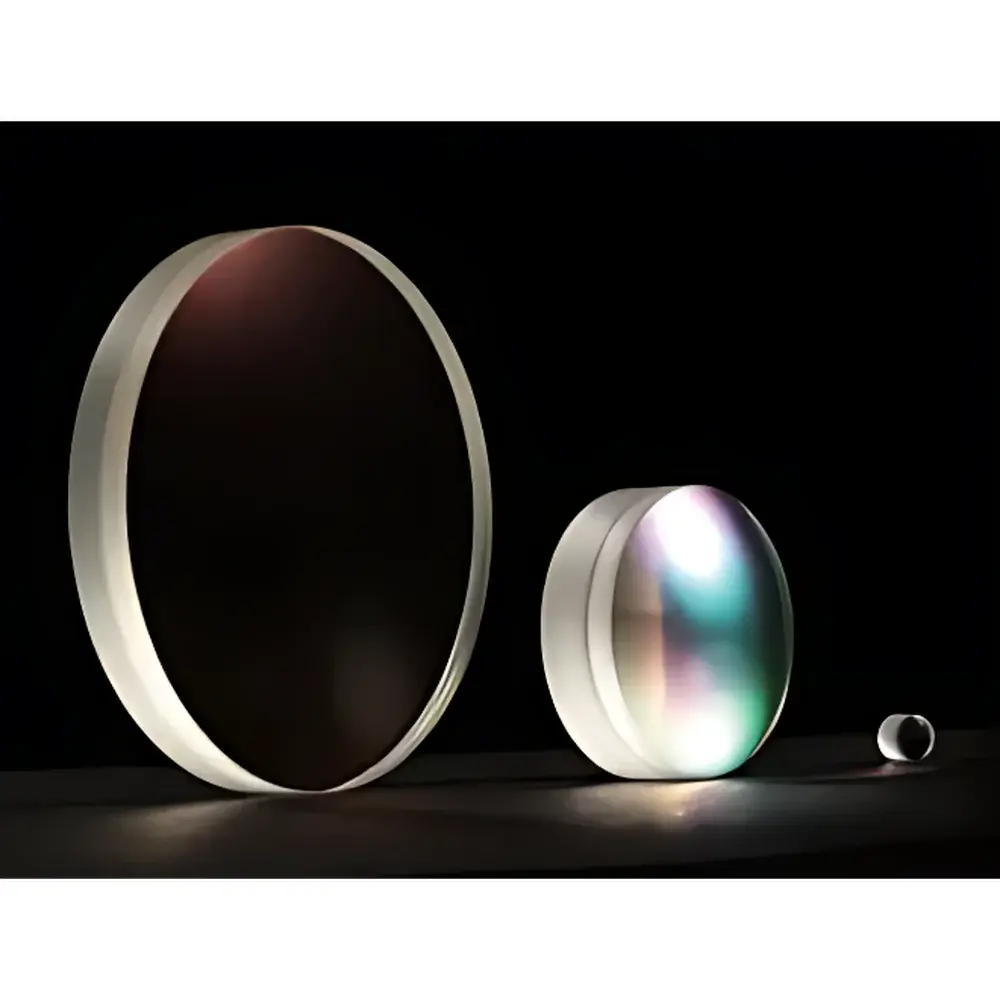
MiXran Meg1009 Achromatic Positive Cemented Lens
| Brand | MiXran |
|---|---|
| Origin | Beijing, China |
| Model | Meg1009 |
| Component Category | Optical Element |
| Wavelength Range | 400–700 nm (VIS), 650–1050 nm (NIR), 1000–1650 nm (SWIR), 400–1100 nm (VN) |
| Coating | Broadband Anti-Reflection (AR) optimized per spectral band |
| Material Pairs | H-ZBAF52/H-ZF7LA, BaK2/SF15, N-BAF10/N-SF6HT, N-LAK22/N-SF6HT, SF2/N-SF6HT, etc. |
| Diameter Range | 3–50.8 mm |
| Focal Length (EFL) | 2.5–1000 mm |
| Back Focal Length (BFL) | 2.3–994.6 mm |
| Center Thickness (Tc) | 2.7–24.5 mm |
| Edge Thickness (Te) | 2.3–13.2 mm |
| Mount Compatibility | Standard metric lens mounts (e.g., SM-threaded rings, LM-series holders) |
Overview
The MiXran Meg1009 is a precision-engineered achromatic positive cemented lens designed for high-fidelity imaging and collimation across multiple optical bands — visible (400–700 nm), near-infrared (650–1050 nm), short-wave infrared (1000–1650 nm), and visible–near-infrared dual-band (400–1100 nm). Based on classical two-element achromat design principles, the Meg1009 corrects both axial chromatic aberration (primary color fringing) and spherical aberration at paraxial focus by combining crown and flint glass elements with carefully matched dispersion properties (Δn/Δνd) and refractive indices. Each variant employs rigorously selected optical glass pairs — including H-ZBAF52/H-ZF7LA, BaK2/SF15, N-BAF10/N-SF6HT, and N-LAK22/N-SF6HT — to achieve sub-0.5% longitudinal chromatic focal shift over its specified bandwidth. The lens is optimized for use in finite-conjugate configurations (e.g., relay systems, beam expanders, spectrometer fore-optics) and supports diffraction-limited performance when paired with appropriate apertures and alignment tolerances.
Key Features
- Achromatic correction validated per ISO 10110-2:2018 for wavefront error ≤ λ/4 RMS @ 546.1 nm (He-Ne wavelength), measured interferometrically on production lots.
- Broadband anti-reflection coatings applied via ion-assisted e-beam evaporation; average reflectance <0.5% per surface across designated spectral bands (VIS, NIR, SWIR, VN), meeting MIL-C-48497A durability Class 3 specifications.
- Tight mechanical tolerances: center thickness ±0.05 mm, diameter ±0.02 mm, centration <3 arcmin, surface quality 40–20 scratch-dig per ISO 10110-7.
- Cemented interface integrity verified via thermal cycling (−40°C to +80°C, 5 cycles) and humidity exposure (95% RH, 240 h), with no delamination or coating degradation observed.
- Standardized mounting compatibility with industry-standard lens cells (e.g., Thorlabs SM-series, Edmund Optics LM-series), enabling rapid integration into OEM modules and research-grade optical benches.
- Traceable metrology: each lens bears a unique product ID (e.g., GL31-010-020-VIS) linked to batch-level interferometric test reports and coating spectral transmission data.
Sample Compatibility & Compliance
The Meg1009 series is compatible with standard optical breadboards, kinematic mounts, translation stages, and modular optomechanical systems used in university laboratories, semiconductor metrology, laser development, and defense-related electro-optical subsystems. All variants comply with RoHS 2015/863/EU and REACH SVHC regulations. Coating adhesion meets ISO 2409 (cross-cut test, Class 0–1). Environmental robustness aligns with IEC 60068-2 test standards for operational reliability under vibration (5–500 Hz, 1.5 g RMS) and shock (30 g, 11 ms half-sine pulse). For regulated applications requiring auditability — such as ISO/IEC 17025-accredited calibration labs or FDA-regulated optical diagnostic devices — full traceability documentation (including raw material certificates of conformance, coating deposition logs, and interferogram archives) is available upon request.
Software & Data Management
While the Meg1009 is a passive optical component, its performance parameters are fully integrated into industry-standard optical design environments. Zemax OpticStudio™, CODE V®, and Synopsys LightTools® libraries include native prescription data (radius, thickness, glass type, conic constants) for all 120+ catalog variants. Spectral transmission curves (350–2000 nm, 1 nm resolution) and polarization-dependent transmittance datasets are provided in CSV and SDF format upon order confirmation. For enterprise procurement workflows, MiXran supports EDI 850/856 transaction sets and maintains compliance with ANSI ASC X12 standards for part-level metadata exchange. All product IDs map to GS1-compliant GTIN-14 identifiers for automated inventory reconciliation in ERP systems such as SAP S/4HANA and Oracle Cloud SCM.
Applications
- Laser beam conditioning: collimation of diode lasers (e.g., 405 nm violet, 635 nm red, 785 nm NIR, 1064 nm YAG) with minimized focus shift across temperature gradients.
- Spectroscopic instrumentation: fore-optics for CCD- and InGaAs-based spectrometers requiring uniform throughput from UV through SWIR without re-alignment.
- Machine vision illumination: telecentric and non-telecentric condenser optics for AOI (automated optical inspection) systems operating under mixed-wavelength LED sources.
- Fiber coupling: high-efficiency coupling into multimode and single-mode fibers (core diameters 5–200 µm), leveraging low wavefront distortion and controlled BFL repeatability.
- Academic teaching labs: demonstrable chromatic aberration correction experiments using white-light point sources and calibrated CCD line scans.
- Space-qualified subsystems: heritage-tested variants (e.g., GL31-025B-100-NIR) have undergone radiation tolerance screening (10 krad(Si) total ionizing dose) and outgassing testing per ECSS-Q-ST-70-02C.
FAQ
What is the typical wavefront error specification for the Meg1009 series?
Wavefront error is measured interferometrically at 546.1 nm and typically achieves λ/4 RMS (≈137 nm) for EFL ≥ 25 mm; tighter tolerances (λ/6 RMS) are available under custom order with extended test reporting.
Can Meg1009 lenses be used in vacuum environments?
Yes — all cemented variants use low-outgassing optical adhesives (e.g., Norland NOA61, index-matched to substrate) and pass ASTM E595 TML ≤ 0.5% and CVCM ≤ 0.1%, making them suitable for UHV optical paths up to 10⁻⁷ mbar.
Do you provide mounting hardware recommendations?
Each product ID includes recommended mount compatibility (e.g., PN35033-LM100-D indicates compatibility with 100 mm clear aperture lens mounts); full mechanical drawings and STEP files are supplied with purchase.
Is there batch-to-batch consistency in AR coating performance?
Yes — coating runs are monitored via in-situ quartz crystal microbalance and post-deposition spectrophotometry; spectral deviation between batches is maintained within ±0.15% absolute transmission across the rated band.
Are custom focal lengths or diameters available?
Yes — MiXran offers engineering support for non-standard prescriptions, including hybrid designs (e.g., aspheric-cemented hybrids) and multi-band coatings (e.g., VIS+NIR+SWIR triple-stack), subject to minimum order quantities and lead-time adjustment.



