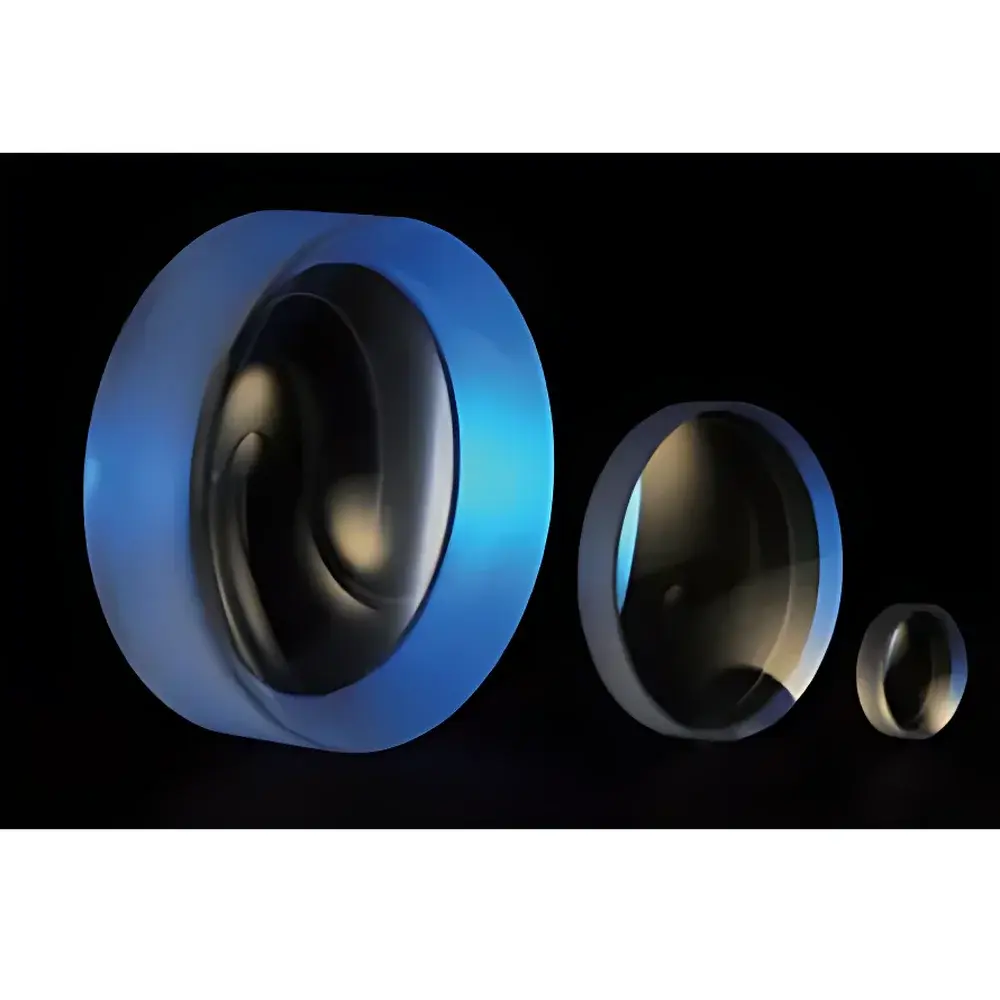
MiXran Meg1024 Calcium Fluoride (CaF₂) Plano-Concave Lens

| Brand | MiXran |
|---|---|
| Model | Meg1024 |
| Material | Calcium Fluoride (CaF₂) |
| Lens Type | Plano-Concave |
| Coating Options | Uncoated or IR1 Broadband Anti-Reflection Coating (Rₐᵥg < 1.5% @ 3–5 µm) |
| Diameter | 12.7 mm / 25.4 mm |
| Focal Length (EFL) | –18 mm to –500 mm |
| Back Focal Length (BFL) | –19.4 mm to –502.8 mm |
| Radius of Curvature (R₁) | –7.8 mm to –216.9 mm |
| Center Thickness (Tc) | 2.5 mm to 4.6 mm |
| Edge Thickness | 2.54 mm to 4.4 mm |
| Mounting Compatibility | Standard SM1 (1.035"-40) and SM25 (2.035"-40) lens mounts |
| Compliance | ISO 10110-1, MIL-O-13830 Surface Quality (scratch-dig 60-40), RoHS-compliant manufacturing |
Ask about pricing, availability and specifications.
Overview
The MiXran Meg1024 is a precision-engineered plano-concave lens fabricated from high-purity calcium fluoride (CaF₂), optimized for demanding mid-infrared (MIR) optical systems operating in the 3–5 µm spectral band. Unlike fused silica or BK7 lenses, CaF₂ exhibits exceptionally low absorption and high transmission across this wavelength range—critical for thermal imaging, laser beam expansion, divergent beam collimation, and Fourier-transform infrared (FTIR) spectroscopy applications. Its negative focal length enables beam divergence control, virtual image formation, and optical power correction in multi-element assemblies. The lens conforms to ISO 10110-1 dimensional tolerances and MIL-O-13830 surface quality standards (60-40 scratch-dig), ensuring consistent wavefront fidelity and minimal scatter under high-flux irradiation. All Meg1024 variants are manufactured using single-crystal CaF₂ boules grown via the Bridgman method, minimizing birefringence and internal stress—an essential requirement for polarization-sensitive MIR instrumentation.
Key Features
- Optical substrate: High-transmission calcium fluoride (CaF₂) with refractive index n ≈ 1.39 @ 4 µm and dn/dT ≈ –1.1 × 10⁻⁶ /°C—enabling stable performance across moderate thermal gradients.
- Two coating configurations: Uncoated for maximum UV-VIS-NIR versatility or IR1 broadband anti-reflection coating (Rₐᵥg < 1.5% over 3–5 µm), deposited via ion-assisted e-beam evaporation for environmental durability and low residual stress.
- Dimensional consistency: Tight tolerance control on EFL (±1%), radius of curvature (±0.5%), center thickness (±0.05 mm), and surface flatness (λ/4 @ 633 nm on plano side).
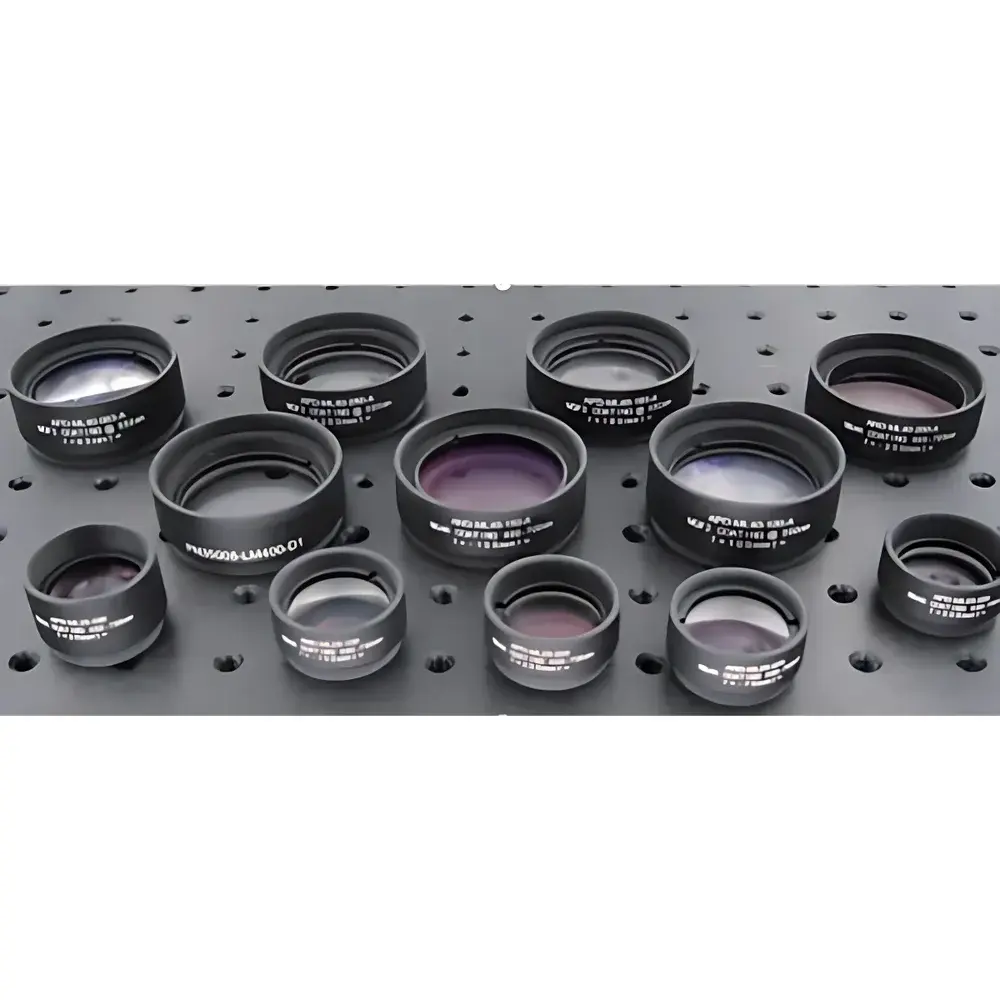
- Mount-ready geometry: Beveled edges (0.2 mm × 45°) and standardized outer diameters (12.7 mm and 25.4 mm) ensure secure retention in industry-standard SM1 and SM25 lens cells without slippage or tilt-induced aberration.
- Thermal stability: Low coefficient of thermal expansion (α ≈ 18.9 × 10⁻⁶ /°C) and high laser-induced damage threshold (>500 MW/cm² @ 10.6 µm, 10 ns pulse) support use in pulsed CO₂ laser delivery optics and stabilized interferometric cavities.
Sample Compatibility & Compliance
The Meg1024 lens is compatible with standard optomechanical platforms including Thorlabs, Newport, and Edmund Optics mounting systems. It meets ISO 9001-certified production protocols at MiXran’s Beijing facility, with full traceability to raw material lot numbers and in-process metrology records. All coated variants comply with ISO 13665 (optical coating adhesion testing) and pass humidity cycling (IEC 60068-2-30) and thermal shock (MIL-STD-810G Method 503.5) validation. The CaF₂ substrate is certified free of heavy metals per RoHS Directive 2011/65/EU and conforms to REACH Annex XIV restrictions. No hazardous substances are introduced during polishing or coating—ensuring compatibility with cleanroom-class vacuum environments (outgassing rate < 1.0 × 10⁻⁷ g/cm²·s per ASTM E595).
Software & Data Management
While the Meg1024 is a passive optical component, its specifications are fully integrated into Zemax OpticStudio (v23+) and CODE V (v12.2+) material libraries as “CaF2_MiXran_Meg1024”, including measured dispersion data (Sellmeier coefficients valid from 0.2 µm to 8.0 µm). Each shipped unit includes a digital calibration certificate (PDF) with interferometric surface map (Zygo GPI data format), transmitted wavefront error (TWE) measurement, and spectral transmittance curve (PerkinElmer Lambda 1050+ scan). These files are timestamped, digitally signed, and archived for GLP/GMP audit readiness—supporting FDA 21 CFR Part 11 compliance when used in regulated analytical instrument design.
Applications
- Mid-IR beam shaping in quantum cascade laser (QCL) systems and tunable diode laser absorption spectroscopy (TDLAS) gas analyzers.
- Field-correcting elements in uncooled microbolometer-based thermal imaging objectives (e.g., 3–5 µm f/1.0 wide-field lenses).
- Negative power compensation in FTIR Michelson interferometers to balance path-length asymmetry.
- Collimation of divergent output from quantum well infrared photodetectors (QWIPs) and type-II superlattice detectors.
- UV-grade CaF₂ compatibility enables dual-band usage (e.g., excimer laser harmonics at 193 nm + MIR diagnostics), provided AR coating is omitted.
FAQ
Is the CaF₂ substrate resistant to moisture-induced degradation?
Yes—MiXran’s CaF₂ crystals undergo post-growth annealing at 600°C under dry nitrogen to eliminate hydroxyl (OH⁻) impurities. Measured hygroscopicity is < 0.001% mass gain after 96 h at 85% RH, per ASTM D570.
Can the IR1 coating withstand high-power CW CO₂ laser exposure?
The IR1 film stack is qualified for continuous-wave operation up to 2 kW/cm² at 10.6 µm, with no measurable delamination or absorption increase after 10⁴ hours at 50°C ambient.
What is the recommended cleaning protocol for coated CaF₂ surfaces?
Use only spectroscopic-grade acetone followed by methanol, applied with Class 100 cleanroom swabs (Texwipe TX609); avoid ultrasonic agitation or aqueous solutions due to potential etching.
Are custom focal lengths or diameters available?
Yes—MiXran offers OEM fabrication per ISO 10110 drawings; minimum order quantity applies for non-standard geometries.
Does the product include ISO 17025-accredited calibration data?
No—calibration is performed per internal MiXran SOP-OP-027 (traceable to NIM Beijing), but third-party ISO/IEC 17025 accreditation requires separate service engagement.