
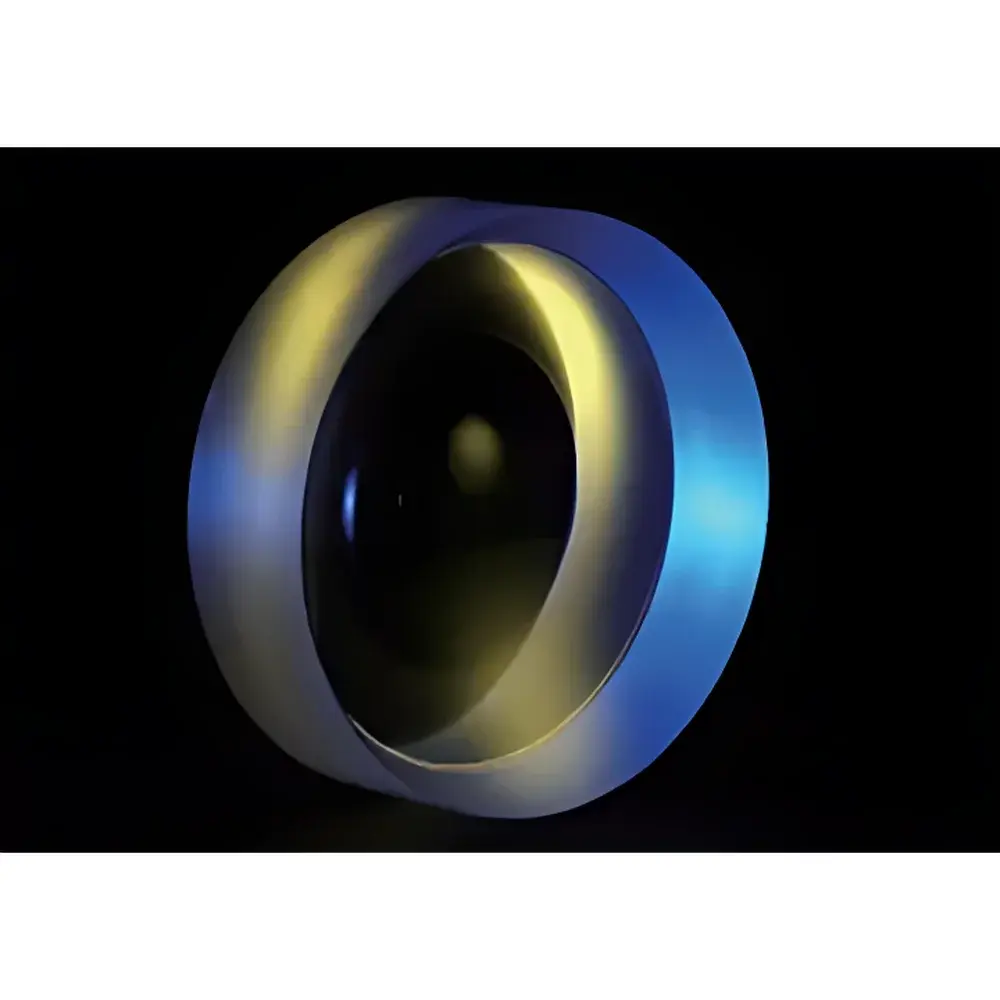
Meg1011 Dual-Concave Lens (Uncoated & AR-Coated Options)
| Brand | MiXran |
|---|---|
| Origin | Beijing, China |
| Model | Meg1011 |
| Component Category | Optical Element |
| Coating Options | Uncoated, VIS (400–700 nm), NIR (650–1050 nm), SWIR (1000–1650 nm) |
| Diameter Range | 2–50 mm |
| Focal Length (EFL) | –2.22 to –52.15 mm |
| Radius of Curvature (R₁ = –R₂) | –2.31 to –50.99 mm |
| Center Thickness (Tc) | 1.5–3 mm |
| Edge Thickness (Te) | 2.22–15.77 mm |
| Compatible Mounting Rings | GL14-series & PN350xx-LMxxx-S series |
Overview
The Meg1011 Dual-Concave Lens is a precision optical component engineered for beam expansion, divergence control, and negative focal length applications in laser systems, interferometry, collimation setups, and optical cavity design. As a symmetric biconcave lens (R₁ = –R₂), it introduces uniform negative optical power across its aperture with minimal spherical aberration when used at appropriate conjugate ratios. Manufactured from high-homogeneity optical-grade BK7 glass (Schott N-BK7 or equivalent), the Meg1011 adheres to ISO 10110-1 surface quality standards (scratch-dig 60-40 typical) and features tight tolerances on radius of curvature (±0.2%), center thickness (±0.05 mm), and focal length (±1%). Its symmetric geometry ensures balanced wavefront distortion and simplifies alignment in multi-element systems where back-reflection management and telecentricity constraints are critical.
Key Features
- Symmetric dual-concave geometry (R₁ = –R₂) enabling predictable, sign-consistent negative power and reduced coma in off-axis use
- Multiple coating options: uncoated for UV-VIS-NIR flexibility; broadband anti-reflection (BBAR) coatings optimized for VIS (400–700 nm), NIR (650–1050 nm), and SWIR (1000–1650 nm) spectral bands — each achieving <0.25% average reflectance per surface
- Standard diameter range from 2 mm to 50 mm, with EFL spanning –2.22 mm to –52.15 mm — supporting compact micro-optics integration and macro-scale beam manipulation
- Precision ground and polished surfaces meeting λ/4 @ 633 nm transmitted wavefront error (TWE) specification for critical interferometric applications
- Compatible with industry-standard lens mounts including GL14-series retaining rings (e.g., GL14-025-025) and PN350xx-LMxxx-S kinematic cell adapters, enabling repeatable, stress-free mounting in OEM and research-grade optical benches
- Traceable dimensional certification available upon request, aligned with ISO 10110-5 tolerancing for centration (≤3 arcmin) and wedge (≤1 arcmin)
Sample Compatibility & Compliance
The Meg1011 lens is suitable for integration into Class 1 and Class 3R laser systems operating within its specified wavelength and power density limits. All coated variants comply with MIL-C-48497A for environmental durability (adhesion, humidity, abrasion). Uncoated BK7 substrates meet RoHS Directive 2011/65/EU and REACH Annex XIV restrictions. While not certified to IEC 60825-1 as a standalone laser product, the Meg1011 conforms to optical safety requirements when embedded in compliant host systems. Documentation supports GLP-aligned procurement workflows, including material certificates of conformance (CoC) and spectral transmittance reports traceable to NIST-traceable spectrophotometers.
Software & Data Management
No embedded firmware or proprietary software is associated with the Meg1011, consistent with passive optical component standards. However, full Zemax OpticStudio (ZOS) and CODE V prescription files are provided upon order confirmation — including surface data, coating stack definitions (layer count, material indices, thicknesses), and thermal expansion coefficients (α = 7.1 × 10⁻⁶ /°C for BK7). These files support rigorous tolerance analysis, stray light modeling, and system-level sensitivity studies under ISO 10110-7 and ISO 21254 compliance frameworks. Digital asset delivery includes STEP AP214 geometry models for mechanical integration verification in SolidWorks, Creo, and NX environments.
Applications
- Laser beam expansion in ultrafast Ti:sapphire and fiber laser chains requiring low-dispersion negative elements
- Negative lens pairs in Galilean telescopes for compact collimation of divergent diode sources
- Optical cavity mode matching in external-cavity diode lasers (ECDLs) and frequency-doubled Nd:YAG systems
- Reference optics in Michelson and Mach–Zehnder interferometers where symmetric wavefront inversion improves common-mode rejection
- Chromatic dispersion compensation in broadband OCT and spectroscopic setups using matched VIS/NIR/SWIR-coated variants
- Education kits for geometric optics labs demonstrating virtual image formation, ray tracing conventions, and Abbe number effects
FAQ
What is the refractive index of the Meg1011 lens substrate at 587.6 nm (d-line)?
The BK7 substrate has a nominal refractive index of nd = 1.5168 ± 0.0002, measured per ISO 7944 and verified via prism coupling on representative production lots.
Can the Meg1011 be used in vacuum or high-humidity environments?
Uncoated and VIS-coated versions are rated for operation in 0–95% RH non-condensing environments. NIR and SWIR coatings incorporate dense ion-assisted deposition (IAD) and pass qualification per MIL-STD-810G Method 507.6 (humidity) and Method 500.6 (low pressure); vacuum compatibility up to 10⁻⁵ Torr is confirmed via outgassing testing (ASTM E595).
Is custom diameter or focal length available?
Yes — MiXran offers rapid-turnaround custom grinding and polishing for diameters beyond 50 mm and EFL values outside the standard range, subject to minimum order quantities and metrology validation per ISO 10110-3.
Do you provide mounting solutions with kinematic alignment capability?
Standard GL14-series threaded rings support basic retention; for sub-arcsecond alignment repeatability, we recommend pairing with PN350xx-LMxxx-S series flexure-mounted cells, which integrate three-point contact kinematics and 120° azimuthal symmetry per ISO 10110-8.
Are spectral transmission curves available for each coating variant?
Yes — full spectral transmittance/reflectance datasets (200–2000 nm, 1 nm resolution) are supplied digitally with every order, referenced to NIST SRM 2036 and calibrated against a certified integrating sphere system.





