
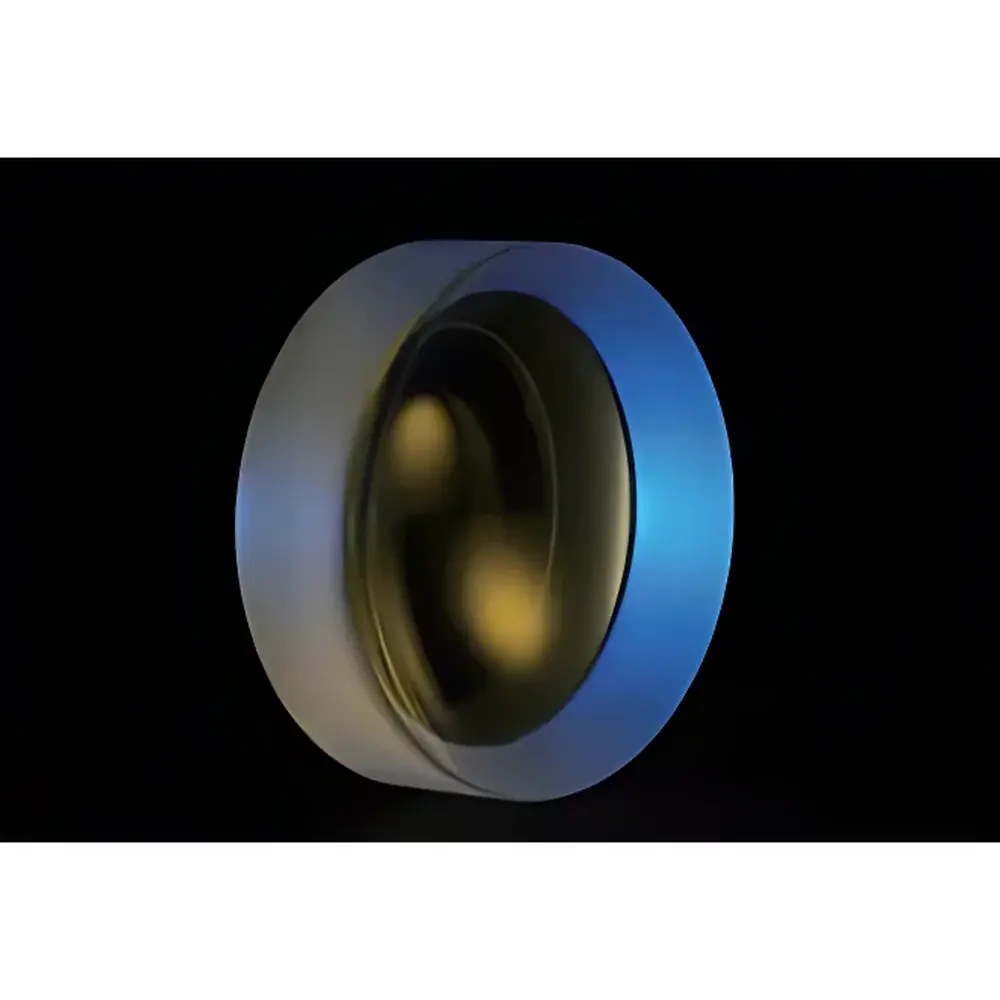
MiXran Meg-PA-1002 Plano-Concave Lens
| Brand | MiXran |
|---|---|
| Origin | Beijing, China |
| Manufacturer Type | Authorized Distributor |
| Product Category | Optical Component |
| Model | Meg-PA-1002 |
| Coating Options | Uncoated, VIS (400–700 nm), NIR (650–1050 nm), SWIR (1000–1650 nm) |
| Diameter Range | 4–50 mm |
| Focal Length (EFL) Range | –4 to –1000 mm |
| Substrate Material | Optical Grade BK7 Glass (n<sub>d</sub> = 1.5168, ν<sub>d</sub> = 64.2) |
| Surface Quality | 40–20 scratch-dig |
| Centration | < 3 arcmin |
| Clear Aperture | ≥ 90% of diameter |
Overview
The MiXran Meg-PA-1002 is a precision-engineered plano-concave lens designed for beam expansion, optical system focal length extension, and divergence control in visible, near-infrared (NIR), and short-wave infrared (SWIR) applications. As a fundamental negative spherical lens element, it features one optically polished plane surface and one spherically concave surface—configured to introduce controlled negative power while minimizing spherical aberration when used with collimated or converging input beams. Its optical design adheres to standard paraxial thin-lens conventions, where the effective focal length (EFL) is negative and defined relative to the direction of incident light propagation. Manufactured from high-homogeneity BK7 optical crown glass, the Meg-PA-1002 ensures consistent refractive index (nd = 1.5168) and low dispersion (Abbe number νd = 64.2), enabling predictable ray tracing and stable performance across laboratory, OEM integration, and educational optical setups.
Key Features
- Precision-ground and polished plano-concave geometry with strict conformance to ISO 10110-1 and ISO 10110-3 surface specifications
- Multiple coating options: uncoated for UV-VIS-NIR flexibility; broadband anti-reflection (BBAR) coatings optimized for 400–700 nm (VIS), 650–1050 nm (NIR), and 1000–1650 nm (SWIR) spectral bands—each achieving < 0.5% average reflectance per surface at normal incidence
- Diameter range from 4 mm to 50 mm; EFL options spanning –4 mm to –1000 mm, supporting both compact micro-optic assemblies and large-format beam manipulation systems
- Surface quality rated at 40–20 scratch-dig per MIL-PRF-13830B; plano surface flatness ≤ λ/4 @ 632.8 nm; concave surface figure accuracy ≤ λ/2 peak-to-valley wavefront error
- Centering tolerance < 3 arcminutes, ensuring minimal beam deviation and compatibility with alignment-critical applications such as interferometry, laser cavity design, and fiber coupling optics
- Clear aperture ≥ 90% of nominal diameter, maximizing usable optical area without vignetting in standard kinematic mounts
Sample Compatibility & Compliance
The Meg-PA-1002 is fully compatible with industry-standard lens mounting solutions—including SM-threaded lens tubes (e.g., Thorlabs SM05, SM1, SM2), kinematic lens holders (e.g., Newport KM100 series), and custom-designed optomechanical housings. Each lens is supplied with individual calibration data including measured radius of curvature (R₁), center thickness (Tc), edge thickness (Te), and back focal length (BFL), traceable to NIST-traceable interferometric verification. All BK7 substrates meet RoHS Directive 2011/65/EU and REACH Regulation (EC) No. 1907/2006 requirements. Coated variants comply with ISO 9211-3 for coating durability (adhesion, abrasion, humidity, and temperature cycling tests). Documentation includes material certificates, coating spectral transmission curves, and surface inspection reports—supporting GLP-compliant optical system validation and audit-ready technical dossiers.
Software & Data Management
While the Meg-PA-1002 is a passive optical component, its geometric and material parameters are fully integrated into leading optical design software platforms—including Zemax OpticStudio (ZOS), Synopsys CODE V, and Lambda Research TracePro—via standardized .zmx, .seq, and .cat files available upon request. All product SKUs (e.g., GL13-025-100-VIS) map directly to parametric databases supporting automated bill-of-materials (BOM) generation, inventory reconciliation, and procurement workflow integration (SAP, Oracle ERP). Spectral performance data (transmission, reflection, phase delay) is delivered in CSV and JSON formats compatible with Python-based analysis pipelines (NumPy, SciPy, Matplotlib) and LabVIEW VI libraries for real-time system characterization.
Applications
- Beam expansion in HeNe, diode, and DPSS laser systems—paired with plano-convex lenses in Galilean or Keplerian configurations
- Focal length tuning in multi-element objectives, relay lenses, and imaging spectrometers
- Divergence compensation in free-space optical interconnects and fiber collimator assemblies
- Negative power correction in aberration-balanced doublet and triplet designs (e.g., achromatic or apochromatic objectives)
- Optical null testing and reference wavefront generation in Michelson and Mach-Zehnder interferometers
- Educational demonstrations of Gaussian beam propagation, ray optics principles, and sign convention in paraxial approximation
FAQ
What is the difference between plano-concave and biconcave lenses in terms of aberration performance?
Plano-concave lenses exhibit lower spherical aberration than biconcave lenses when used with collimated input beams, as the plane surface minimizes refraction-induced wavefront distortion. For divergent sources, orientation matters: the concave surface should face the source to reduce coma and astigmatism.
Can the Meg-PA-1002 be used in high-power laser applications?
Uncoated BK7 versions are rated for continuous-wave (CW) power densities up to 500 W/cm² at 1064 nm (with appropriate beam homogenization); VIS/NIR/SWIR AR-coated variants maintain LIDT > 10 J/cm² (10 ns, 10 Hz, 1064 nm) per ISO 21254-1. Custom high-LIDT coatings are available upon request.
How is centration verified during manufacturing?
Each lens undergoes automated centration measurement using a Trioptics OptiCentric® 100 system, reporting residual decenter and tilt vectors referenced to mechanical and optical axes—data included in the certificate of conformance.
Are custom diameters, focal lengths, or coatings available?
Yes. MiXran supports OEM customization including non-standard diameters (2–100 mm), extended EFL ranges (±1 mm tolerance), ion-beam-sputtered (IBS) coatings, and substrate alternatives (e.g., fused silica, CaF₂, SF10) under NDA-protected development agreements.
Do you provide mounting recommendations for thermal stability?
For temperature-sensitive applications (±0.1°C stability), we recommend low-CTE titanium or invar lens cells with radial compression mounts—not adhesive bonding—to avoid stress-induced birefringence and focal drift. Mounting torque specifications are provided per diameter and thickness group.




