
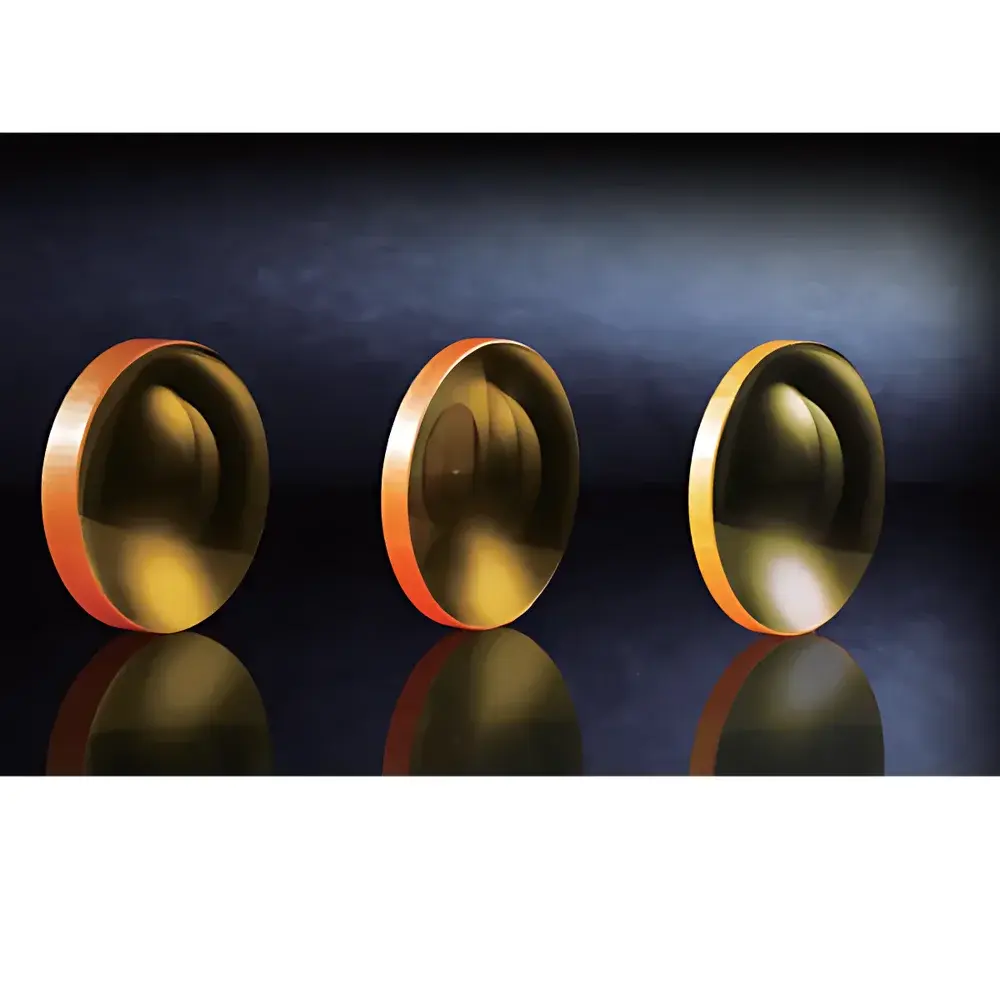
MiXran Meg1032 ZnSe Double-Concave Lens
| Brand | MiXran |
|---|---|
| Origin | Beijing, China |
| Manufacturer Type | Authorized Distributor |
| Product Category | Optical Component |
| Model | Meg1032 |
| Component Type | Zinc Selenide (ZnSe) Optical Lens |
| Coating Options | Uncoated or IR2 Broadband Anti-Reflection Coating (Ravg < 1.5% @ 8–12 µm) |
| Diameter | 25.4 mm |
| Focal Lengths Available | −25.4 mm, −50 mm, −75 mm, −100 mm, −200 mm |
| Surface Geometry | Symmetric Biconcave (R₁ = R₂) |
| Material | CVD-grown Zinc Selenide (ZnSe), Grade A |
| Transmission Range | 0.5–20 µm (peak transmission > 70% in 8–12 µm MWIR band) |
| Refractive Index | ~2.4 at 10.6 µm |
| Damage Threshold | > 500 MW/cm² (10 ns, 10.6 µm, pulsed CO₂ laser) |
Overview
The MiXran Meg1032 is a precision-engineered zinc selenide (ZnSe) double-concave lens designed for demanding mid-wave infrared (MWIR) optical systems operating in the 8–12 µm atmospheric window. Fabricated from chemical vapor deposition (CVD)-grown ZnSe crystal with Grade A surface quality and bulk homogeneity, this lens delivers high transmission (>70% per surface uncoated; >97% with IR2 coating), low absorption, and excellent thermal stability—critical for CO₂ laser beam expansion, thermal imaging relay optics, FTIR spectrometer collimation, and quantum cascade laser (QCL) beam shaping applications. Its symmetric biconcave geometry (R₁ = R₂) ensures balanced wavefront divergence and minimal spherical aberration under collimated illumination, while the material’s low dispersion and isotropic crystalline structure support consistent performance across polarized and unpolarized MWIR radiation.
Key Features
- Optical substrate: High-purity CVD ZnSe with ≤0.1% bulk absorption at 10.6 µm and ≤10 µm/cm² inclusion density
- Surface quality: λ/4 @ 633 nm surface flatness (per ISO 10110-3), scratch-dig 20–10 compliant
- Coating options: Standard uncoated version or optional broadband IR2 anti-reflection coating (Ravg < 1.5% over 8–12 µm, measured at 45° AOI)
- Dimensional tolerance: ±0.05 mm on diameter and center thickness; ±1% on focal length (EFL)
- Mechanical robustness: Hardness of 120 Knoop; compatible with standard kinematic and threaded lens mounts (e.g., SM1-threaded housings)
- Environmental stability: Non-hygroscopic; resistant to thermal shock up to ΔT = 150°C (tested per MIL-PRF-13830B)
Sample Compatibility & Compliance
The Meg1032 lens is fully compatible with industry-standard optical mounting hardware—including SM1-threaded lens tubes (e.g., Thorlabs SM1L05, Newport LMR1), kinematic mirror mounts adapted for transmissive elements, and custom-designed MWIR lens cells with Invar or stainless-steel barrels. All ZnSe substrates comply with ASTM F2645–22 (Standard Specification for Zinc Selenide Optical Materials) and meet RoHS Directive 2011/65/EU requirements. Batch-certified material data sheets include refractive index dispersion curves (Sellmeier coefficients), absorption spectra (FTIR verified), and interferometric surface maps. Each lens undergoes 100% inspection using phase-shifting interferometry (PSI) and spectral transmission verification via FTIR spectrophotometry (PerkinElmer Frontier).
Software & Data Management
While the Meg1032 is a passive optical component, its integration into system-level design workflows is supported by comprehensive optical modeling data. Zemax OpticStudio and CODE V-compatible .ZMX and .SEQ files—including full dispersion models (based on published Sellmeier coefficients for CVD ZnSe), surface irregularity PSD profiles, and coating stack definitions—are available upon request. All certified test reports are archived in PDF/A-1b format with embedded metadata (ISO 19005-1), traceable to NIST-traceable radiometric calibration standards. For GxP-regulated environments, documentation packages include audit trails for manufacturing lot traceability, coating process logs (vacuum chamber pressure, deposition rate, thickness monitor output), and QC sign-off records aligned with ISO 9001:2015 Clause 8.5.2.
Applications
- CO₂ laser beam expansion and collimation in materials processing systems (e.g., cutting, welding, surface annealing)
- Objective and relay optics in uncooled microbolometer-based thermal imaging cameras (VOx and a-Si focal plane arrays)
- Sample compartment optics in Fourier-transform infrared (FTIR) spectrometers operating in the fingerprint region
- Beam conditioning for quantum cascade lasers (QCLs) and interband cascade lasers (ICLs) used in gas sensing and spectroscopy
- Reference optics in MWIR interferometric metrology setups requiring stable, low-birefringence transmissive elements
- Test platforms for evaluating AR coating durability under high-power pulsed irradiation (per ISO 21254–2)
FAQ
What is the damage threshold for the Meg1032 lens under continuous-wave (CW) CO₂ laser irradiation?
The uncoated ZnSe substrate has a CW laser-induced damage threshold (LIDT) of ≥15 kW/cm² at 10.6 µm (measured per ISO 21254–1, 1-minute exposure). With IR2 coating, LIDT remains >12 kW/cm² due to optimized thermal management in the thin-film stack.
Is the IR2 coating suitable for use with QCLs emitting at 9.2 µm or 10.55 µm?
Yes—the IR2 coating is specified for Ravg < 1.5% across 8–12 µm with no local maxima exceeding 2.5%, validated via spectrophotometric measurement at 0.1 µm resolution.
Can the Meg1032 be mounted in vacuum environments without outgassing concerns?
Yes—CVD ZnSe exhibits negligible volatile organic compound (VOC) emission; total mass loss (TML) < 0.05% and collected volatile condensable materials (CVCM) < 0.005% per ASTM E595, making it suitable for high-vacuum optical benches and space-qualified instrumentation.
Do you provide mounting solutions specifically designed for MWIR thermal stability?
Yes—compatible lens mounts (e.g., PN35019-LM254-S series) feature low-CTE aluminum alloy housings with integrated thermal relief grooves and axial preload compensation, minimizing focus shift over −40°C to +85°C operational range.
Are ZnSe lenses susceptible to degradation when exposed to ambient humidity?
No—unlike NaCl or KBr, ZnSe is non-hygroscopic and chemically inert under standard laboratory conditions; no desiccant housing or nitrogen purging is required for long-term storage or operation.






