
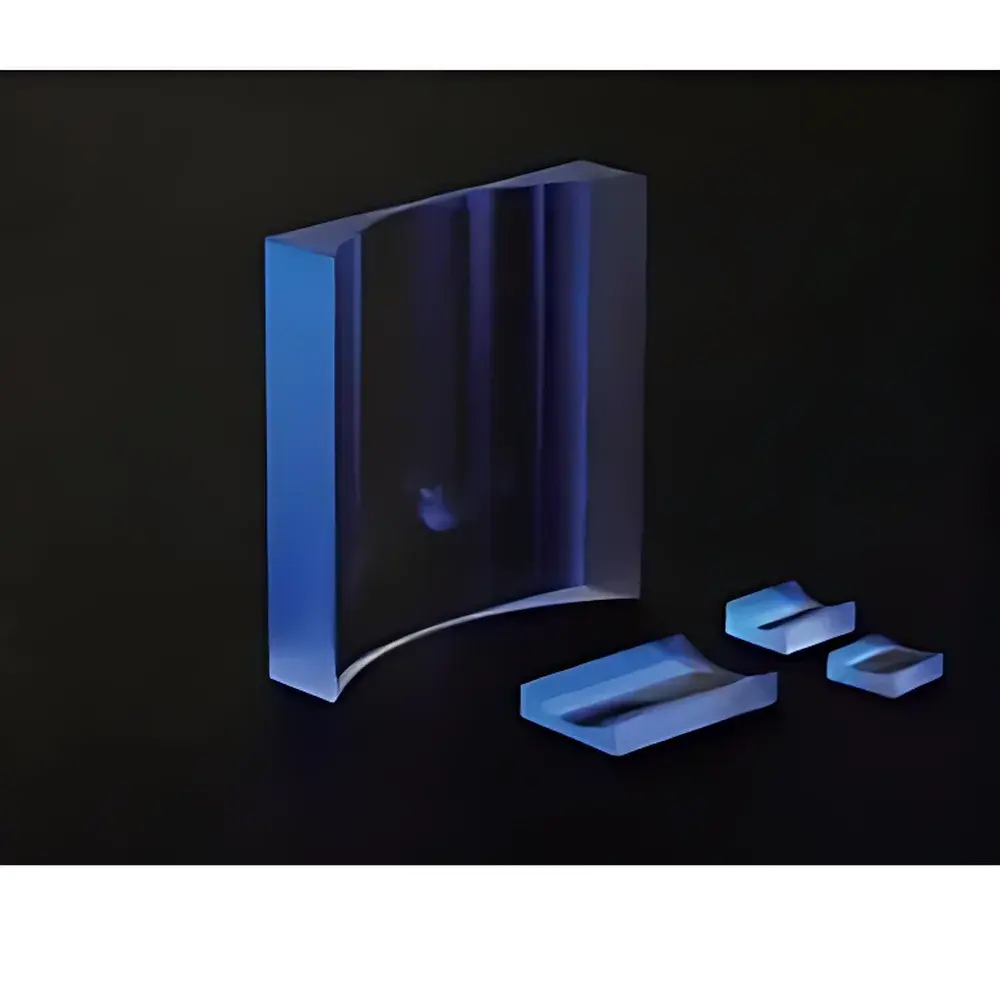
Meg1016 UV-Fused Silica Plano-Concave Cylindrical Lens
| Brand | MiXran |
|---|---|
| Origin | Beijing, China |
| Model | Meg1016 |
| Component Category | Optical Element |
| Substrate Material | UV-Fused Silica |
| Coating Options | Uncoated or UV Broadband AR (250–400 nm) |
| Dimensions (W × H) | 10.0 × 10.0 mm, 20.0 × 10.0 mm, or 30.0 × 20.0 mm |
| Focal Lengths (EFL) | –12.7 mm to –300 mm |
| Surface Quality | 40–20 scratch-dig |
| Clear Aperture | ≥90% of nominal dimension |
| Radius of Curvature (R₁) | –5.82 mm to –137.55 mm |
| Center Thickness (Tc) | 22.09–27.87 mm |
| Edge Thickness (Te) | 1.0–4.84 mm |
| Compliance | ISO 10110-1, ISO 10110-7, MIL-PRF-13830B |
Overview
The Meg1016 UV-Fused Silica Plano-Concave Cylindrical Lens is a precision optical component engineered for beam shaping and astigmatic correction in ultraviolet (UV) spectral applications. Unlike spherical lenses, cylindrical lenses focus light into a line rather than a point—making them indispensable in laser line generation, anamorphic beam expansion, optical scanning systems, and spectroscopic slit illumination. Constructed from high-purity synthetic fused silica (SiO₂), the Meg1016 exhibits exceptional transmission (>90%) across the deep UV to near-IR range (185–2100 nm), with minimized hydroxyl (OH⁻) content and negligible fluorescence under 254 nm excitation. Its plano-concave geometry introduces negative cylindrical power along one axis while maintaining collimation in the orthogonal direction—enabling controlled divergence or line focusing without axial symmetry constraints.
Key Features
- UV-optimized fused silica substrate with low thermal expansion coefficient (α ≈ 0.55 × 10⁻⁶ /°C) and high laser-induced damage threshold (LIDT > 5 J/cm² at 266 nm, 10 ns, 20 Hz)
- Two coating variants: uncoated for maximum UV reflectivity control or broadband anti-reflection (AR) coating optimized for 250–400 nm—reducing surface reflectance to <0.5% per surface
- Precision diamond-turned or polished cylindrical surface conforming to ISO 10110-5 tolerances (surface irregularity ≤ λ/4 @ 633 nm)
- Strict dimensional control: ±0.05 mm on width/height, ±0.2 mm on focal length (EFL), ±0.02 mm on center thickness (Tc)
- Available in three standard clear aperture formats: 10.0 × 10.0 mm, 20.0 × 10.0 mm, and 30.0 × 20.0 mm—with corresponding curvature radii ranging from –5.82 mm to –137.55 mm
- Back focal length (BFL) specified per configuration to support accurate optical layout in multi-element systems
Sample Compatibility & Compliance
The Meg1016 lens meets international standards for optical manufacturing and metrology, including ISO 10110-1 (general requirements), ISO 10110-7 (surface imperfections), and MIL-PRF-13830B (scratch-dig specification). All lenses undergo interferometric verification using Zygo Verifire™ or equivalent phase-shifting interferometers to confirm cylindrical wavefront error (WFE) ≤ λ/2 PV over the clear aperture. The UV-grade fused silica complies with ASTM F795 for optical quartz materials and satisfies material traceability requirements per ISO 9001:2015. No RoHS-restricted substances are used in substrate fabrication or coating processes. While not certified for medical device use, the lens is suitable for research-grade UV photolithography alignment, fluorescence microscopy excitation path conditioning, and UV Raman spectroscopy coupling optics where high transmission and low birefringence (<5 nm/cm) are critical.
Software & Data Management
Each Meg1016 lens is supplied with a digital Certificate of Conformance (CoC) containing measured surface figure data (Zernike coefficients), transmitted wavefront map (in .zmf or .txt format), and spectral transmittance curve (200–1100 nm, 1 nm resolution). CoC files are timestamped, digitally signed, and archived for traceability—supporting GLP/GMP-aligned documentation workflows. For integration into optical design software, Zemax OpticStudio™, CODE V®, and FRED-compatible raytrace-ready files (including surface sag tables and coating dispersion models) are available upon request. All data adhere to NIST-traceable calibration protocols; measurement uncertainty for EFL is ±0.15% (k = 2), and for radius of curvature, ±0.3% (k = 2).
Applications
- Laser diode collimation in UV curing systems (e.g., 355 nm DPSS lasers), where asymmetric fast-axis divergence requires cylindrical correction
- Line-generation optics in confocal Raman microspectroscopy—enabling uniform excitation across sample slits without spherical aberration
- Beam homogenization in UV lithography mask aligners, particularly for proximity printing with mercury lamp sources (i-line, g-line, h-line)
- Optical cavity mode control in tunable UV dye lasers and OPO systems requiring astigmatic compensation
- Calibration reference elements in UV radiometry setups compliant with CIE S 025/E:2015
- Custom hybrid assemblies with aspheric or diffractive elements in EUV pre-optics test benches (as non-imaging relay components)
FAQ
What is the difference between plano-concave cylindrical and spherical lenses in UV applications?
Plano-concave cylindrical lenses provide power in only one meridian—ideal for correcting astigmatism or generating line foci—whereas spherical lenses introduce symmetric focusing. In UV systems, this asymmetry minimizes unnecessary chromatic and spherical aberrations when manipulating narrow-band laser lines.
Can the Meg1016 be used below 200 nm?
While UV-fused silica transmits down to ~185 nm, performance below 200 nm requires vacuum or nitrogen-purged environments due to atmospheric oxygen absorption. Uncoated versions are preferred for VUV applications to avoid organic binder degradation in AR layers.
Is the UV AR coating durable under repeated cleaning?
Yes—the coating uses ion-assisted e-beam deposition with SiO₂/Ta₂O₅ multilayer architecture, rated for >100 cleanings with Class 100 cleanroom-grade acetone/isopropanol wipes and lint-free polyester swabs per MIL-C-48497A.
How is focal length tolerance verified?
EFL is measured via collimated beam displacement method using a HeCd laser (325 nm) and calibrated translation stage with sub-micron resolution; results are cross-validated against interferometric radius-of-curvature measurements.
Do you provide custom mounting solutions or kinematic adapters?
Standard lenses ship unmounted, but we offer CNC-machined aluminum kinematic mounts (e.g., SM1-threaded, Ø25.4 mm compatible) with adjustable tip/tilt and XYZ translation—designed for stability under thermal cycling from –20°C to +60°C.





