
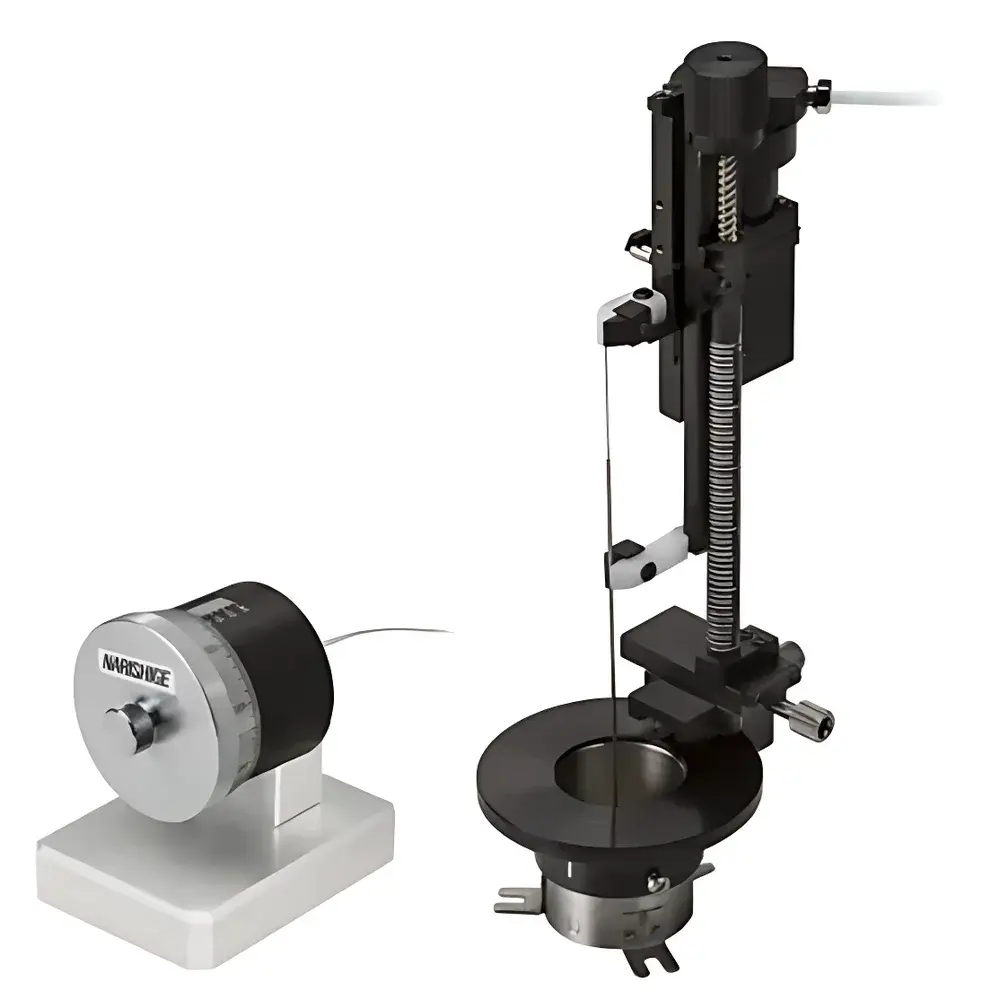
MO-97A Oil-Driven Micromanipulator by NARISHIGE
| Brand | NARISHIGE |
|---|---|
| Origin | Japan |
| Model | MO-97A |
| Movement Range (Z-axis) | 30 mm |
| Movement Range (X-axis) | 13 mm |
| Movement Range (Y-axis) | 18 mm |
| Coarse Z-Travel | 50 mm |
| Fine Adjustment per Full Knob Rotation | 500 µm |
| Minimum Scale Division | 2 µm |
| Control Unit Dimensions | 65 × 88 × 93 mm |
| Weight | 630 g |
| Guide Tube | Stainless Steel, Ø0.7 × 60 mm |
| Hydraulic Tubing Length | 1.5 m |
Overview
The MO-97A Oil-Driven Micromanipulator is a precision mechanical positioning system engineered by NARISHIGE (Japan) for high-stability, low-drift microscale manipulation in life science and electrophysiology applications. Unlike motorized or piezoelectric alternatives, the MO-97A employs incompressible hydraulic transmission—using silicone oil within sealed capillary pathways—to convert fine rotational input into smooth, backlash-free linear displacement. This hydrostatic coupling eliminates mechanical hysteresis and provides inherent damping, making it especially suitable for intracellular electrode insertion, patch-clamp pipette positioning, and long-duration live-cell imaging experiments where thermal drift and vibration sensitivity must be minimized. Its compact open-frame cavity architecture allows direct integration with incubator lids, microscope stages, or custom environmental chambers without structural modification.
Key Features
- Three-axis manual control (X, Y, Z) with independent coarse and fine adjustment mechanisms: coarse Z-travel up to 50 mm; fine Z-resolution of 2 µm per scale division, with 500 µm linear displacement per full 360° knob rotation.
- Low-center-of-gravity aluminum alloy housing (65 × 88 × 93 mm, 630 g) ensures mechanical stability on vibration-sensitive optical tables and inverted microscope platforms.
- Stainless steel guide tube (Ø0.7 × 60 mm) precisely constrains electrode trajectory and minimizes lateral deflection during penetration—critical for consistent seal formation in whole-cell patch clamping.
- Open internal cavity design accommodates third-party actuators, pressure controllers, or fiber-optic feedthroughs, enabling hybrid setups such as simultaneous optogenetic stimulation and electrophysiological recording.
- Hydraulic actuation system uses inert, non-evaporative silicone oil and 1.5 m reinforced polyurethane tubing, ensuring leak-resistant, maintenance-free operation over extended experimental sessions.
- Modular accessory interface includes threaded mounting points for incubator lid integration, stainless steel fasteners, washers, and alignment spacers—designed for repeatable reinstallation across multi-day experiments.
Sample Compatibility & Compliance
The MO-97A is routinely deployed in GLP-compliant electrophysiology labs conducting neuronal excitability assays, cardiac myocyte action potential recordings, and oocyte voltage-clamp studies. Its all-metal construction (anodized aluminum frame, stainless steel guide components) meets ISO 13485 material biocompatibility prerequisites for use in regulated preclinical research environments. While the device itself does not require electrical certification, its mechanical design conforms to IEC 61000-6-2 (immunity) and IEC 61000-6-3 (emission) when integrated into larger instrument systems. The absence of electromagnetic components ensures zero interference with sensitive low-noise amplifiers (<1 nV/√Hz input-referred noise) and Faraday cage–based recording configurations.
Software & Data Management
As a purely mechanical, analog positioning system, the MO-97A operates independently of software control or digital interfaces. It requires no drivers, firmware updates, or computer connectivity—reducing failure modes and validation overhead in regulated workflows. All positional settings are manually recorded via engraved vernier scales and documented in lab notebooks or electronic lab management systems (ELN) such as LabArchives or Benchling. For labs adhering to 21 CFR Part 11 requirements, traceability is maintained through operator-signed calibration logs and standardized SOPs governing micromanipulator setup, zero-point verification, and post-experiment retraction protocols.
Applications
- Intracellular sharp-electrode impalement of neurons, plant protoplasts, and Xenopus oocytes
- Manual patch-clamp pipette positioning under DIC or IR-DIC optics
- Microinjection of CRISPR-Cas9 ribonucleoprotein complexes into zygotes
- Targeted placement of carbon-fiber microelectrodes for fast-scan cyclic voltammetry (FSCV)
- Alignment of optical fibers or microlenses in custom optophysiology rigs
- Integration with temperature-controlled perfusion chambers for dual-modality (electrical + chemical) stimulation paradigms
FAQ
Is the MO-97A compatible with upright or inverted microscopes?
Yes—the compact footprint and low profile allow unobstructed objective access on both upright and inverted platforms, including Nikon Eclipse FN1, Zeiss Axioskop, and Olympus BX series.
Can the hydraulic system be refilled or serviced by the user?
No—oil filling is performed under cleanroom conditions at NARISHIGE’s factory. Attempted disassembly or oil replacement voids calibration integrity and is not supported.
What is the maximum recommended electrode diameter for the included guide tube?
The Ø0.7 mm stainless steel guide tube supports borosilicate glass capillaries with outer diameters ≤0.65 mm; quartz or coated electrodes exceeding this OD require custom guide tube adaptation.
Does the MO-97A meet ISO/IEC 17025 requirements for calibration traceability?
While the unit ships with a NARISHIGE factory verification report (including scale linearity and repeatability data), formal ISO/IEC 17025 accreditation requires third-party calibration against certified length standards—available through authorized metrology partners upon request.



