
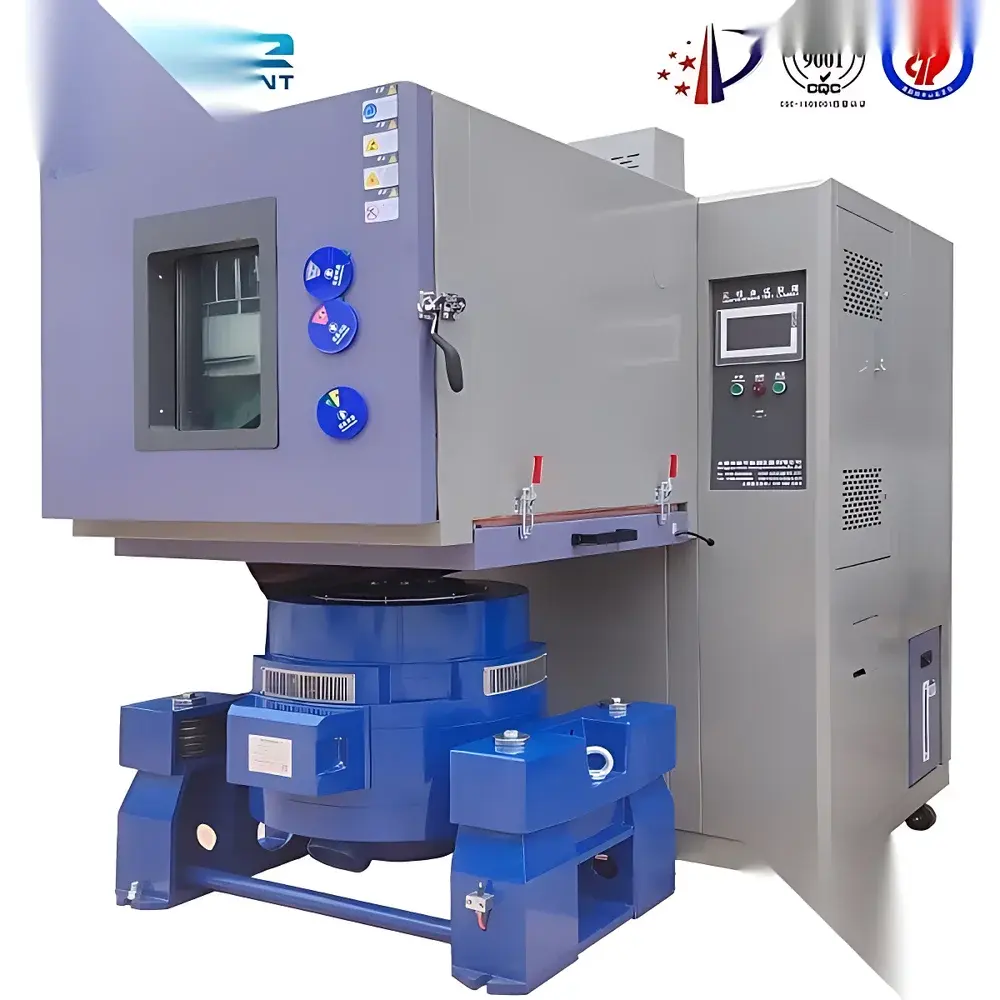
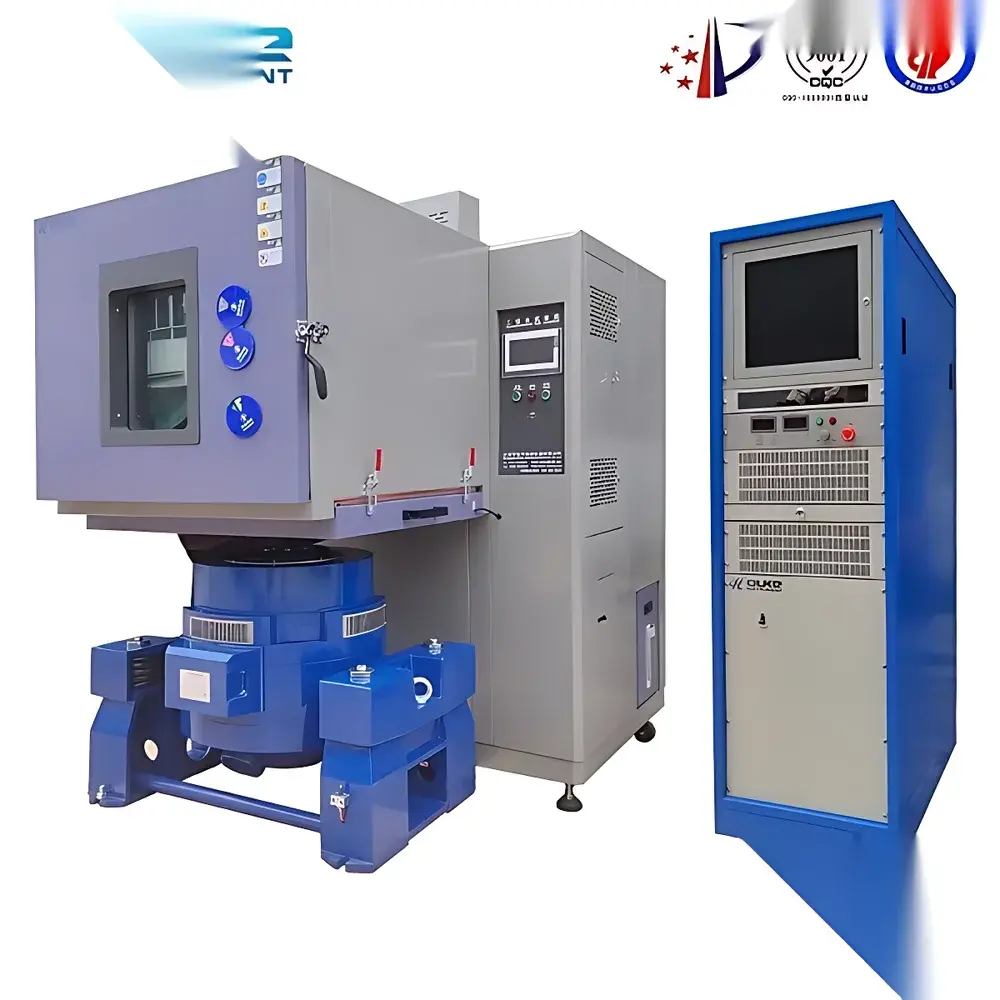
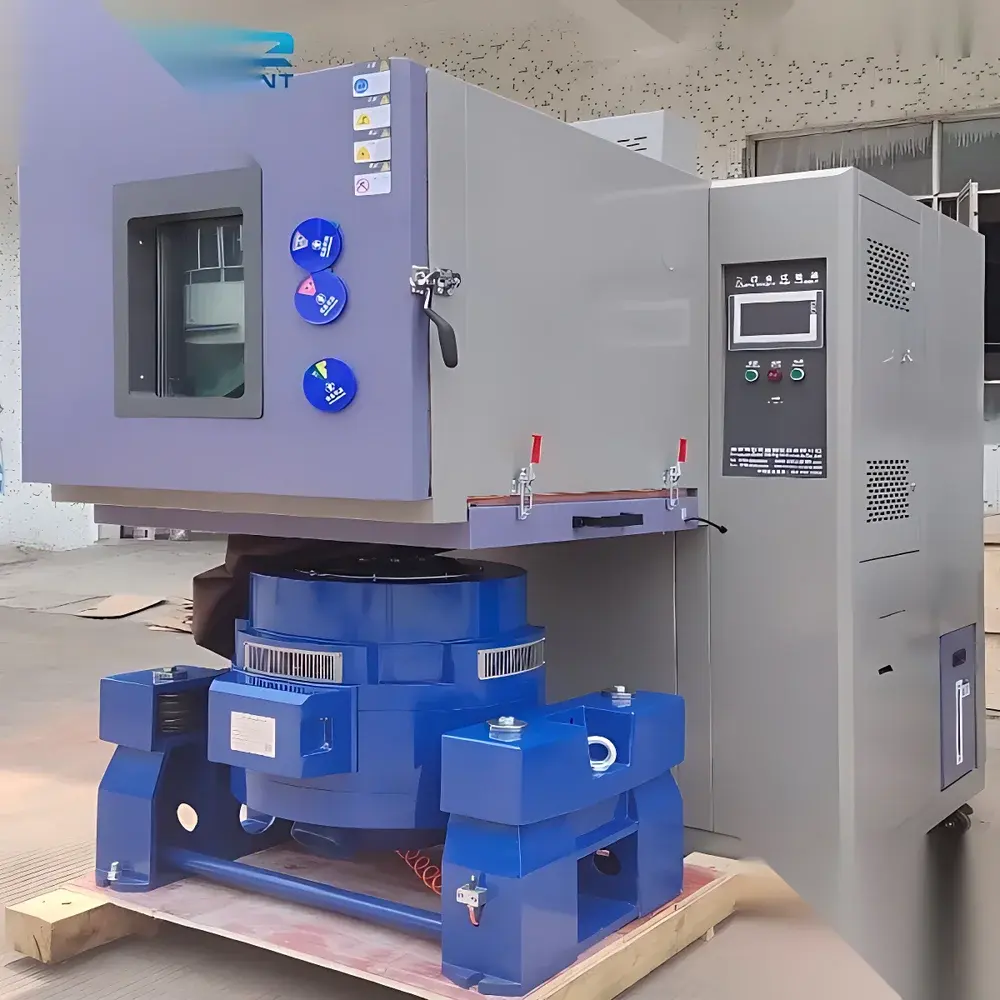
OK-ZTH Series Combined Environmental Test Chamber with Integrated Vibration System
| Brand | OK Instruments |
|---|---|
| Origin | Imported |
| Manufacturer Type | Authorized Distributor |
| Price | USD 21,500 (FOB) |
| Compliance | GB/T 5170.2–1996, GB/T 2423.1–1989, GB/T 2423.2–1989, GB/T 2423.3–1993, GJB 150.3–1986, GJB 150.4–1986 |
| Internal Dimensions (L×W×H mm) | OK-ZTH-225: 600×800×800 |
| OK-ZTH-408 | 800×1000×1000 |
| OK-ZTH-1000 | 1000×1000×1000 |
Overview
The OK-ZTH Series Combined Environmental Test Chamber is an integrated tri-stress testing system engineered for simultaneous or sequential application of temperature, humidity, and mechanical vibration—enabling accelerated reliability assessment of electronic components, automotive modules, aerospace subsystems, and industrial control hardware. Unlike conventional single-stress chambers, this platform implements a physically decoupled yet synchronized architecture: the vibration exciter is mounted on a precision linear rail beneath the environmental chamber cavity, allowing full mechanical isolation during thermal/humidity-only tests and rapid re-engagement for combined stress profiles. The core measurement principle relies on controlled climatic conditioning (via PID-regulated heating/cooling and humidification/dehumidification subsystems) coupled with electrodynamic shaker excitation (capable of sine, random, and shock waveforms per IEC 60068-2-6 and MIL-STD-810H). Its structural integrity supports long-duration HALT/HASS protocols while maintaining traceable environmental uniformity (±0.5 °C temperature stability, ±2 % RH accuracy over 20–98 % RH range) across the working volume.
Key Features
- Modular vibration integration: Removable electrodynamic shaker mounted on low-friction stainless steel rails—enables independent operation of environmental and mechanical test functions without cross-contamination or thermal coupling.
- Hermetic interface design: Multi-layer sealing between shaker table and chamber base employs alternating layers of high-temperature silicone rubber and epoxy resin, rated for continuous operation up to 150 °C and maintaining IP54-rated dust/moisture resistance.
- Dual-independent control architecture: Separate microprocessor-based controllers govern climate (temperature/humidity) and vibration parameters, ensuring no software or firmware interference—critical for audit-ready validation under ISO/IEC 17025 and FDA 21 CFR Part 11 environments.
- Optimized air circulation: Forward-curved centrifugal blower (Xiangming low-noise motor) with multi-wing impeller ensures uniform airflow distribution; top-down supply and bottom-return configuration minimizes thermal stratification (<0.8 °C gradient across test volume).
- Observation & access: Triple-layer tempered safety glass viewport with embedded conductive ITO film prevents condensation and enables real-time optical monitoring; 50 mm diameter cable port on left side allows feedthrough of power, signal, or thermocouple lines without compromising chamber integrity.
- Robust construction: Exterior housing fabricated from A3 carbon steel with epoxy-polyester powder coating; interior chamber lined with mirror-finish SUS304 stainless steel; insulation composed of 100 mm thick ultra-fine glass wool (thermal conductivity ≤0.036 W/m·K).
Sample Compatibility & Compliance
The OK-ZTH chamber accommodates DUTs ranging from PCB assemblies and sensor modules to complete ECUs and avionics enclosures, with maximum payload capacities of 30 kg (OK-ZTH-225), 50 kg (OK-ZTH-408), and 80 kg (OK-ZTH-1000). All models conform to national and military standards for environmental test equipment verification, including GB/T 5170.2 (temperature performance calibration), GB/T 2423.1 and 2423.2 (cold/heat testing procedures), GB/T 2423.3 (damp heat cycling), and GJB 150.3/150.4 (military-grade high/low temperature qualification). While not certified to UL or CE as a complete system, its subsystems meet EN 61000-6-3 (EMC emission) and EN 61000-6-2 (immunity) requirements when installed per manufacturer-specified grounding and shielding protocols.
Software & Data Management
The chamber operates via a dedicated Windows-based HMI with dual-channel data logging (100 Hz sampling rate for both environmental and vibration channels). Raw datasets are stored in CSV and binary formats compliant with ASTM E2918 for post-test statistical analysis. Audit trail functionality records all parameter changes, operator logins, and system alarms with time stamps—fully supporting GLP/GMP documentation requirements. Optional Ethernet/IP and Modbus TCP interfaces enable integration into enterprise MES or LabVantage platforms; data export supports direct import into MATLAB, JMP, and Weibull++ for failure mode analysis and life prediction modeling.
Applications
This system is routinely deployed in R&D labs and QA departments for: thermal cycling validation of solder joints per IPC-9701; humidity-induced corrosion testing of connector housings; vibration-induced fatigue assessment of MEMS accelerometers under thermal soak conditions; pre-compliance screening of automotive ADAS modules against ISO 16750-4; and qualification of battery management systems under combined thermal-vibrational stress per UN 38.3 Section 38.3.3. Its modular design also supports custom fixture development for non-standard DUT geometries—including tilt-table configurations for gravity-sensitive optomechanical systems.
FAQ
Can the vibration system operate independently of temperature/humidity control?
Yes—the shaker module is fully mechanically and electrically isolated and can be operated standalone using external signal generators or the built-in waveform synthesizer.
What is the maximum allowable vibration frequency range?
Standard configuration supports 5–2000 Hz for sine sweep and 10–2000 Hz for random vibration, compliant with IEC 60068-2-6 Ed. 6.2.
Is remote monitoring supported via industry-standard protocols?
Yes—OPC UA and MQTT clients are available as optional firmware upgrades for IIoT integration.
Does the system include calibration certificates traceable to NIM or NIST?
Factory calibration reports (temperature, humidity, and acceleration transducer) are provided with each unit; third-party NIST-traceable certification is available upon request.
What maintenance intervals are recommended for long-term reliability?
Blower motor bearings require lubrication every 12 months; shaker armature alignment verification is advised after 500 operational hours or annually—whichever occurs first.



