
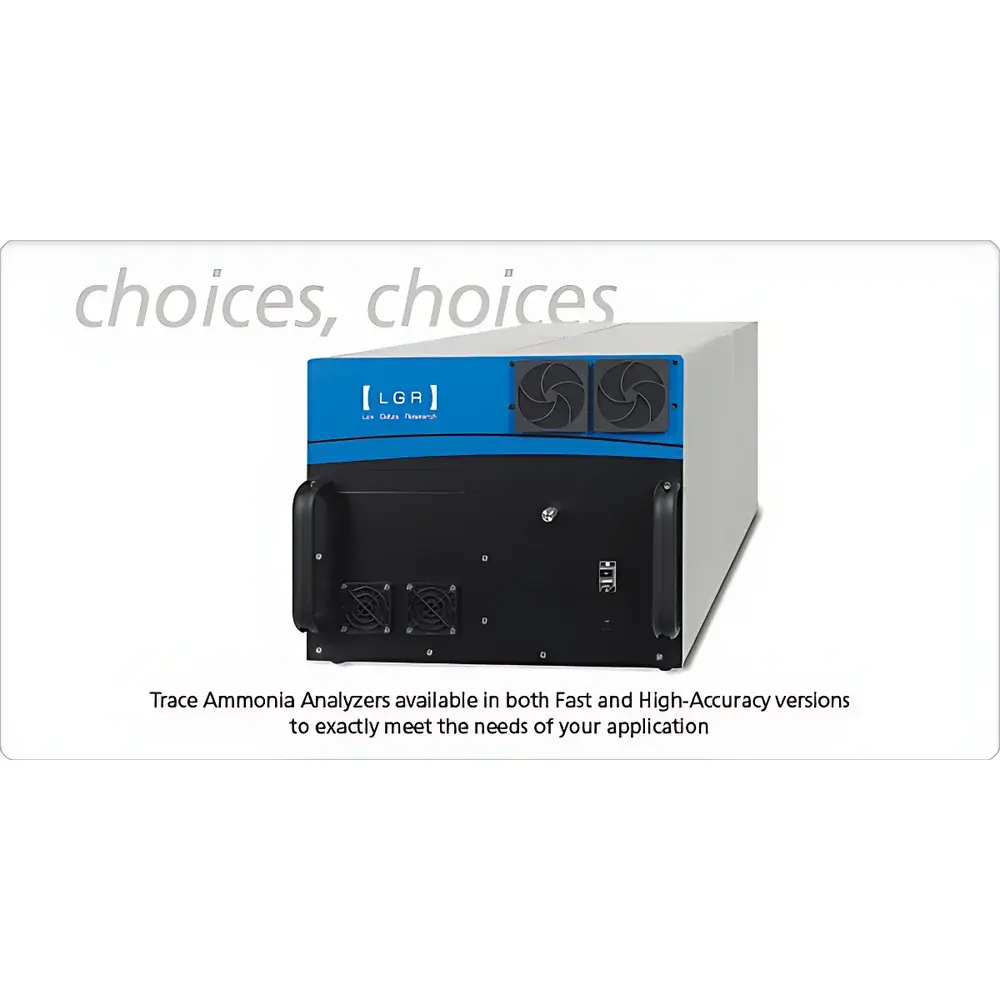
ABB LGR HCl and HF Ambient Air Quality Monitor with OA-ICOS Technology
| Brand | ABB |
|---|---|
| Origin | USA |
| Manufacturer Type | Authorized Distributor |
| Origin Category | Imported |
| Model | LGR |
| Price Range | USD 14,000 – 42,500 |
| Measurement Principle | Off-Axis Integrated Cavity Output Spectroscopy (OA-ICOS) |
| Target Analytes | Hydrogen Chloride (HCl), Hydrogen Fluoride (HF), Water Vapor (H₂O) |
| Detection Limits (1σ) | HF < 0.1 ppb (1 s), HCl < 0.4 ppb (1 s) |
| Response Time | < 2 s (with external N920 vacuum pump) |
| Measurement Range | HF: 0.3–20,000 ppb |
| HCl | 0.3–2,000 ppb |
| H₂O | 10–20,000 ppm (non-condensing) |
| Operating Range | HF: 0–10 ppm |
| HCl | 0–10 ppm |
| Stability | Ultra-low drift via proprietary temperature-controlled optical architecture |
| Data System | Embedded Linux computer with local storage, Ethernet/IP remote access, real-time spectral visualization |
| Compliance | Designed for EPA Method TO-15 / ASTM D6348-18 alignment |
Overview
The ABB LGR HCl and HF Ambient Air Quality Monitor is a high-performance, field-deployable trace gas analyzer engineered for continuous, simultaneous quantification of hydrogen chloride (HCl), hydrogen fluoride (HF), and water vapor (H₂O) in ambient air and industrial stack emissions. Built upon LGR’s proprietary Off-Axis Integrated Cavity Output Spectroscopy (OA-ICOS) platform, this instrument delivers laboratory-grade precision in an operational field package. Unlike conventional Cavity Ring-Down Spectroscopy (CRDS) systems—which require active laser-cavity mode matching, stringent thermal stabilization, and frequent wavelength calibration—the OA-ICOS architecture eliminates the need for dynamic cavity alignment or real-time feedback loops. This results in inherently robust optical performance, minimal sensitivity to mechanical vibration or thermal transients, and long-term measurement stability without routine recalibration. The system operates at near-atmospheric pressure and is optimized for direct sampling without pre-concentration or chemical conversion, ensuring fidelity across dynamic concentration gradients typical of fugitive emission monitoring, fence-line compliance, and process off-gas characterization.
Key Features
- Simultaneous, real-time detection of HCl, HF, and H₂O with independent, overlapping spectral fitting—enabling cross-interference correction and enhanced selectivity.
- Sub-second response time (<2 s system residence time with N920 vacuum pump), supporting rapid plume tracking and transient event capture.
- Ultra-low detection limits: <0.1 ppb HF and <0.4 ppb HCl at 1-second integration, scalable to <0.05 ppb HF and <0.1 ppb HCl at 100-second averaging—meeting stringent regulatory thresholds for toxic air pollutant (TAP) reporting.
- Patented thermostatic optical enclosure maintaining cavity temperature stability within ±0.02 °C, reducing baseline drift to <1% over 30 days under uncontrolled environmental conditions.
- Integrated Linux-based embedded computer with dual SD card storage, automated daily backup, and timestamped raw spectral archives (including full high-resolution absorption spectra).
- Remote operation via secure Ethernet/IP interface: full instrument control, live spectral display, diagnostic logging, and firmware updates accessible through standard web browsers or API-driven scripts.
- Low power consumption (<65 W nominal), enabling extended battery- or solar-powered deployment in remote or mobile monitoring applications.
Sample Compatibility & Compliance
The analyzer accepts untreated, humidified ambient air or conditioned stack gas (filtered to ≤0.3 µm) without catalytic scrubbers or permeation dryers—preserving native HCl/HF speciation integrity. It complies with key regulatory frameworks governing hazardous air pollutant (HAP) monitoring, including EPA Method TO-15 (for grab sampling correlation), ASTM D6348-18 (for gaseous emissions testing), and EU BREF reference methodologies for chlorinated/fluorinated compound tracking. Optional configurations support 21 CFR Part 11-compliant electronic records, including user-authenticated access control, immutable audit trails, and electronic signatures—suitable for GLP and GMP-regulated environmental QA/QC programs. All calibration protocols follow ISO/IEC 17025 principles, with traceability to NIST-traceable HCl and HF permeation standards.
Software & Data Management
LGR’s proprietary AcqView™ software suite runs natively on the onboard Linux OS and provides three-tier data handling: (1) real-time spectral visualization with interactive line-fit overlays and residual analysis; (2) automated concentration calculation using multi-spectral least-squares fitting with H₂O-dependent broadening correction; and (3) structured export to CSV, NetCDF, or MODBUS TCP for SCADA integration. Data files include metadata headers compliant with CF-1.8 conventions and are timestamped to UTC with microsecond resolution. Remote users can configure alarm thresholds, initiate zero/span sequences, and download historical spectra via HTTPS or SFTP—without requiring onsite physical access. Firmware updates preserve all user-defined settings and retain full backward compatibility with legacy data formats.
Applications
- Ambient air quality monitoring networks targeting TAPs near industrial zones, waste incinerators, and chemical manufacturing facilities.
- Fence-line and perimeter monitoring for compliance with NAAQS subparts and local air toxics ordinances.
- Continuous emission monitoring (CEM) of HCl/HF from municipal solid waste (MSW) and hazardous waste incinerators—supporting semi-continuous validation against reference methods.
- Process optimization and leak detection in fluoropolymer production, semiconductor etching, and metal refining operations.
- Research applications in atmospheric chemistry, including heterogeneous reaction kinetics and halogen radical budget studies.
- Mobile monitoring platforms (e.g., van-mounted or drone-deployable configurations) leveraging low power draw and vibration-tolerant OA-ICOS optics.
FAQ
Does the analyzer require periodic calibration with certified gas standards?
Yes—while long-term stability minimizes drift, quarterly span calibration using NIST-traceable HCl and HF permeation tubes is recommended per EPA PS-18 and ASTM D6348-18 guidance.
Can the instrument operate in high-humidity environments without condensation artifacts?
Yes—the H₂O measurement channel actively corrects for pressure-broadening and continuum absorption effects up to 20,000 ppm H₂O, provided no liquid condensation occurs in the sample cell.
Is the system compatible with existing plant DCS or environmental data acquisition systems?
Yes—it supports Modbus TCP, OPC UA, and ASCII-over-TCP protocols for seamless integration into industrial control architectures.
What maintenance intervals are required for the optical cavity and vacuum pump?
The OA-ICOS cavity is sealed and requires no user-serviceable optics; the external N920 pump typically operates >12 months between oil changes under continuous duty.
Can raw spectral data be exported for third-party spectral analysis?
Yes—full-resolution absorbance spectra (wavenumber vs. intensity) are stored in HDF5 format and accessible via SFTP or local USB transfer.







