
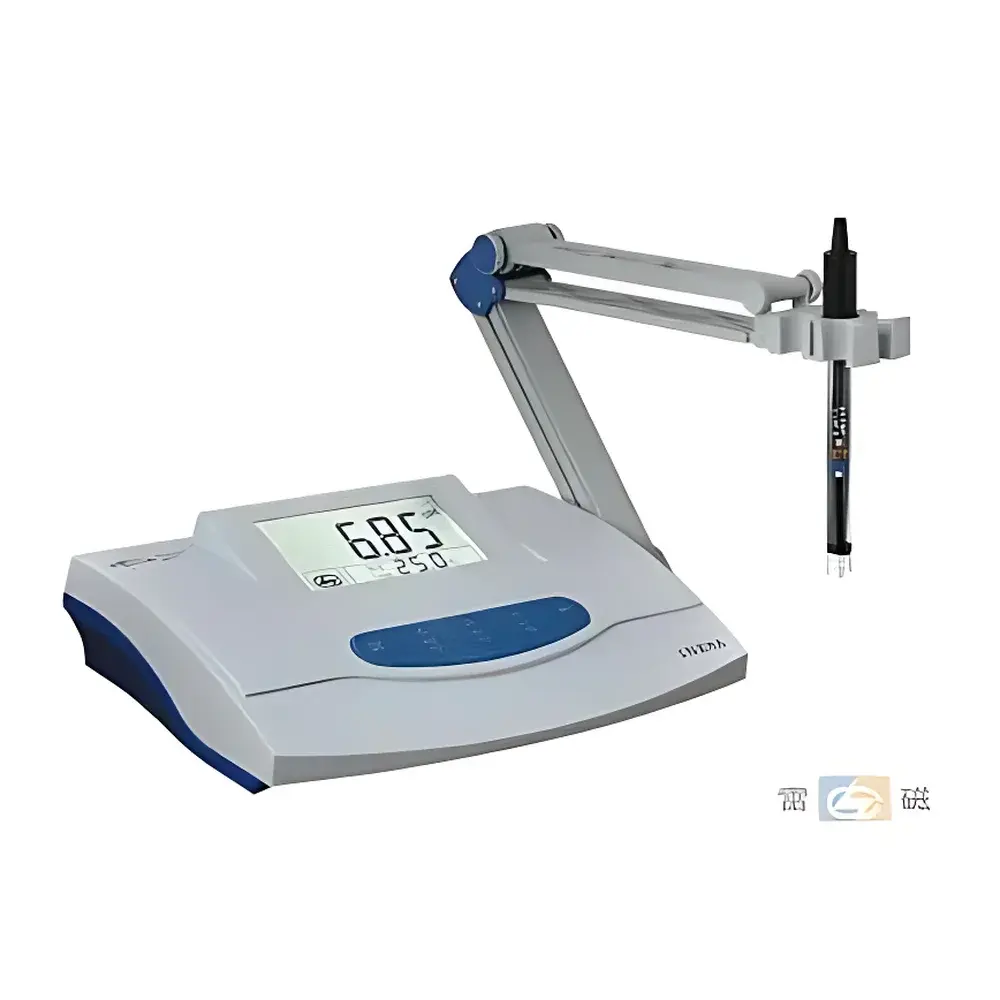
Leici PHS-3C Benchtop pH Meter
| Brand | Leici |
|---|---|
| Origin | Shanghai, China |
| Instrument Type | Benchtop |
| Parameter Type | Dual (pH/mV) |
| Measurement Range | pH (0.00–14.00), mV (−1999 to +1999) |
| Resolution | 0.01 pH / 1 mV |
| Accuracy | ±0.01 pH ±1 digit |
| Temperature Compensation | Manual (0.0–60.0 °C) |
| Display | Segment LCD |
| Calibration | Auto-buffer recognition, 2-point calibration |
| Power Supply | AC 220 V ±10%, 50 Hz |
| Dimensions & Weight | 300 × 220 × 90 mm, 1 kg |
| Compliance | Meets JJG 919–2008 (Chinese National Verification Regulation for pH Meters) |
Overview
The Leici PHS-3C is a benchtop dual-parameter electrochemical analyzer engineered for routine pH and millivolt (mV) measurements in quality control laboratories, educational institutions, and industrial process support environments. It operates on the fundamental principle of potentiometric measurement: a glass pH electrode generates a voltage proportional to hydrogen ion activity in aqueous solution, referenced against a stable Ag/AgCl reference electrode. The instrument converts this potential difference into a calibrated pH reading using the Nernst equation (−59.16 mV/pH unit at 25 °C), with built-in temperature compensation to correct for thermal drift in electrode response. Designed to meet JJG 919–2008 — the People’s Republic of China National Verification Regulation for pH Meters — the PHS-3C delivers traceable performance at 0.01-level accuracy, making it suitable for applications requiring compliance with national metrological standards in domestic regulatory or academic settings.
Key Features
- Benchtop form factor with compact footprint (300 × 220 × 90 mm) and lightweight construction (1 kg), optimized for space-constrained lab benches or mobile testing stations.
- Segment-type LCD display with high-contrast numeric rendering for clear visibility under varied ambient lighting conditions; no backlight required, enhancing long-term reliability.
- Auto-buffer recognition during calibration: automatically identifies standard pH 4.01, 6.86, and 9.18 buffer solutions (Chinese national standard formulation), reducing operator error and improving calibration repeatability.
- Two-point calibration protocol with slope and offset calculation, supporting both single-solution and multi-solution calibration workflows.
- Manual temperature compensation (0.0–60.0 °C), allowing users to input measured sample temperature for precise Nernstian correction without integrated thermistor probes.
- Dual-parameter capability: simultaneous readout and storage of pH and mV values, enabling redox potential (Eh) assessment, electrode diagnostics, and direct millivolt monitoring for non-pH applications.
- Stability specification of ≤ ±0.01 pH ±1 digit over 3 hours ensures consistent readings during extended batch analysis or teaching demonstrations.
Sample Compatibility & Compliance
The PHS-3C is intended for use with aqueous or low-ionic-strength liquid samples compatible with standard glass pH electrodes (e.g., general-purpose combination electrodes with KCl-filled reference systems). It is not rated for non-aqueous solvents, highly viscous media, or aggressive HF-containing solutions. While the instrument itself does not carry CE, UKCA, or FDA 510(k) certification, its design aligns with foundational electrochemical safety and metrological principles outlined in ISO 7027 (for photometric comparators) and IEC 61010-1 (safety requirements for electrical equipment). Its verification pathway follows JJG 919–2008, which defines permissible error limits, calibration procedures, and environmental operating conditions (temperature: 5–40 °C; relative humidity ≤85%). For GLP/GMP-aligned labs, manual calibration logs and handwritten records satisfy basic audit requirements; however, the absence of electronic audit trails or data export interfaces limits full 21 CFR Part 11 compliance.
Software & Data Management
The PHS-3C operates as a standalone hardware instrument with no embedded microprocessor-based data logging, USB connectivity, or PC interface. All measurements are displayed in real time and must be manually recorded. No proprietary software, drivers, or firmware updates are provided. This architecture prioritizes operational simplicity, electromagnetic immunity, and long-term serviceability — particularly valuable in teaching labs where student handling and environmental exposure (e.g., chemical splashes, power fluctuations) demand robustness over digital integration. For institutions requiring traceable electronic records, external documentation via laboratory notebooks or LIMS-integrated manual entry remains the recommended practice.
Applications
- Academic instruction: Demonstrating acid-base equilibria, titration endpoints, and electrode theory in undergraduate chemistry and environmental science curricula.
- Water quality testing: Monitoring pH in municipal drinking water pre- and post-treatment, wastewater effluent, and aquaculture systems per GB/T 5750.4–2006 (Standard Methods for Examination of Drinking Water).
- Food and beverage QC: Verifying pH stability in dairy products, fruit juices, and fermented foods where pH correlates with microbial safety and shelf life.
- Pharmaceutical excipient testing: Conducting preliminary pH checks on buffer solutions and diluents prior to HPLC or dissolution testing.
- Soil extract analysis: Measuring pH of saturated paste extracts (per NYSDAM 2002 or ASTM D4972) when paired with appropriate solid-contact electrodes.
FAQ
Does the PHS-3C support automatic temperature compensation (ATC)?
No — it provides manual temperature input only. Users must measure sample temperature separately (e.g., with a calibrated thermometer) and enter the value via front-panel keys.
Can the PHS-3C be used with international pH buffer standards (e.g., NIST-traceable)?
Yes, though auto-recognition is tuned for Chinese standard buffers (pH 4.01, 6.86, 9.18 at 25 °C); manual calibration mode allows use of any certified buffer.
Is electrode calibration data stored internally?
No — the instrument does not retain calibration coefficients or history. Each calibration session is independent and unlogged.
What type of pH electrode is compatible?
Standard BNC-input combination electrodes with integrated reference systems (e.g., Leici E-201-C or equivalent); compatibility assumes 0–1000 mV input range and DC-coupled signal output.
Does the unit include a power adapter for international voltages?
No — it ships with a fixed 220 V AC, 50 Hz input; external step-down transformers are required for 110 V/60 Hz regions.





