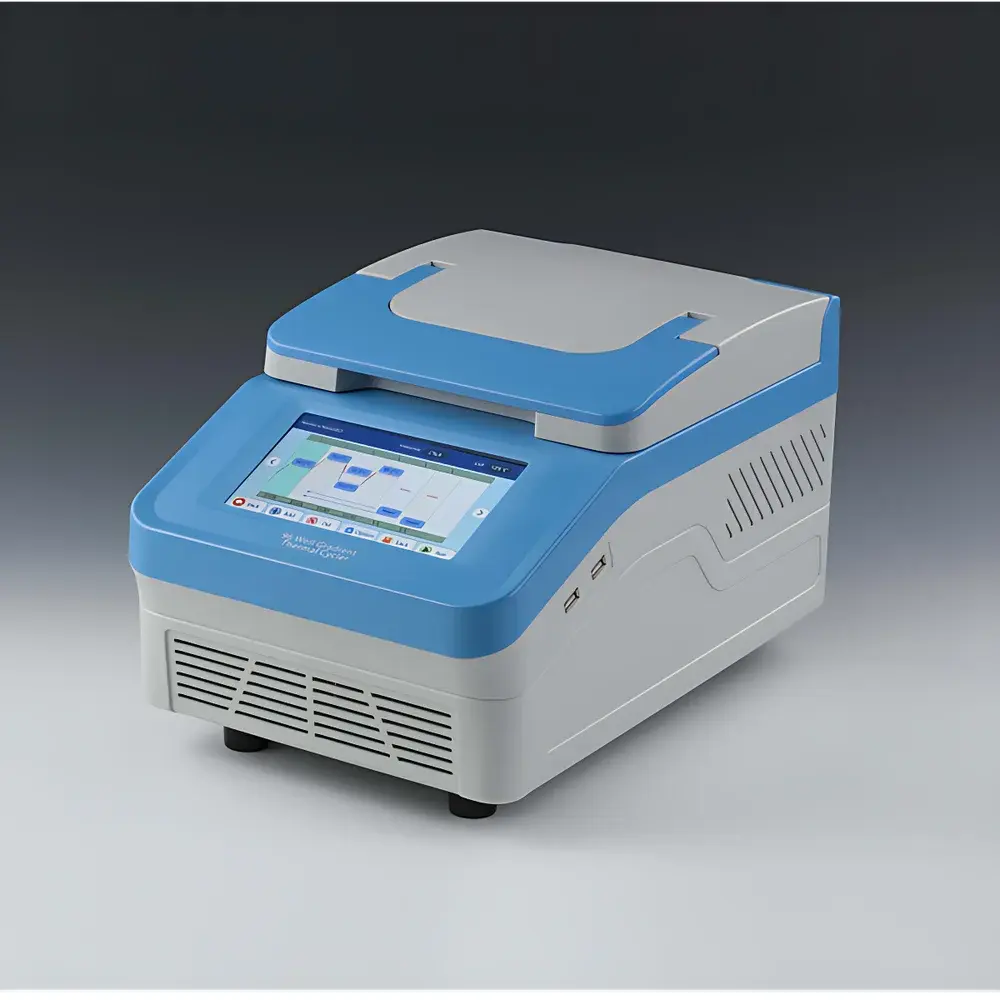
Deerse GM9600 Gradient Thermal Cycler
| Brand | Deerse |
|---|---|
| Model | GM9600 |
| Instrument Type | Gradient PCR Thermal Cycler |
| Sample Capacity | 96-well (0.2 mL tubes & 8-tube strips) |
| Max Heating Rate | 5 °C/s |
| Max Cooling Rate | 4 °C/s |
| Temperature Accuracy | ±0.1 °C |
| Well-to-Well Uniformity | ±0.2 °C |
| Block Temperature Range | 0–105 °C |
| Heat Lid Temperature Range | 30–115 °C |
| Gradient Range | 30–105 °C |
| Gradient Span | 0.1–30 °C |
| Display | 7-inch resistive touchscreen (800 × 480) |
| Power Input | AC 100–240 V, 50–60 Hz |
| Max Power Consumption | 800 W |
| Dimensions (W × D × H) | 420 × 260 × 245 mm |
| Weight | 11 kg |
Overview
The Deerse GM9600 Gradient Thermal Cycler is a precision-engineered, semiconductor-based PCR instrument designed for high-fidelity nucleic acid amplification under tightly controlled thermal conditions. It operates on the fundamental principle of thermal cycling—repeated denaturation, annealing, and extension phases—using Peltier elements to achieve rapid, programmable temperature transitions across a 96-well aluminum block. Unlike conventional single-zone cyclers, the GM9600 features three independently controlled thermal zones, enabling simultaneous optimization of annealing temperatures across a defined gradient range (0.1–30 °C span), which is essential for primer validation, assay development, and multiplex PCR protocol refinement. Its embedded real-time thermal monitoring system ensures traceable, reproducible performance compliant with laboratory quality management frameworks including ISO/IEC 17025 and GLP-aligned operational practices.
Key Features
- Triple-zone Peltier thermal control architecture for precise, independent regulation of heating and cooling profiles across the block surface.
- Anodized aluminum reaction block offering enhanced thermal conductivity, corrosion resistance, and long-term mechanical stability under repeated thermal stress.
- Dynamic heat lid with auto-adjusting spring-loaded pressure mechanism—ensures consistent contact with tube caps across variable tube heights and prevents evaporation during extended cycles.
- 7-inch resistive touchscreen interface (800 × 480 resolution) with intuitive navigation, haptic feedback, and multi-language support—including English, Spanish, and French—optimized for glove-compatible operation in biosafety cabinets.
- Embedded Linux-based operating system delivering deterministic response times (10,000 protocols), and seamless firmware updates via dual USB 2.0 ports.
- Programmable ramp rate control (0.1–4 °C/s), time/temperature increment/decrement functions (±999 s / ±10 °C), and infinite 16 °C hold for post-PCR enzyme storage or ligation incubation.
- Comprehensive diagnostics suite: real-time fault detection (e.g., lid open, sensor drift, thermal overload), audible/visual alerts, and automatic log generation with timestamped error codes.
- Optional Wi-Fi module (factory-installable) enables remote monitoring, secure protocol push, and integration with LIMS via HTTPS-based RESTful API endpoints.
Sample Compatibility & Compliance
The GM9600 accommodates standard 0.2 mL PCR tubes, 8-tube strips, and 96-well plates—compatible with both low-profile and full-height consumables from major global suppliers (e.g., Thermo Fisher, Eppendorf, Bio-Rad). All thermal specifications—including ±0.1 °C accuracy and ≤±0.2 °C well-to-well uniformity—are validated per ASTM E2725-20 (“Standard Practice for Performance Verification of Thermal Cyclers”) using NIST-traceable calibrated thermocouples placed at nine defined positions across the block. The instrument meets IEC 61010-1:2010 safety requirements for laboratory equipment and carries CE marking under the EU Machinery Directive. Data integrity features—including audit trail-enabled protocol editing, user-access-level permissions, and tamper-evident run logs—support compliance with FDA 21 CFR Part 11 when operated in conjunction with validated software configurations.
Software & Data Management
Data export and archival are supported via USB mass storage mode: raw cycle logs (CSV), instrument event history, and user session records are saved with ISO 8601 timestamps and SHA-256 checksums. The onboard file system enforces write-once-read-many (WORM) behavior for critical logs to prevent post-run modification. Firmware updates require digital signature verification prior to installation. For enterprise deployment, optional PC-based Deerse Thermal Control Suite (v3.2+) provides advanced features including Tm prediction (nearest-neighbor method), gradient optimization wizards, cross-instrument protocol migration, and automated report generation compliant with ISO/IEC 17025 clause 7.8.2 (result reporting).
Applications
- Optimization of primer annealing temperatures in qPCR and endpoint PCR assay development.
- High-throughput genotyping workflows requiring parallel testing of multiple allele-specific conditions.
- Library preparation for next-generation sequencing (NGS), including adapter ligation and index amplification steps.
- Clinical molecular diagnostics where regulatory-grade thermal consistency is required for FDA-cleared or CE-IVD assays.
- Academic research involving mutagenesis, cloning, and CRISPR gRNA validation where reproducibility across instruments and laboratories is critical.
FAQ
What thermal validation documentation is provided with the GM9600?
A factory-issued Certificate of Conformance (CoC) is included, listing measured temperature accuracy, uniformity, and ramp rates per ASTM E2725-20. Optional IQ/OQ documentation packages are available upon request.
Can the GM9600 be integrated into automated liquid handling platforms?
Yes—via its RS-232 serial port (optional) or Ethernet/Wi-Fi interface, it supports standard SCPI commands and can be triggered by external TTL signals through the auxiliary I/O port.
Is the heat lid pressure adjustable manually?
No—the self-adjusting spring mechanism automatically compensates for tube height variations; manual calibration is neither required nor supported.
Does the instrument support ramp rate profiling within individual steps?
Yes—each step allows independent ramp rate assignment (0.1–4 °C/s), enabling non-linear thermal profiles such as “slow denaturation → fast annealing” sequences.
How is data security maintained during USB transfers?
All exported files are digitally signed and encrypted using AES-128; the USB interface disables write access to internal system partitions to prevent malware injection or configuration tampering.
Related Products