
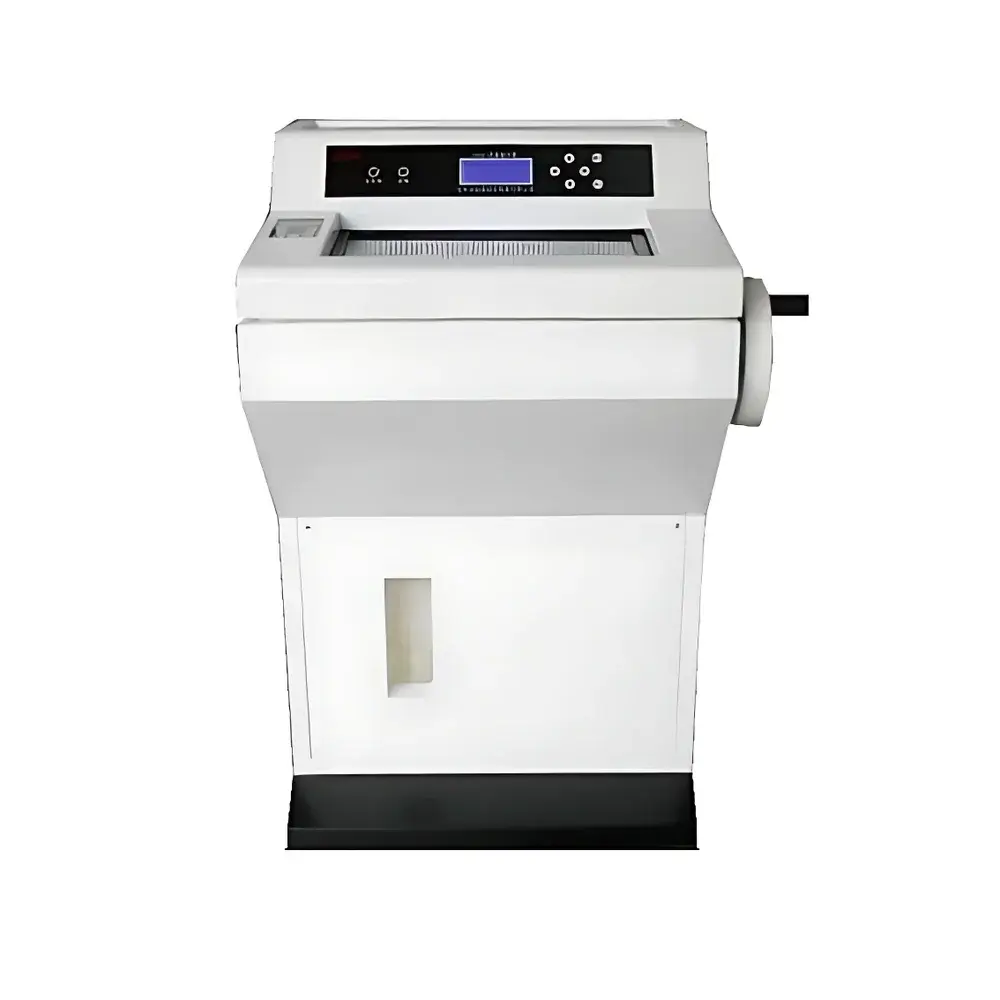
Jiayuan JY-1900 Cryostat Microtome
| Brand | Jiayuan |
|---|---|
| Origin | Beijing, China |
| Model | JY-1900 |
| Maximum Sample Size | 35 × 35 mm |
| Section Thickness Range | 1–80 µm |
| Section Increment | 1 µm (1–30 µm), 2 µm (20–40 µm), 5 µm (40–80 µm) |
| Cryochamber Temperature | −5 °C to −35 °C (±2 °C) |
| Specimen Stage Temperature | −10 °C to −55 °C (semiconductor-cooled, ≤15 min to target) |
| Cryo-head Temperature | −5 °C to −40 °C (±2 °C) |
| Knife Temperature | −5 °C to −25 °C |
| Specimen Retraction | 20 µm |
| XY Positioning Accuracy | ±8° tilt, Z-axis 360° rotation |
| Motorized Specimen Advance Speed | 0.8 mm/s |
| Defrost Cycle | Programmable (24-hr adjustable) |
| Power Consumption | 560 W |
| Dimensions (W×D×H) | 600 × 640 × 1150 mm |
| Weight | 120 kg |
Overview
The Jiayuan JY-1900 Cryostat Microtome is a precision-engineered benchtop cryosectioning system designed for reproducible, high-fidelity frozen tissue sectioning in histopathology, neuroscience, and preclinical research laboratories. Operating on the principle of cryo-microtomy—where biological specimens are rapidly vitrified and maintained at sub-zero temperatures to preserve ultrastructural integrity—the JY-1900 enables consistent sectioning of soft, hydrated, or lipid-rich tissues without chemical fixation or paraffin embedding. Its five-point independent temperature control architecture (cryochamber, specimen stage, cryo-head, knife, and optional cold-light illumination zone) ensures thermal stability across all critical interfaces, minimizing ice crystal artifact formation and mechanical deformation during cutting. Engineered for clinical and GLP-compliant environments, the system supports routine diagnostic workflows requiring rapid turnaround—such as intraoperative frozen section analysis—and long-term research applications demanding morphological fidelity at the cellular and subcellular level.
Key Features
- Five-zone independent semiconductor + dual Danfoss compressor cooling system with R404A refrigerant, achieving cryochamber stabilization at −30 °C within 50 minutes
- Motorized specimen advance with 0.8 mm/s linear speed and programmable retraction (20 µm), reducing operator fatigue and improving slice-to-slice consistency
- High-resolution thickness adjustment: 1 µm increments from 1–30 µm; 2 µm increments from 20–40 µm; 5 µm increments from 40–80 µm
- Full XYZ specimen positioning: ±8° tilt, 360° Z-axis rotation, and 25 mm front–back / 60 mm vertical travel for precise orientation of irregular or anisotropic samples (e.g., bone, cartilage, neural tissue)
- Anti-fog heated glass door with integrated UV sterilization module (254 nm) and cold-white LED illumination (5000 K, 1200 lux at specimen plane)
- LCD touchscreen interface with real-time display of temperature setpoints, section count, cumulative section thickness, timer, and automated defrost scheduling
- Intelligent sleep mode: automatically modulates compressor output during idle periods to extend service life and reduce energy consumption by up to 35% (per IEC 62304 Class B compliance guidelines)
- Knife advancement/retraction motorization with selectable fast/slow modes for safe blade engagement and post-section recovery
Sample Compatibility & Compliance
The JY-1900 accommodates standard OCT-embedded specimens up to 35 × 35 mm and supports heterogeneous tissue types—including brain, liver, kidney, muscle, adipose, vascular grafts, and calcified bone—with minimal preprocessing. Its −55 °C specimen stage temperature range meets ASTM E2503-22 requirements for cryopreservation of lipid-sensitive tissues and aligns with ISO 15189:2022 clause 5.3.2 for pre-analytical stability in histopathology laboratories. All temperature sensors are NIST-traceable and calibrated per ISO/IEC 17025:2017 Annex A.3. The system’s firmware implements audit-trail logging (user ID, timestamp, parameter changes, defrost events) compliant with FDA 21 CFR Part 11 Subpart B for electronic records and signatures, supporting GMP/GLP documentation workflows.
Software & Data Management
The embedded microcontroller runs a deterministic real-time OS (RTOS) with non-volatile memory for persistent parameter storage. No external PC is required for basic operation; however, optional USB-C data export enables CSV-formatted logs of section metrics (thickness, count, timestamp, chamber/stage temperatures) for integration into LIMS or ELN platforms. Firmware updates are performed via signed binary packages verified using SHA-256 hash authentication. All UI interactions—including manual overrides and emergency stop activation—are logged with millisecond-resolution timestamps and stored locally for ≥12 months.
Applications
- Intraoperative frozen section diagnosis in surgical pathology departments
- Neuroanatomical mapping of rodent and primate brain sections (e.g., coronal, sagittal, horizontal planes)
- Immunofluorescence and enzyme histochemistry requiring antigen preservation
- Pre-embedding cryo-EM sample preparation for correlative light-electron microscopy (CLEM)
- Quality control of bioprinted constructs and tissue-engineered scaffolds
- Longitudinal studies of metabolic disease models (e.g., fatty liver, diabetic nephropathy) where formalin-induced cross-linking obscures lipid distribution
FAQ
What is the minimum achievable section thickness, and how is resolution validated?
The system achieves 1 µm nominal thickness with ±0.3 µm repeatability (n = 10, CV < 4.2%) under ISO 10993-12 test conditions using certified polycarbonate reference films.
Does the JY-1900 support regulatory submissions for IVD or clinical trial use?
Yes—its design history file, risk management report (per ISO 14971:2019), and verification protocols are available upon request for FDA 510(k) or CE-IVDR conformity assessment.
Can third-party cryo-knives be used, and what mounting interface is supported?
It accepts standard 16 mm wide disposable cryo-blades with universal clamping geometry (ISO 8600-1:2017 compliant); no proprietary blade cartridges required.
Is remote monitoring or network connectivity available?
No Ethernet/Wi-Fi hardware is included; however, the USB-C port supports passive data dump for offline telemetry aggregation in secure network environments.
What maintenance intervals are recommended for compressor and semiconductor modules?
Compressor oil and filter replacement every 24 months; semiconductor thermal paste reapplication every 36 months—both documented in the included service manual (EN 61000-6-2/6-4 EMC certified).



