
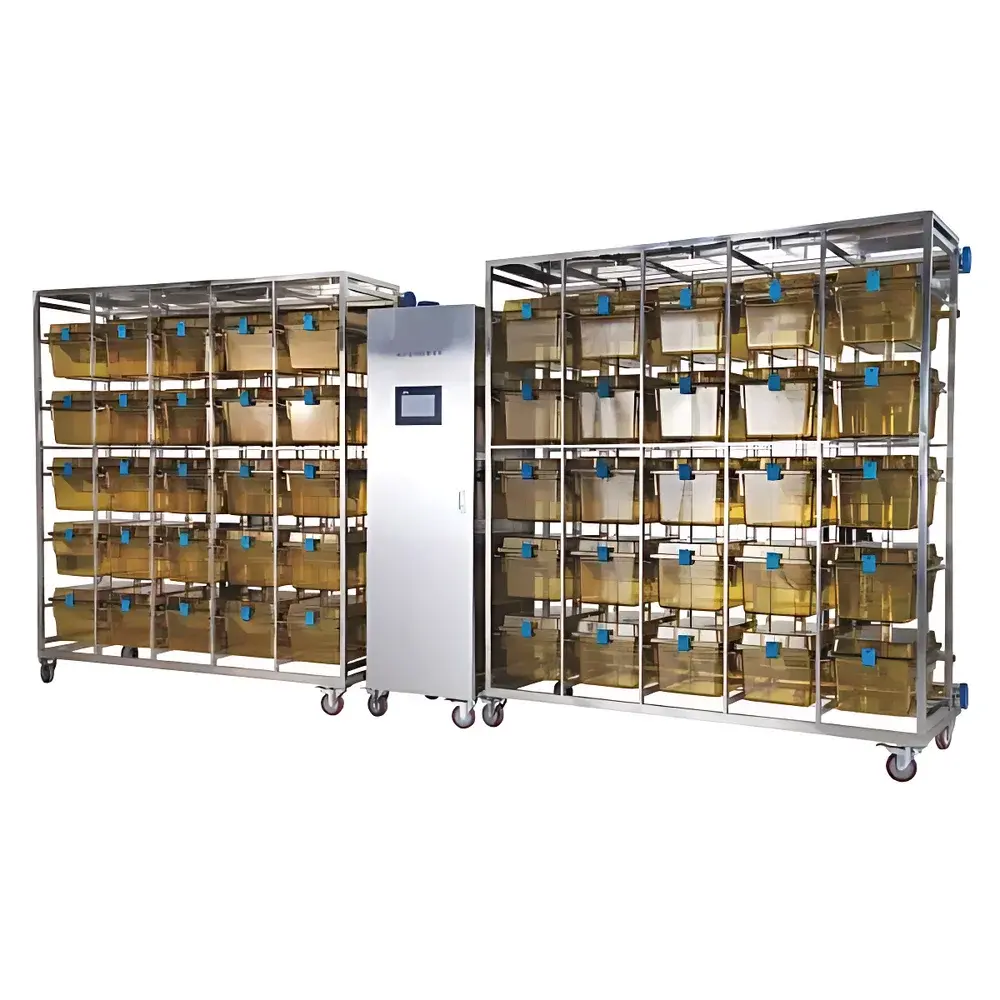
JIAYUAN CA30 Individual Ventilated Cage (IVC) System for Rats
| Brand | JIAYUAN |
|---|---|
| Origin | Beijing, China |
| Manufacturer Type | Authorized Distributor |
| Product Category | Domestic |
| Model | CA30 |
| Pricing | Available Upon Request |
| Dimensions (L×W×H) | 2020 × 600 × 190 mm |
| Rack Configuration | 6-tier × 5-cage per tier (30 cages total) |
| Cage Dimensions | 470 × 312 × 260 mm (PSU transparent material) |
| Power Supply | 220 V AC |
| Construction Material | AISI 304 stainless steel (electropolished finish) |
| Air Delivery | Static-pressure microflow, individually ducted per cage |
| Filtration | HEPA-filtered supply air, pre-filtered exhaust |
| Safety Features | Power failure alarm, temperature/humidity limit alerts, emergency life-window activation |
| Control Interface | Full-color LCD touchscreen with programmable timer and maintenance prompts |
| Sealing | High-compliance silicone gasket (autoclavable, 150°C/15 psi, 30 min) |
| Water Bottle | Polycarbonate (PC), transparent, clip-mounted |
| Floor Grid | 1Cr18Ni9 stainless steel wire mesh (Φ1.8 mm wires, 4.0 mm pitch) |
Overview
The JIAYUAN CA30 Individual Ventilated Cage (IVC) System is an engineered solution for the housing and husbandry of laboratory rats under Specific Pathogen-Free (SPF) conditions. Designed in accordance with internationally recognized principles of barrier animal facility design, the CA30 system employs static-pressure microflow ventilation to deliver HEPA-filtered air independently to each cage unit—eliminating cross-contamination between animals and ensuring strict environmental isolation. Each cage receives a controlled, laminar, downward airflow pattern generated by a centralized blower module housed within a fully enclosed AISI 304 stainless steel cabinet. The system maintains consistent intra-cage air exchange rates (typically 40–60 air changes per hour, configurable via control interface), relative humidity (30–70% RH), and ambient temperature (20–26°C) — parameters validated for rat physiological stability and experimental reproducibility. Unlike conventional open caging or centrally ducted rack systems, the CA30’s per-cage airflow architecture complies with ISO 14644-1 Class 5 (ISO Class 5 equivalent) cleanroom performance standards when operated in standard laboratory environments.
Key Features
- Stainless steel frame and enclosure constructed entirely from electropolished AISI 304 stainless steel — corrosion-resistant, non-porous, and compatible with autoclaving, vaporized hydrogen peroxide (VHP), and common disinfectants including 70% ethanol and sodium hypochlorite.
- PSU (polyphenylsulfone) cage bodies offering superior optical clarity, mechanical strength, and thermal stability — rated for repeated autoclaving at 150°C and 15 psi for 30 minutes without deformation or haze development.
- Integrated silicone gasket sealing system (FDA-compliant, acid/alkali resistant) ensuring leak-tight integrity between cage and rack interface — validated via smoke testing and differential pressure decay measurement per ASTM E779.
- Microflow static-pressure air distribution manifold delivering uniform, low-velocity (≤0.2 m/s) laminar airflow directly into the animal living zone — minimizing turbulence, noise, and bedding displacement while maximizing particulate removal efficiency.
- Full-color LCD touchscreen controller with real-time monitoring of supply/exhaust airflow, internal cabinet temperature/humidity, filter service intervals, and fault diagnostics — supports user-defined alarm thresholds and event logging.
- Dual-stage filtration: H14-grade HEPA filters (≥99.995% @ 0.3 µm) on supply air path; coarse pre-filters on exhaust path to capture hair, dander, and bedding particulates prior to recirculation or external venting.
Sample Compatibility & Compliance
The CA30 IVC system is specifically validated for use with Sprague-Dawley, Wistar, and Long-Evans rat strains across standard body weight ranges (200–500 g). Cage volume (38.5 L) and floor area (1,466 cm²) conform to NIH Guide for the Care and Use of Laboratory Animals (8th Edition) and EU Directive 2010/63/EU minimum housing requirements. All materials contacting animals or environment are USP Class VI certified and free of leachable plasticizers. The system supports GLP-compliant operation through audit-trail-capable data logging (timestamped parameter records stored onboard for ≥30 days), password-protected configuration access, and calibration traceability documentation. Electrical design complies with IEC 61010-1 safety standards for laboratory equipment; CE marking is available upon request for export configurations.
Software & Data Management
The embedded control firmware provides continuous acquisition of critical environmental parameters at 10-second intervals. Logged data includes supply airflow (CFM), cabinet temperature (±0.3°C accuracy), relative humidity (±3% RH), filter differential pressure (indicative of loading state), and alarm event timestamps. Data export is supported via USB 2.0 port in CSV format for integration into institutional LIMS or electronic lab notebooks. Optional Ethernet connectivity enables remote monitoring via secure HTTPS interface, supporting role-based user permissions and TLS 1.2 encryption. Audit trail functionality satisfies FDA 21 CFR Part 11 requirements for electronic records and signatures when paired with institutional identity management infrastructure.
Applications
The CA30 IVC system is routinely deployed in academic research laboratories conducting longitudinal pharmacokinetic, toxicological, and behavioral studies where microbiological consistency directly impacts endpoint validity. Its stable microenvironment supports immunocompromised rat models, transgenic lines requiring stringent pathogen exclusion, and multi-site comparative efficacy trials demanding inter-laboratory reproducibility. The modular rack design facilitates scalable deployment—from single-rack installations in core facilities to multi-rack arrays integrated with automated cage-washing and bedding-dispensing workflows. Validation protocols are provided for routine performance qualification (PQ), including airflow mapping (ISO 14644-3 Annex B), filter integrity testing (DOP/PAO scan), and environmental monitoring (viable and non-viable particle counts).
FAQ
What is the recommended HEPA filter replacement interval?
Filter service life depends on ambient particulate load and usage frequency; typical replacement is scheduled every 6–12 months. The system triggers a visual and audible alert when differential pressure exceeds 250 Pa across the supply filter.
Can the CA30 system be connected to building exhaust ducts?
Yes — the exhaust plenum includes a 100 mm diameter port compatible with standard laboratory ductwork; optional exhaust damper and balancing valve kits are available for pressure-stable integration.
Is the PSU cage material compatible with gamma irradiation sterilization?
No — PSU is not gamma-stable. Autoclaving (150°C, 15 psi, 30 min) or VHP decontamination are the validated sterilization methods.
Does the system support integration with third-party environmental monitoring platforms?
Yes — Modbus RTU protocol is supported via RS-485 interface for integration with BMS or centralized facility monitoring systems.
What validation documentation is supplied with the system?
Each unit ships with Factory Acceptance Test (FAT) report, material certifications (EN 10204 3.1), filter test certificates (EN 1822), and IQ/OQ templates aligned with GAMP 5 guidance.






