
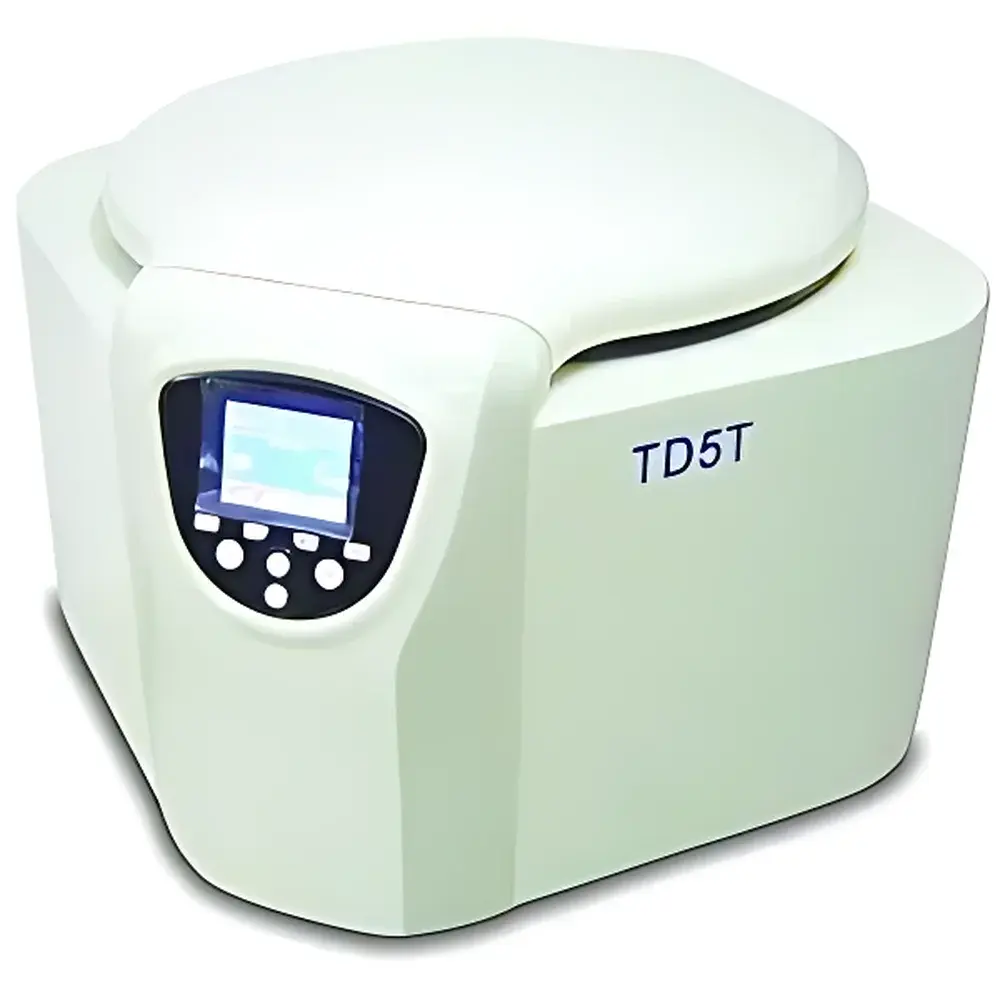
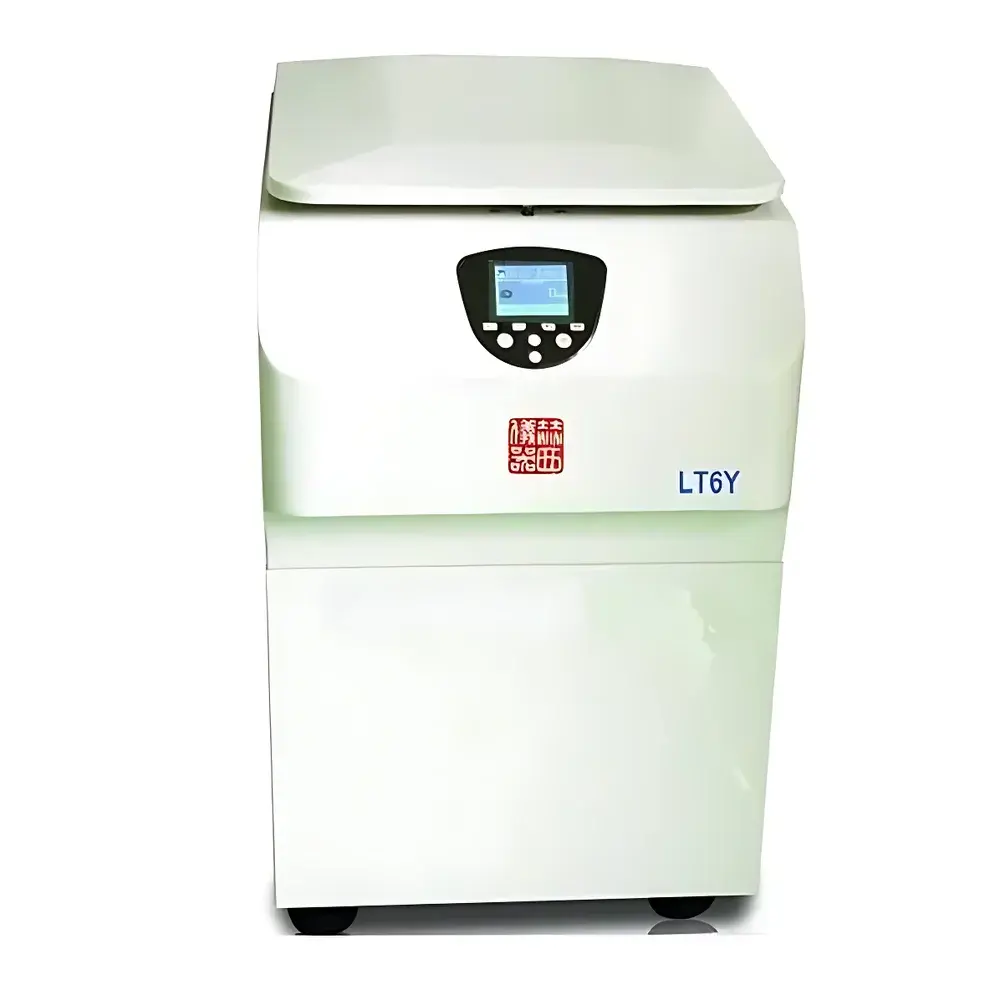
TD5T Petroleum Centrifuge
| Origin | Hunan, China |
|---|---|
| Manufacturer Type | Distributor |
| Origin Category | Domestic |
| Model | TD5T |
| Price | ¥24,800 |
| Centrifugation Class | General-purpose petroleum analysis |
| Max Capacity | 4 × 250 mL |
| Max Speed | 5000 rpm |
| Dimensions | 600 × 540 × 360 mm |
| Max RCF | 4200 × g |
| Speed Accuracy | ±50 rpm |
| Temperature Range | Ambient +10 °C to 70 °C |
| Temp. Accuracy | ±2 °C |
| Timer Range | 0–99 h 59 min |
| Noise Level | ≤60 dB(A) |
| Power Supply | AC 220 V, 50 Hz |
| Weight | 50 kg |
Overview
The TD5T Petroleum Centrifuge is a purpose-built benchtop centrifugal instrument engineered for quantitative determination of water and sediment content in crude oil samples, in strict compliance with GB/T 6533–1986 (“Determination of Water and Sediment in Crude Oil — Centrifuge Method”). It operates on the principle of high-g force sedimentation under controlled thermal conditions, enabling phase separation of immiscible components (water, hydrocarbons, and suspended solids) based on density differentials. Unlike general-purpose laboratory centrifuges, the TD5T integrates precise temperature regulation (ambient +10 °C to 70 °C), programmable timing, and robust mechanical design specifically validated for petroleum industry workflows—including upstream field laboratories, refinery QC labs, and independent testing facilities accredited to ISO/IEC 17025. Its fixed-angle rotor configuration supports four 250 mL glass or metal centrifuge bottles, ensuring reproducible sample geometry critical for ASTM D96-22 and ISO 3733 alignment when adapted via protocol validation.
Key Features
- High-torque brushless DC frequency-controlled motor delivering stable rotational speed at 5000 rpm with ±50 rpm accuracy—optimized for consistent sediment compaction without vortex-induced re-emulsification.
- Integrated heating system with uniform thermal distribution across the rotor chamber; temperature maintained within ±2 °C tolerance over full operating range (ambient +10 °C to 70 °C), minimizing viscosity drift during extended runs.
- Dual-display interface: user-selectable PLC-based LCD or LED digital panel for real-time monitoring and on-the-fly parameter adjustment—including speed, temperature, and elapsed time—during active operation.
- Structural integrity assured by all-steel monocoque frame, certified mechanical overspeed protection, automatic imbalance detection, and dual-stage vibration damping with auto-balance recognition (visual equilibrium confirmation sufficient for safe operation).
- Electromechanical quiet-lock door mechanism with interlocked safety cutoff; eliminates manual latching errors and prevents accidental lid opening under load.
Sample Compatibility & Compliance
The TD5T accommodates standard 250 mL borosilicate glass centrifuge bottles (e.g., ASTM D96-compliant containers) and compatible metal sampling cans used in field-deployed petroleum testing. Its rotor geometry and acceleration profile are calibrated to meet the centrifugal force requirements (≥4200 × g) specified in GB/T 6533–1986 for 15-minute separation cycles. While not intrinsically certified to ATEX or IECEx for hazardous area use, the unit complies with GB 4793.1–2007 (Safety requirements for electrical equipment for measurement, control, and laboratory use) and conforms to electromagnetic compatibility (EMC) standards per GB/T 18268.1–2010. Documentation packages support GLP audit readiness, including calibration traceability for temperature and timer subsystems.
Software & Data Management
The TD5T operates as a standalone hardware platform with no embedded PC or proprietary software dependency. All operational parameters are stored in non-volatile memory with power-loss recovery functionality. Event logs—including start/stop timestamps, final speed, achieved temperature, and error codes—are retained for ≥1000 cycles and accessible via front-panel query. For regulated environments, users may integrate the device into LIMS via optional RS-232 or USB-to-serial interface (available as accessory), enabling automated data capture compliant with FDA 21 CFR Part 11 when paired with validated third-party acquisition software and electronic signature protocols.
Applications
- Routine water-and-sediment (W&S) quantification in crude oil per GB/T 6533–1986 and equivalent international methods (e.g., ASTM D96, ISO 3733).
- Preparative separation of emulsified water phases prior to Karl Fischer titration or GC analysis.
- Sediment characterization studies in enhanced oil recovery (EOR) research, including clay dispersion stability assessment.
- QC screening of desalting efficiency in upstream dehydration units and pipeline custody transfer verification.
- Method development for alternative solvent extraction protocols requiring thermally stabilized centrifugation steps.
FAQ
Does the TD5T comply with ASTM D96 or ISO 3733?
It is designed to meet the functional performance criteria of those standards when operated using validated protocols, though formal conformance requires user-side method verification per ISO/IEC 17025 clause 7.2.2.
Can the TD5T be used for non-petroleum samples such as biodiesel or lubricants?
Yes—provided rotor compatibility, thermal stability, and density differentials permit effective phase separation; however, method adaptation and precision verification are required per ISO 17025 Section 7.2.
Is temperature calibration traceable to national standards?
Factory calibration uses NIST-traceable reference thermometers; certificate of calibration is provided with each unit and includes as-found/as-left data.
What maintenance is required for the brushless DC motor?
None—sealed construction eliminates need for carbon brush replacement, grease replenishment, or commutator cleaning over rated service life (>20,000 hours MTBF).
How is rotor imbalance detected and managed?
Vibration sensors feed real-time signals to the control logic; if imbalance exceeds 0.5 mm/s RMS acceleration, rotation decelerates immediately and an audible/visual alarm activates—no manual rebalancing needed due to passive dynamic compensation design.



