
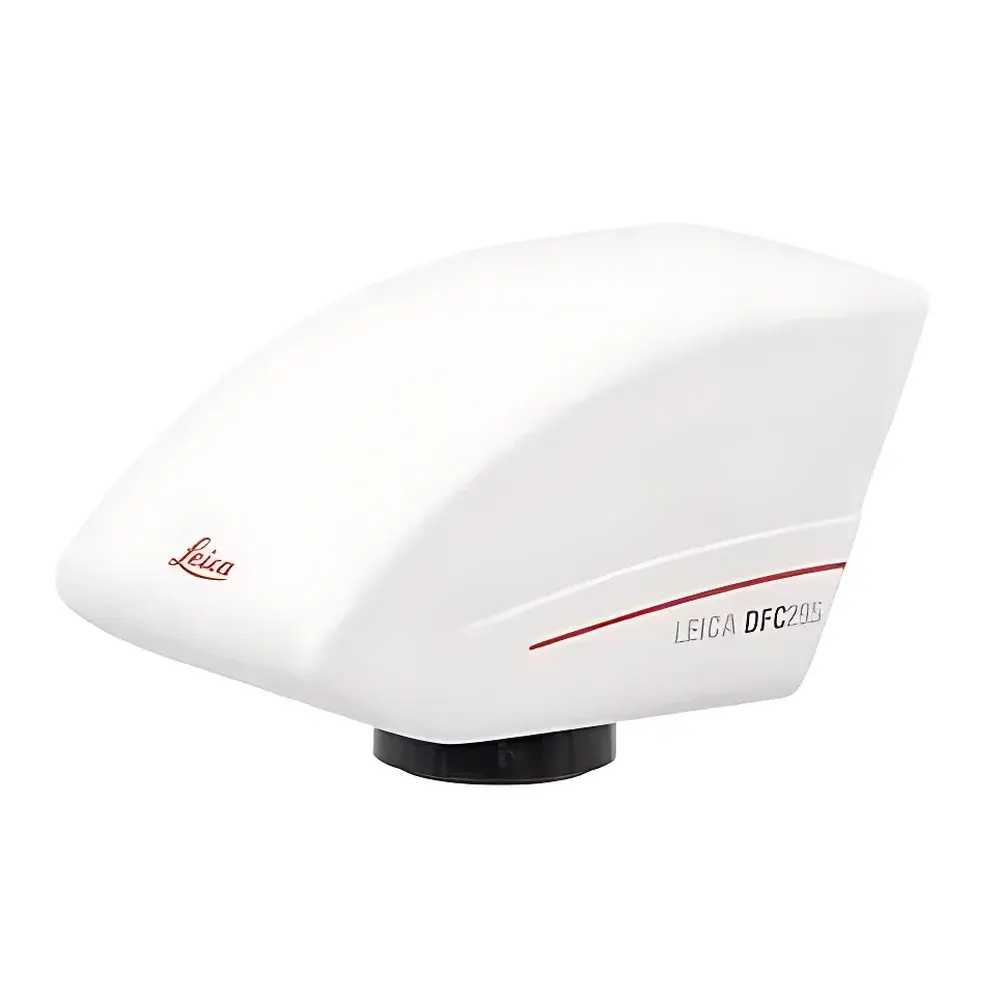
Leica DFC295 Microscope Camera
| Brand | Leica |
|---|---|
| Origin | Germany |
| Model | DFC295 |
| Sensor Type | CCD |
| Resolution | 5 MP (2592 × 1944) |
| Output Interface | USB 2.0 |
| Frame Rate | up to 30 fps @ 1920 × 1080 |
| Storage | Removable SD card (in standalone mode) |
| Software Compatibility | Leica Application Suite (LAS) v4.x+ |
| Compliance | CE, RoHS, ISO 13485–certified manufacturing environment |
| Warranty | 24 months |
Overview
The Leica DFC295 is a high-performance, scientific-grade CCD microscope camera engineered for precision digital imaging in life science, pathology, materials science, and quality control laboratories. Based on progressive-scan CCD sensor architecture, it delivers low-noise, high-dynamic-range monochrome or color imaging with excellent quantum efficiency in the visible spectrum (400–700 nm). Unlike consumer-grade sensors, the DFC295 employs global shutter operation—eliminating motion artifacts during rapid stage movement or time-lapse acquisition—and supports hardware-triggered synchronization with external devices such as motorized stages or fluorescence shutters. Its optical design incorporates a C-mount interface (1″ format, 17.5 mm flange distance), ensuring mechanical and optical compatibility with all major upright, inverted, and stereomicroscope platforms from Leica Microsystems and third-party manufacturers. The camera operates in two distinct modes: PC-connected mode via high-bandwidth USB 2.0 for real-time streaming and full software integration, and standalone mode for autonomous image capture—enabling immediate deployment without host computer dependency.
Key Features
- 5-megapixel CCD sensor (2592 × 1944 active pixels) optimized for microscopy contrast and signal fidelity
- Real-time full HD video output at 30 fps (1920 × 1080) with on-chip binning options for enhanced sensitivity in low-light applications
- Standalone operation supported by integrated SD card slot (up to 32 GB) and IR wireless remote control for white balance adjustment, exposure setting, image capture, and gallery review
- Hardware-level exposure control with programmable integration times ranging from 100 µs to 60 s, enabling quantitative fluorescence intensity measurement
- USB 2.0 interface compliant with UVC (USB Video Class) standards—no proprietary drivers required for basic preview functionality on Windows, macOS, and Linux systems
- Support for metadata embedding (objective magnification, illumination type, filter set, timestamp, user ID) directly into TIFF and JPEG file headers per DICOM-SR and MIAME-compliant workflows
Sample Compatibility & Compliance
The DFC295 is validated for use across brightfield, phase contrast, differential interference contrast (DIC), polarized light, and epifluorescence modalities. Its spectral response profile aligns with standard fluorophore excitation/emission bands (e.g., DAPI, FITC, TRITC, Cy5), and its linearity over 12-bit dynamic range (0–4095 DN) meets ASTM E2718-19 requirements for quantitative digital microscopy. The device is manufactured under ISO 13485:2016 quality management systems and bears CE marking for conformity with EU Medical Device Regulation (MDR 2017/745) Annex II when used in diagnostic support applications. Firmware and LAS software updates comply with FDA 21 CFR Part 11 electronic record and signature requirements—including audit trail logging, user authentication, and electronic signature capability—making it suitable for GLP/GMP-regulated environments.
Software & Data Management
In PC-connected mode, the DFC295 integrates natively with Leica Application Suite (LAS) v4.13 or later, supporting advanced modules including LAS X Core, LAS X Live, and LAS X Quant. It enables synchronized multi-channel acquisition, Z-stack reconstruction, extended depth-of-field (EDF) rendering, and pixel-based intensity profiling. All captured images retain embedded EXIF-like metadata, facilitating automated import into LIMS or ELN systems via standardized XML or JSON export templates. Raw image data is stored in lossless TIFF format with optional compression (LZW), while annotated reports can be exported as PDF/A-1b for long-term archival compliance. Remote firmware updates are delivered through Leica’s secure update portal, with SHA-256 hash verification and rollback capability.
Applications
- High-fidelity documentation of histological sections in clinical pathology labs requiring traceable image provenance
- Time-lapse monitoring of live-cell cultures under controlled environmental chambers, leveraging hardware triggering for precise temporal alignment
- Metallurgical inspection of grain structure, inclusion analysis, and coating thickness assessment in QA/QC workflows
- Educational microscopy where ease of use, wireless control, and immediate SD-based image sharing accelerate classroom instruction
- Forensic fiber or particulate analysis requiring calibrated scale overlays, region-of-interest (ROI) masking, and measurement traceability to NIST-traceable standards
FAQ
Does the DFC295 support trigger input for synchronized acquisition with external equipment?
Yes—the camera features a TTL-compatible BNC trigger input port for hardware-synchronized frame capture, compatible with motorized stages, shutters, and environmental controllers.
Can I use the DFC295 without installing Leica software?
Yes—basic preview and recording functions operate via native OS UVC drivers; however, advanced features (metadata embedding, multi-channel alignment, EDF) require LAS installation.
What is the maximum recommended cable length for stable USB 2.0 operation?
For optimal signal integrity and sustained 30 fps throughput, Leica specifies ≤ 3 m for passive cables; active extension solutions (USB 2.0 repeaters) may extend reach to 10 m with verified latency compensation.
Is calibration data (e.g., pixel size per objective) stored onboard or only within LAS?
Calibration parameters are stored both in LAS project files and optionally embedded in image metadata headers, ensuring portability across analysis platforms.
Does the standalone mode support video recording to SD card?
Yes—full HD (1920 × 1080) video is recorded directly to SD card in AVI format with MJPEG compression, preserving frame-accurate timestamps and exposure metadata.




