
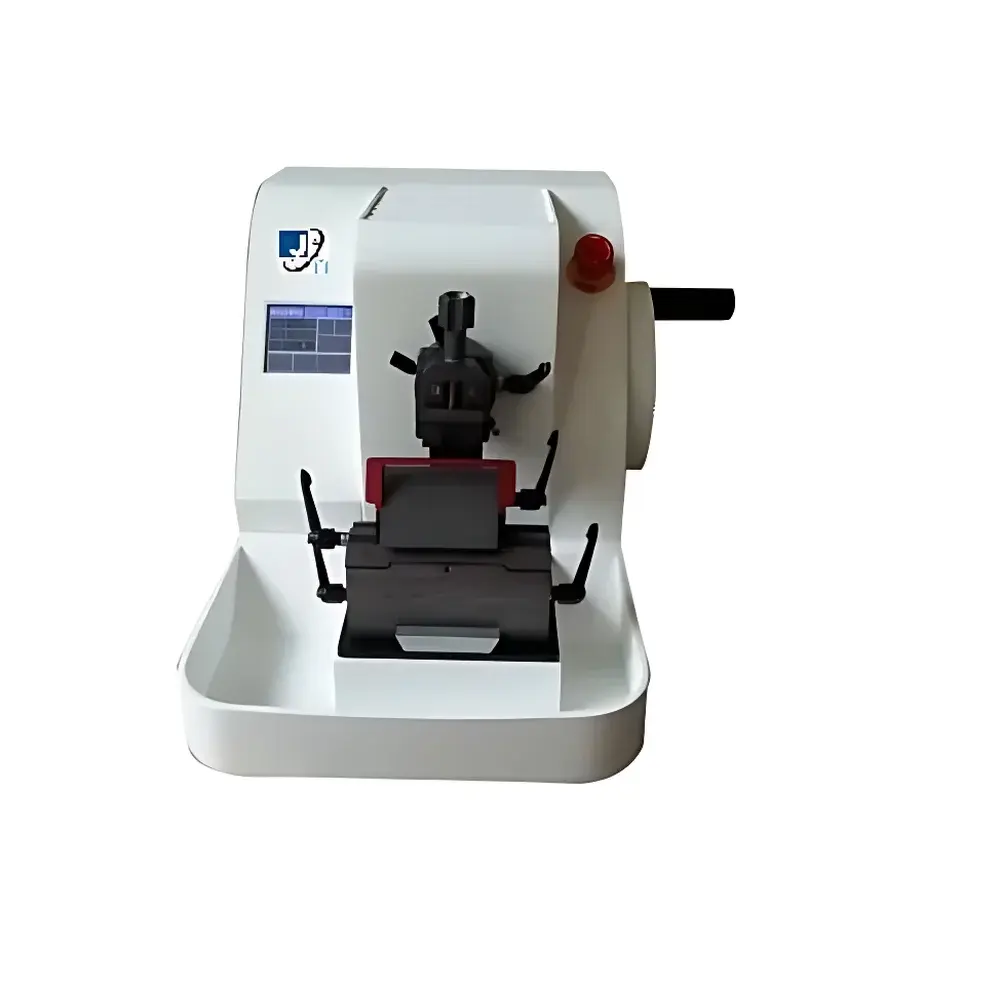
Jiayuan JY-335 Semi-Automatic Computer-Controlled Rotary Microtome
| Brand | Jiayuan |
|---|---|
| Origin | Beijing, China |
| Model | JY-335 |
| Maximum Sample Thickness Range | 0–100 µm |
| Sectioning Increment | 1 µm (0–10 µm), 2 µm (10–20 µm), 5 µm (20–50 µm), 10 µm (50–100 µm) |
| Re-Trim Range | 0–500 µm |
| Max Horizontal Specimen Travel | 28 mm |
| Max Vertical Specimen Travel | 60 mm |
| Automatic Specimen Advance & Retraction | 12 µm |
| Minimum Sectioning Resolution | 1 µm |
| Sectioning Accuracy | ±1% |
| Max Section Area | 50 × 50 mm |
| Dimensions | 520 × 450 × 300 mm |
| Power Supply | AC 220 V / 110 V, 50 / 60 Hz |
Overview
The Jiayuan JY-335 Semi-Automatic Computer-Controlled Rotary Microtome is engineered for precision sectioning of biological and hard-tissue specimens embedded in paraffin, plastic, or resin matrices. It operates on the fundamental principle of rotary microtomy—where a specimen block advances toward a stationary knife via a precisely controlled vertical feed mechanism, and sections are cut during the forward stroke of the handwheel. This design ensures consistent shear geometry and minimizes compression artifacts, critical for histopathological diagnosis, morphometric analysis, and electron microscopy sample preparation. The JY-335 integrates a high-resolution stepper motor-driven feed system, crossed-roller linear guides, and recirculating ball screws to achieve sub-micron repeatability in thickness control. Its ergonomic architecture complies with ISO 13485-aligned manufacturing practices and supports GLP-compliant laboratory workflows through deterministic motion control and traceable parameter logging.
Key Features
- Motorized, programmable sectioning with discrete increment modes: 1 µm (0–10 µm), 2 µm (10–20 µm), 5 µm (20–50 µm), and 10 µm (50–100 µm)—enabling optimal resolution for both light microscopy and semi-thin EM embedding.
- Independent stepper motor control for both sectioning and re-trimming functions, each with 1 µm minimum adjustment resolution and automatic stop-on-contact logic to prevent over-travel.
- Intelligent specimen retraction of 12 µm after each cut—reducing knife-edge wear and eliminating reverse-drag damage to delicate tissue interfaces.
- Full-color LCD touchscreen interface with bilingual (English/Chinese) menu navigation, supporting real-time adjustment of section thickness, re-trim depth, section count, rapid advance/retreat, and mode switching.
- Ergonomic handwheel with position-locking capability at any angular orientation—enhancing operator safety and procedural consistency during manual intervention.
- Modular waste tray with large-volume capacity and tool-free removal, facilitating contamination-free maintenance in high-throughput histology labs.
- Integrated acoustic and visual alarm system triggered by abnormal load conditions, knife collision events, or power instability—ensuring equipment longevity and user protection.
Sample Compatibility & Compliance
The JY-335 accommodates a broad spectrum of specimen types, including but not limited to paraffin-embedded soft tissues (e.g., liver, kidney, brain), decalcified bone, undecalcified calcified tissues, plant stems and roots, polymer-embedded neural tissues, and fiber-reinforced composite biomaterials. Its 50 × 50 mm maximum section area and 60 mm vertical travel support standard cassette-based blocks as well as custom macro-sectioning applications. The instrument conforms to IEC 61000-6-2 (EMC immunity) and IEC 61000-6-4 (EMC emissions) standards. While not certified under FDA 21 CFR Part 11, its parameter logging functionality—including timestamped thickness settings, section counts, and motor status flags—can be integrated into validated laboratory information management systems (LIMS) for audit-ready documentation per ISO/IEC 17025 and CAP accreditation requirements.
Software & Data Management
The embedded firmware provides non-volatile storage of up to 99 user-defined protocols, each storing section thickness, re-trim depth, advance speed, and counting mode. All operational parameters are logged locally with UTC timestamps and can be exported via USB 2.0 to CSV format for integration with downstream QA/QC reporting tools. No cloud connectivity or remote access capabilities are implemented—ensuring full data sovereignty and alignment with institutional IT security policies. Optional RS-232 serial output enables direct communication with automated staining platforms or digital slide scanners for synchronized workflow orchestration.
Applications
- Routine histology laboratories performing H&E, IHC, and special stain preparation on human and veterinary tissue biopsies.
- Academic and pharmaceutical research facilities conducting morphological quantification, stereology, and serial section reconstruction.
- Plant science laboratories preparing transverse and longitudinal sections of lignified stems, root nodules, and seed embryos.
- Biomaterials characterization labs sectioning hydroxyapatite composites, 3D-bioprinted scaffolds, and mineralized tissue-engineered constructs.
- Forensic pathology units requiring reproducible sectioning of fragmented or brittle evidence specimens, including hair shafts and calcified vascular plaques.
- Quality control environments validating embedding media homogeneity, infiltration efficiency, and cryo-embedding integrity prior to downstream analysis.
FAQ
What types of knives are compatible with the JY-335?
The instrument accepts standard disposable blade cassettes (e.g., Leica Type B, Sakura Tissue-Tek) and reusable steel knives mounted in universal knife holders. A dedicated steel knife and one box of disposable blades are included with each unit.
Does the JY-335 support cold-stage operation?
No—the JY-335 is designed exclusively for room-temperature paraffin and plastic-embedded specimens. For cryosectioning, refer to the JY-2950 Cryostat or JY-3368AM Dual-Mode Microtome series.
Is calibration traceable to national standards?
Yes—each unit ships with a factory calibration certificate referencing NIST-traceable interferometric measurement of feed mechanism displacement. Annual recalibration services are available through authorized service centers.
Can the section counter be reset independently of other parameters?
Yes—the digital section counter features a dedicated reset button accessible from both the touchscreen interface and front-panel hardware controls.
What maintenance intervals are recommended?
Lubrication of the ball screw and guide rails is recommended every 6 months or after 5,000 sections; cleaning of optical sensors and waste tray channels should occur after each daily use.
Related Products



