
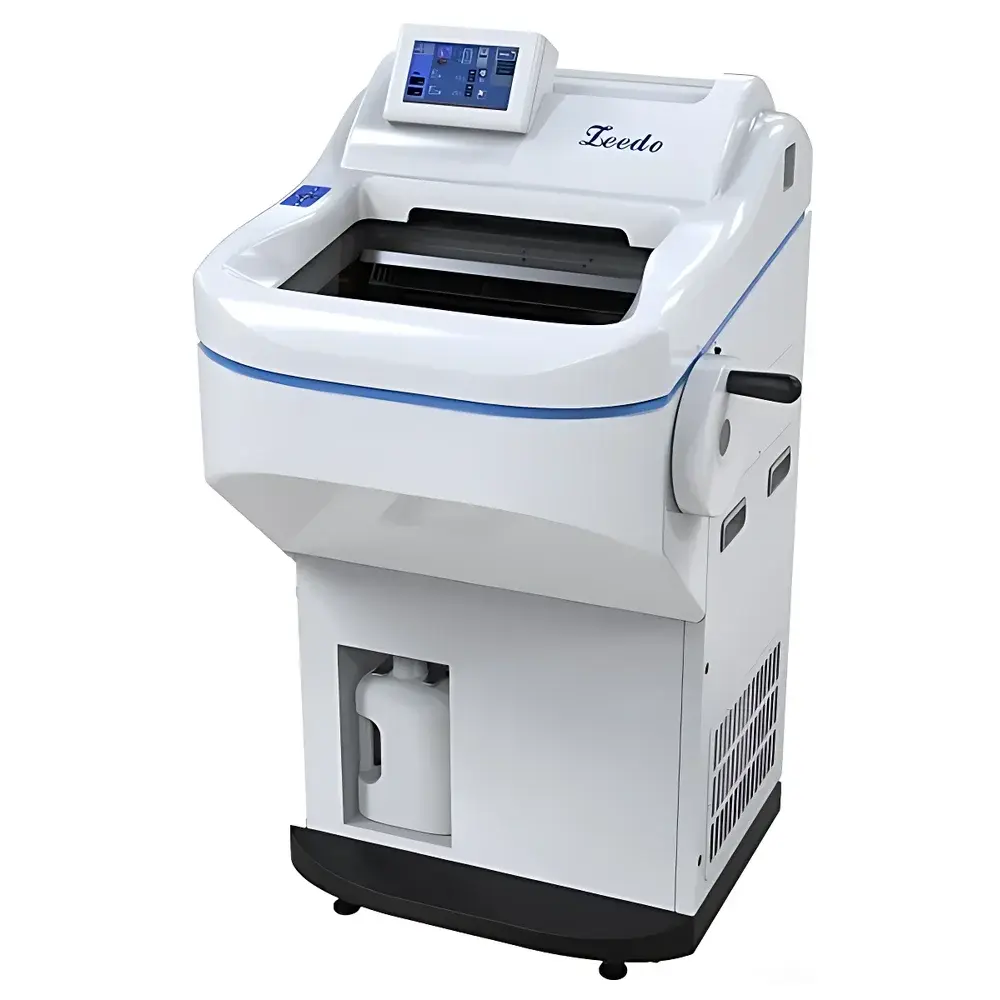
ZEEDO HS-4000 Cryostat Microtome
| Origin | Zhejiang, China |
|---|---|
| Manufacturer Type | Authorized Distributor |
| Country of Origin | PRC |
| Model | HS-4000 |
| Price Range | USD 7,000–14,000 (FOB) |
| Max Specimen Size | 55 × 55 mm |
| Section Thickness Range | 0–100 µm (adjustable in 1/2/5/10 µm increments) |
| Trim Thickness Range | 0–500 µm |
| Cryochamber Temp Range | −10 °C to −35 °C |
| Cold Stage Temp | −45 °C |
| Defrost Mode | Manual & Auto |
| Refrigerant | R404a (300 g ± 5 g) |
| Input Power | 650 VA |
| Electrical Safety Class | I, Type B |
| Dimensions (L×W×H) | 780 × 700 × 1152 mm (140 kg) |
Overview
The ZEEDO HS-4000 Cryostat Microtome is a precision-engineered laboratory instrument designed for rapid, high-fidelity sectioning of fresh or fixed biological tissues at sub-zero temperatures. Operating on the principle of cryosectioning—where tissue specimens are rapidly frozen to preserve structural integrity and enzymatic activity—the HS-4000 enables histopathological analysis without paraffin embedding. Its thermoelectrically assisted cold stage (−45 °C) and independently controlled cryochamber (−10 °C to −35 °C) ensure stable thermal conditions across extended operation cycles, minimizing ice crystal artifact formation and maintaining cellular morphology. Engineered for clinical diagnostics, academic research, and pharmaceutical preclinical labs, the system complies with core safety and electromagnetic compatibility requirements per IEC 61010-1 and IEC 60601-1 (Class I, Type B), supporting routine use in ISO 15189-accredited pathology laboratories and GLP-compliant tissue processing workflows.
Key Features
- Precision cryogenic architecture: Dual-zone temperature control with semiconductor-assisted cold stage (−45 °C) and adjustable cryochamber (−10 °C to −35 °C) for optimal tissue hardness and section consistency
- Stepwise sectioning resolution: 0–100 µm thickness range with programmable increment modes—1 µm (0–10 µm), 2 µm (10–20 µm), 5 µm (20–50 µm), and 10 µm (50–100 µm)—enabling both ultra-thin immunohistochemistry sections and thicker diagnostic slices
- Intuitive dual-mode operation: Full functionality via ergonomic handwheel or responsive 7-inch color LCD touchscreen; supports manual override during automated protocols
- Advanced specimen handling: 12° adjustable specimen head with center-return function, 25 mm anterior-posterior and 59 mm vertical travel, and motorized fast-advance (0.3/0.9 mm/s) for efficient positioning
- Robust mechanical design: German-sourced linear guide rails, retractable knife holder with lateral adjustment, multi-angle anti-roll plate (horizontal/vertical/tilt/gap), and spring-loaded blade ejection mechanism
- Integrated workflow enhancements: UV-C disinfection cycle with auto-shutoff, manual/automatic defrost scheduling, 15-minute standby-to-active recovery, and real-time slice count/thickness logging
Sample Compatibility & Compliance
The HS-4000 accommodates standard OCT-embedded or snap-frozen specimens up to 55 × 55 mm, compatible with both disposable stainless-steel and reusable tungsten-carbide blades (widths: 15–25 mm). Its chamber geometry allows concurrent storage of up to 20 specimens, reducing batch processing time in high-volume clinical settings. The system meets essential regulatory expectations for medical device safety (IEC 60601-1), electrical safety (IEC 61010-1), and refrigerant handling (EN 378-1). While not FDA-cleared as a standalone IVD device, it supports CLIA- and CAP-aligned tissue preparation protocols when operated within validated SOPs. All firmware logs—including section count, thickness setting, chamber temperature history, and defrost events—are timestamped and exportable for internal audit trails compliant with ISO 13485 documentation requirements.
Software & Data Management
The embedded microcontroller records operational metadata—including date/time stamps, user-defined protocol IDs, section thickness parameters, and thermal setpoints—for each session. Data exports via USB 2.0 to CSV format for integration into LIMS or electronic lab notebooks (ELN). Though lacking cloud connectivity or remote monitoring, the system’s local log retention (≥10,000 entries) satisfies minimum traceability thresholds under GLP Annex 11 and ISO/IEC 17025 clause 7.9. No proprietary software installation is required; exported files are natively readable in Excel, GraphPad Prism, or LabArchives. Firmware updates are performed offline via encrypted USB key to maintain data integrity and cybersecurity hygiene in regulated environments.
Applications
- Routine intraoperative frozen section diagnosis in surgical pathology departments
- Immunofluorescence and enzyme histochemistry requiring antigen preservation
- Neuroscience studies involving brain, spinal cord, or peripheral nerve tissue
- Preclinical toxicology assessments in contract research organizations (CROs)
- Academic teaching labs conducting comparative histomorphology across species
- Quality control of biobanked tissue archives prior to nucleic acid extraction
FAQ
What is the minimum achievable section thickness, and how is accuracy maintained at sub-5 µm levels?
The HS-4000 achieves 1 µm resolution in the 0–10 µm range using calibrated micrometer feed and vibration-damped handwheel mechanics. Accuracy is verified per ASTM E1558 through repeated sectioning of standardized polyacrylamide phantoms.
Does the system support 21 CFR Part 11 compliance for electronic records?
No—while audit logs are generated and exportable, the HS-4000 lacks user authentication, electronic signatures, or system-level access controls required for full Part 11 adherence. It is intended for use in environments where paper-based SOPs govern data review.
Can the cryochamber accommodate oversized specimens beyond 55 × 55 mm?
No—maximum specimen footprint is strictly limited by the chuck aperture and knife clearance envelope. Larger blocks must be trimmed prior to mounting.
Is R404a refrigerant service possible outside China?
Yes—R404a is globally available and serviceable by certified HVAC-R technicians holding EPA Section 608 or EU F-Gas certification. Refrigerant charge verification and leak testing follow EN 15603 procedures.
What maintenance intervals are recommended for optimal long-term performance?
Daily: Wipe cold stage and chamber surfaces with ethanol; inspect blade alignment. Quarterly: Lubricate guide rails with silicone-free grease; verify temperature calibration against NIST-traceable probe. Annually: Full refrigeration system pressure test and cold stage thermal mapping.



