
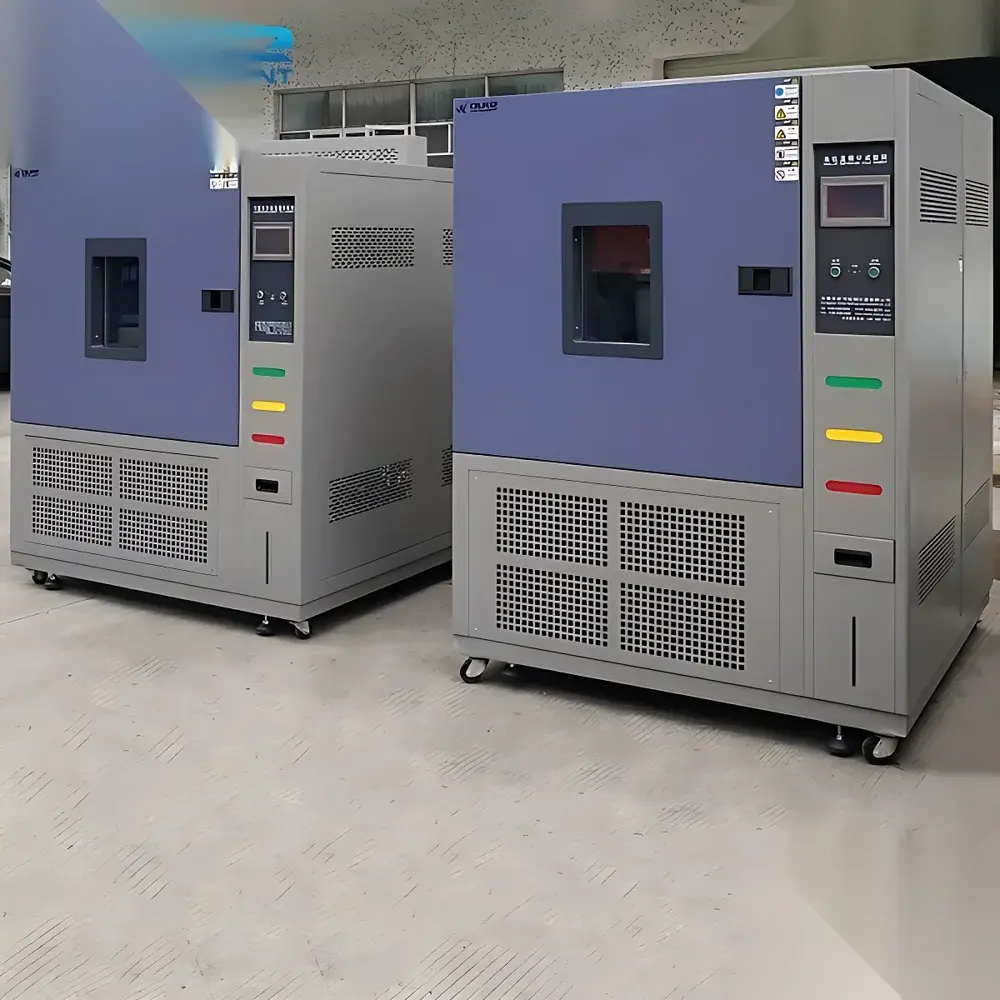
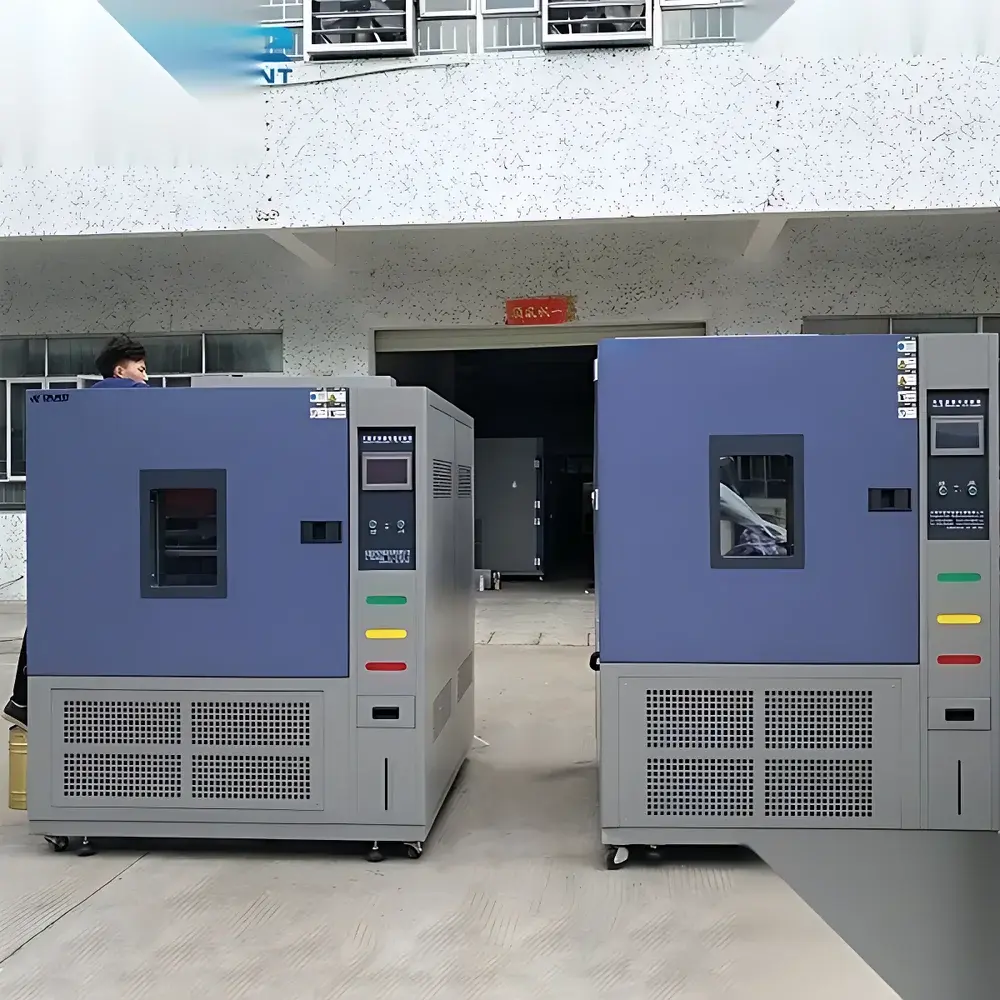
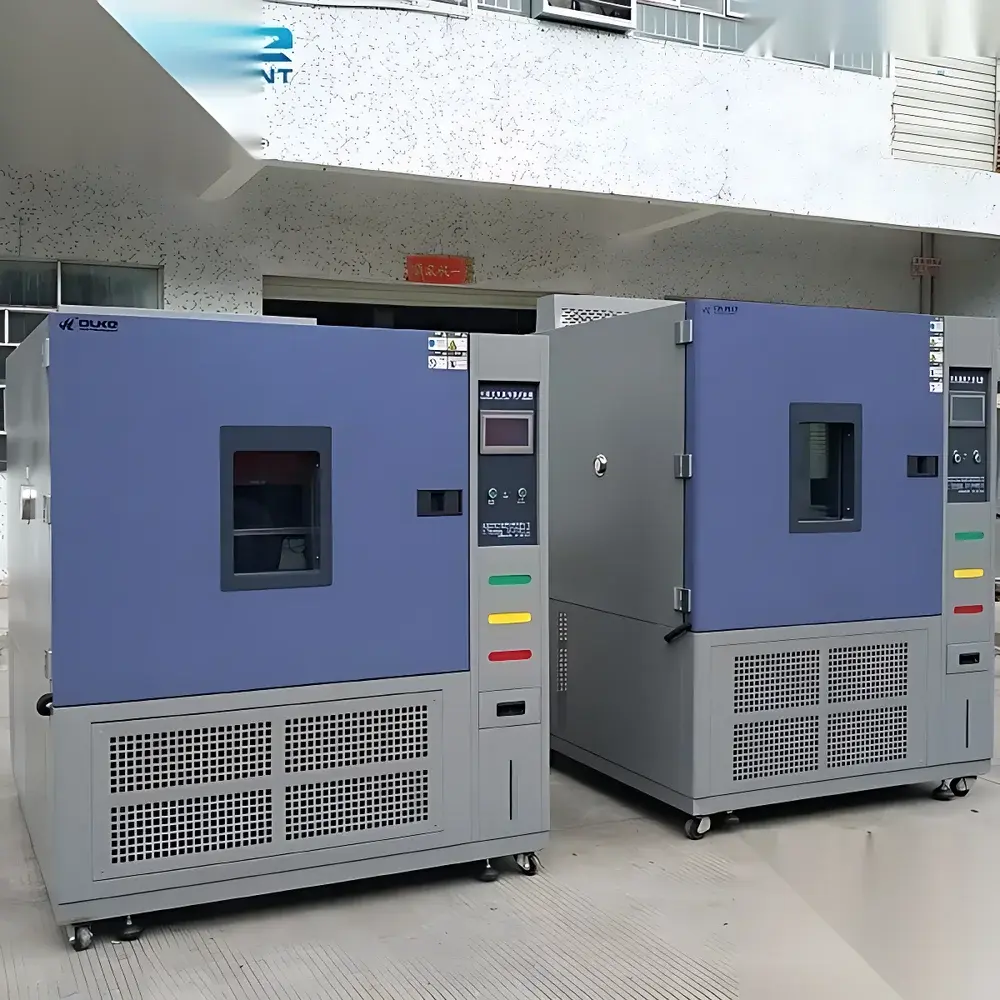
Camera-Specific Temperature and Humidity Controlled Environmental Test Chamber
| Key | Temperature Range: −40 °C to +150 °C (optional −120 °C) |
|---|---|
| Humidity Range | 30–98% RH (optional 5–98% RH) |
| Temperature Resolution | 0.01 °C |
| Humidity Resolution | 0.1% RH |
| Temperature Uniformity | ±0.5 °C |
| Temperature Deviation | ≤±2 °C |
| Humidity Deviation | ≤±2.5% RH |
| Heating Rate | 2.0–3.0 °C/min |
| Cooling Rate | 0.7–1.0 °C/min |
| Control System | TEMI880 Color LCD Touchscreen Controller |
| Power Supply | 380 V ±5%, 50 Hz, 3P+N+G |
Overview
The Camera-Specific Temperature and Humidity Controlled Environmental Test Chamber is an engineered precision environmental simulation system designed explicitly for the reliability validation of imaging modules, embedded vision systems, automotive ADAS cameras, smartphone camera assemblies, and industrial machine vision sensors. Unlike generic environmental chambers, this model integrates structural and thermal management features optimized for optical payload integrity—minimizing condensation risk on lens surfaces, suppressing internal air turbulence that induces focus drift, and maintaining stable thermal gradients across multi-sensor arrays during dynamic temperature transitions. It operates on a dual-loop PID-controlled refrigeration and humidification architecture, compliant with fundamental thermodynamic principles of psychrometric control and forced-air convection uniformity. The chamber supports both steady-state conditioning and programmable thermal/hygric cycling protocols, enabling accelerated life testing, cold-start verification, dew-point margin analysis, and humidity-induced fogging evaluation per industry-critical design verification requirements.
Key Features
- Optimized internal airflow design with laminar-flow diffusers and non-turbulent recirculation paths to prevent lens surface micro-condensation and optical path distortion during high-humidity exposure.
- Dual-stage cascade refrigeration system with low-GWP refrigerant (R507/R23 blend), enabling stable operation down to −40 °C standard (−120 °C optional) without compressor overload or ice accumulation in humidified zones.
- High-stability stainless-steel inner chamber (SUS304) with electropolished finish—resistant to corrosion from repeated RH cycling and compatible with cleanroom-grade validation protocols.
- TEMI880 color touchscreen controller with real-time graphing, multi-segment ramp-soak programming, and built-in data logging (up to 10,000 cycles, timestamped at 1-second intervals).
- Independent humidity generation via steam injection with deionized water pre-heating—ensuring rapid RH response (<60 s to reach target from 30% to 90% RH) and eliminating mineral residue buildup on optical components.
- Modular power architecture supporting 380 V/50 Hz three-phase supply (standard) or configurable 220 V single-phase input for lab-scale integration.
Sample Compatibility & Compliance
This chamber accommodates camera modules up to 600 mm × 600 mm × 600 mm (W×D×H), with dedicated mounting brackets, cable feedthroughs (IP65-rated), and optional vibration-isolated optical benches. All performance specifications—including temperature uniformity (±0.5 °C), humidity deviation (≤±2.5% RH), and ramp rate linearity—are verified under ISO/IEC 17025-accredited calibration conditions at 25 °C ambient, no-load state. The system complies with core test standard methodologies including IEC 60068-2-1 (cold), IEC 60068-2-2 (dry heat), IEC 60068-2-30 (damp heat, cyclic), and ASTM D4332 (conditioning of plastics). It supports full traceability documentation required for automotive AEC-Q200 qualification, IPC-J-STD-020 moisture sensitivity level (MSL) preconditioning, and MIL-STD-810H Method 502.7 (low temperature) and Method 507.6 (humidity).
Software & Data Management
The TEMI880 controller provides native CSV export, USB mass storage support, and Ethernet-based remote monitoring via Modbus TCP or HTTP API. Optional software packages include TESTManager Pro for automated test sequence execution, statistical process control (SPC) charting, and audit-ready reporting aligned with FDA 21 CFR Part 11 requirements—including electronic signatures, user-level access controls, and immutable audit trails for all parameter changes and cycle executions. Data integrity is preserved through redundant SD-card logging and automatic timestamp synchronization with NTP servers. All firmware updates are digitally signed and validated prior to installation to ensure regulatory continuity in GLP/GMP environments.
Applications
- Thermal shock validation of CMOS image sensors under −40 °C to +85 °C cycling with simultaneous 85% RH soak for solder joint and die-attach reliability assessment.
- Dew-point margin testing of automotive surround-view camera housings to verify seal integrity and anti-fog coating performance across −30 °C to +70 °C transitions.
- Humidity-induced focus shift characterization of telecentric lenses used in AOI inspection systems, correlating RH-induced refractive index variation with MTF degradation.
- Pre-conditioning of camera modules prior to HALT/HASS testing to establish baseline optical performance envelopes under controlled hygrothermal stress.
- Qualification of waterproof enclosures (IP67/IP68) using combined temperature-humidity-pressure profiles simulating real-world deployment in tropical or arctic climates.
FAQ
What is the minimum achievable temperature with full humidity capability?
The chamber maintains full 5–98% RH functionality down to −40 °C. Below this point, humidity control is disabled to prevent frost formation on sensors and humidifier elements; optional −120 °C operation is dry-only.
Can the chamber accommodate live video signal monitoring during testing?
Yes—standard configurations include two IP65-rated PG13.5 cable ports and optional fiber-optic feedthroughs for real-time HDMI/MIPI CSI-2 signal transmission without EMI interference.
Is calibration certification included with delivery?
A factory-issued NIST-traceable calibration report (covering temperature and humidity sensors per ISO/IEC 17025) is provided. On-site IQ/OQ/PQ validation support is available upon request.
How is condensation prevented on camera lens surfaces during high-RH ramp-downs?
The system employs a controlled dehumidification ramp strategy—reducing RH before lowering temperature—and includes optional desiccant-assisted purge mode to maintain dew-point safety margins below lens surface temperature.
Does the controller support custom test profiles for automotive OEM-specific standards (e.g., VW 80101)?
Yes—the TEMI880 supports user-defined profile libraries with conditional branching, dwell logic, and pass/fail threshold alerts, fully configurable to meet VW, GM, Ford, and Toyota environmental specification templates.



