
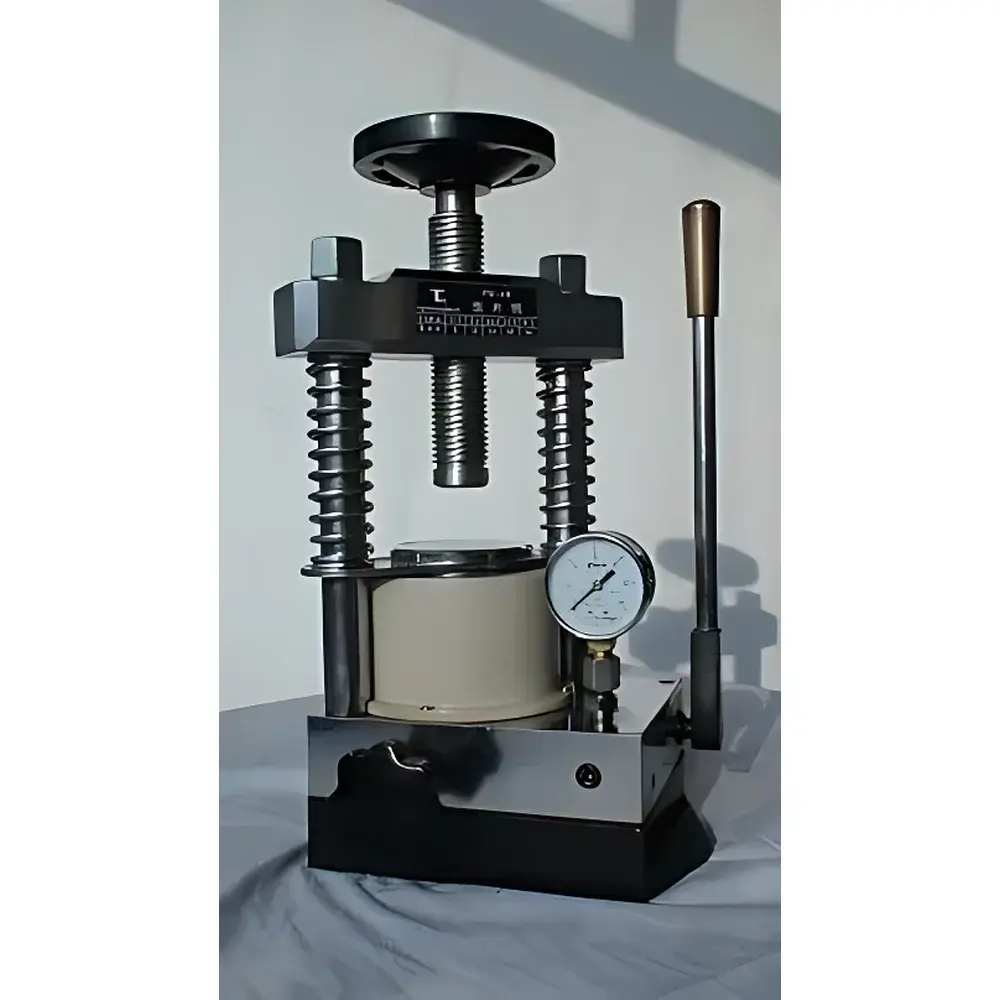
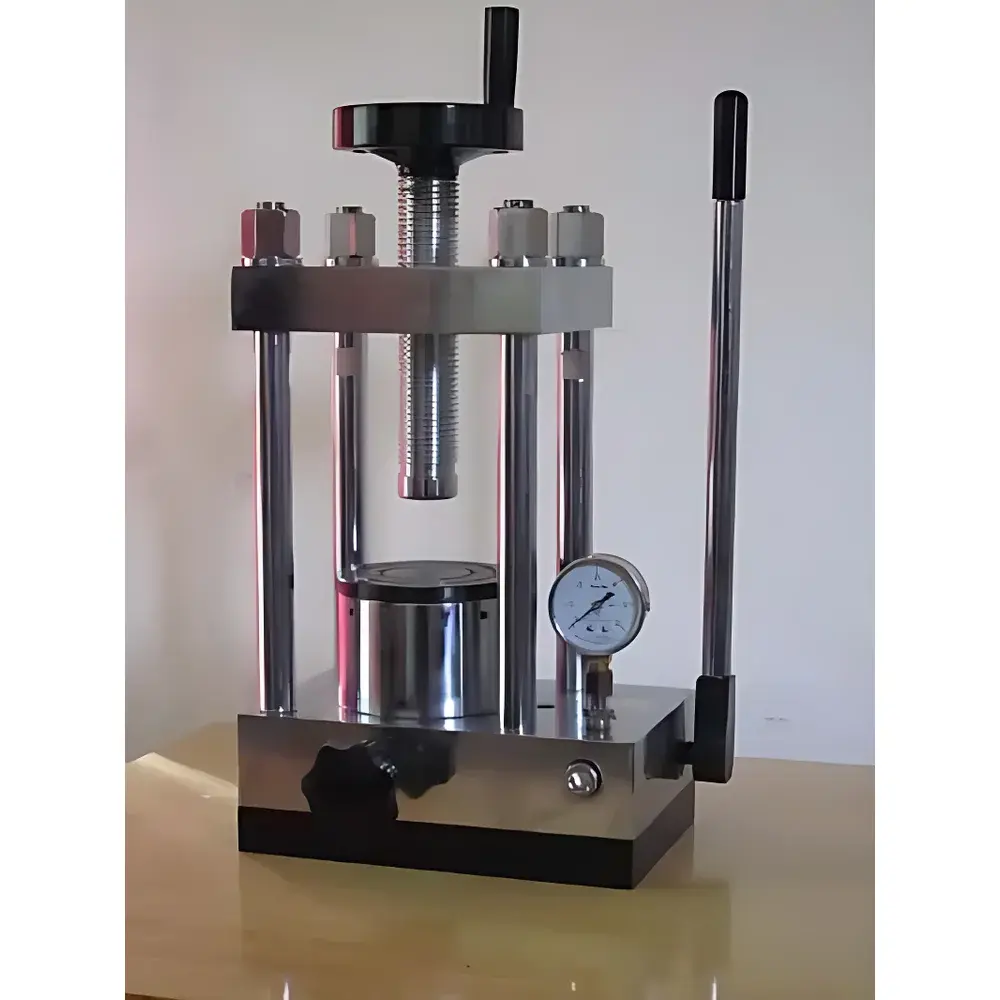
FW-4 Manual Hydraulic Pellet Press
| Origin | Beijing, China |
|---|---|
| Manufacturer Type | Authorized Distributor |
| Model | FW-4 |
| Price | USD 920 (FOB) |
| Max. Pressure | 30 tons (294 kN) |
| Piston Stroke | 30 mm |
| Sample Chamber | 100 × 100 × 100 mm |
| Hydraulic Fluid | ISO VG 46 Mineral Oil |
| Dimensions | 250 × 210 × 480 mm |
| Weight | 40 kg |
| Cylinder Cross-sectional Area | 0.636 dm² (63.6 cm²) |
Overview
The FW-4 Manual Hydraulic Pellet Press is a precision-engineered laboratory instrument designed for reproducible, high-force compaction of powdered samples into uniform, self-supporting pellets—primarily for Fourier Transform Infrared (FTIR) spectroscopy analysis. Operating on fundamental hydraulic amplification principles, the press converts manually applied force via a hand-operated pump into controlled, stable pressure across a large-diameter piston (63.6 cm² cross-section), enabling precise pressure calibration: Pton = 0.636 × PMPa. Unlike pneumatic or electromechanical alternatives, its fully mechanical hydraulic architecture eliminates dependency on external power sources or compressed air, ensuring intrinsic stability and long-term pressure hold—critical for spectral consistency in KBr, polyethylene, or ceramic matrix pellet preparation. The FW-4 meets core functional requirements for GLP-compliant sample preparation workflows in analytical chemistry, materials science, and pharmaceutical QC laboratories.
Key Features
- Stable, non-decaying pressure retention: Engineered sealing system prevents oil leakage and pressure drift during dwell—validated for ≥5-minute hold times at full 30-ton load.
- Expanded sample chamber: 100 × 100 × 100 mm clear internal volume accommodates standard FTIR dies (e.g., 13 mm, 25 mm, 32 mm diameter) and custom tooling for ceramics, battery cathode powders, or geological specimens.
- Dual-pressure capability: Calibrated for operation up to 30 tons (294 kN); optional gauge range supports accurate readout from 5–30 tons with ±1.5% full-scale linearity per ASTM E4.
- Rugged cast-iron frame with machined steel platen surfaces ensures parallelism ≤0.02 mm/m and minimal deflection under load—essential for uniform pellet thickness and optical homogeneity.
- ISO VG 46-compatible hydraulic circuit with integrated relief valve and bleed port enables safe, maintenance-friendly fluid servicing and air purging.
Sample Compatibility & Compliance
The FW-4 is routinely deployed in preparation of IR-transparent pellets from hygroscopic salts (KBr, CsI), conductive fillers (graphene, carbon black), inorganic oxides (Al₂O₃, TiO₂), and polymer blends. Its pressure stability and dimensional repeatability support compliance with ASTM E1252 (Standard Practice for General Techniques for Infrared Quantitative Analysis) and USP (Infrared Absorption Spectroscopy). The absence of electrical components renders it suitable for inert-atmosphere glovebox integration (with optional sealed hydraulic lines). All structural materials comply with RoHS Directive 2011/65/EU; surface finishes meet ISO 8501-1 Sa 2½ for corrosion resistance in controlled lab environments.
Software & Data Management
As a manually operated hydraulic press, the FW-4 does not incorporate embedded electronics or digital control interfaces. Pressure application and dwell timing are operator-managed using calibrated analog gauges and mechanical stopwatches—ensuring full auditability and eliminating firmware-related validation burdens. For laboratories operating under FDA 21 CFR Part 11 or ISO/IEC 17025, documented SOPs—including gauge calibration certificates (traceable to NIST standards), pressure hold logs, and die-specific compression protocols—are maintained externally. Optional third-party load-cell adapters (e.g., Omega LCM series) may be integrated for analog voltage output (0–10 V) compatible with LabVIEW™ or MATLAB® data acquisition systems.
Applications
- Preparation of transmission-mode FTIR pellets for qualitative identification and quantitative assay of APIs, excipients, and degradation products.
- Densification of ceramic green bodies (e.g., ZrO₂, BaTiO₃) prior to sintering studies in materials R&D.
- Compaction of electrode powder mixtures (LiCoO₂ + PVDF + acetylene black) for electrochemical characterization.
- Formation of pressed discs for X-ray fluorescence (XRF) and wavelength-dispersive spectroscopy (WDS) calibration standards.
- Controlled consolidation of soil, sediment, or mineral powders for geochemical reference material development.
FAQ
What is the maximum recommended dwell time at full 30-ton pressure?
Sustained pressure hold up to 10 minutes is verified for thermal and mechanical stability; extended holds (>15 min) require periodic gauge verification due to ambient temperature effects on hydraulic fluid viscosity.
Can the FW-4 be used with heated dies for thermoplastic matrix compaction?
Yes—external heating plates (up to 200°C) may be mounted on the upper/lower platens; ensure hydraulic seals are rated for elevated temperatures and avoid direct contact with hot surfaces.
Is calibration certification included with shipment?
Each unit ships with a factory-issued pressure calibration report (gauge reading vs. dead-weight test stand), traceable to national metrology institutes; annual recalibration is recommended per ISO/IEC 17025 Clause 6.6.
What maintenance intervals are specified for hydraulic oil replacement?
ISO VG 46 oil must be replaced every 500 operating hours or biannually—whichever occurs first—to maintain viscosity index and anti-wear performance per DIN 51524 Part 2.
Are spare parts such as O-rings and seal kits available?
Yes—complete hydraulic seal kits (including Parker NBR #70 durometer compounds), piston rod wipers, and gauge assemblies are stocked and supplied with OEM part numbers for global sourcing.




