
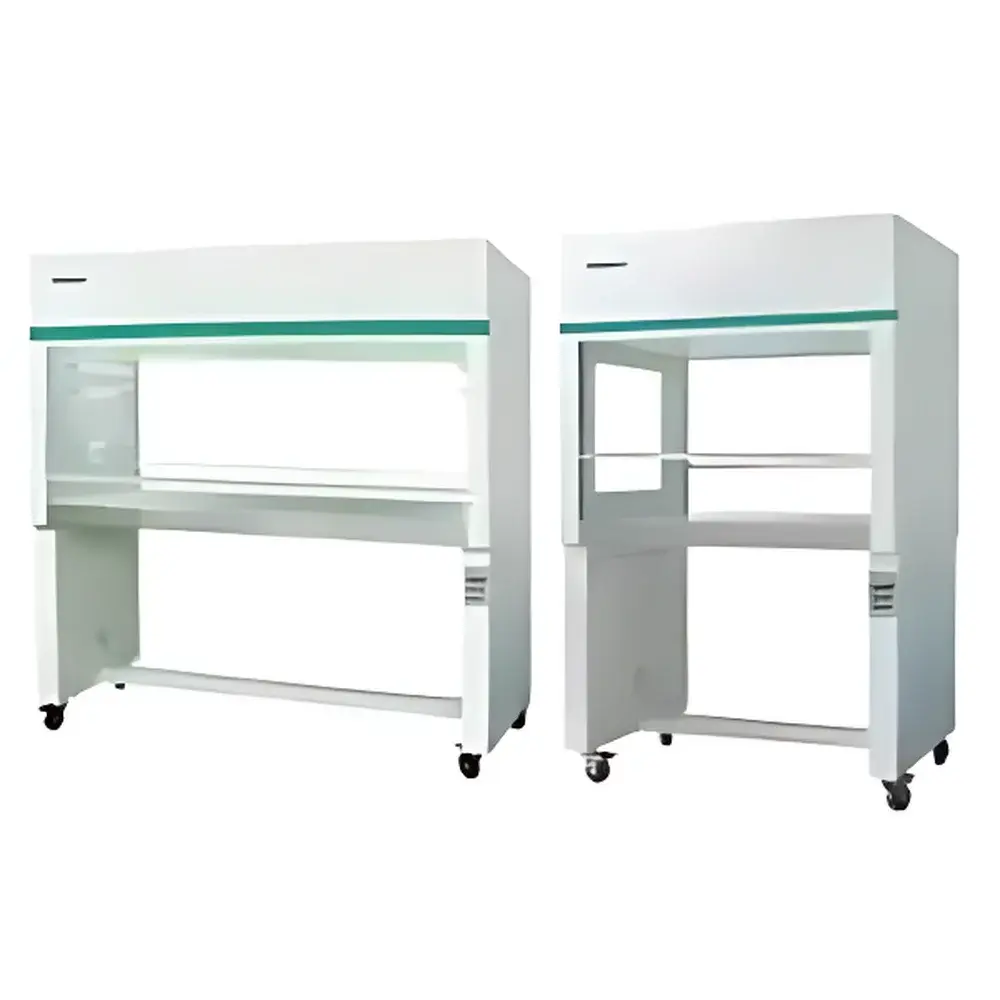
SW-CJ-1FD Vertical Laminar Flow Clean Bench
| Origin | Jiangsu, China |
|---|---|
| Manufacturer Type | Distributor |
| Product Origin | Domestic |
| Model | SW-CJ-1FD |
| Quotation | USD 980 (FOB Jiangsu) |
| Instrument Category | Vertical Flow Clean Bench |
| Cleanliness Class | ISO 5 (equivalent to Class 100 per US Federal Standard 209E) |
| Noise Level | ≤62 dB(A) |
| User Capacity | Single-user, single-sided operation |
| Airflow Pattern | Vertical unidirectional laminar flow |
| Average Air Velocity | ≥0.3 m/s (adjustable) |
| Illumination | ≥300 lx |
| UV Lamp | 14 W × 1 |
| Fluorescent Lamp | 14 W × 1 |
| Work Area Dimensions (W×D×H) | 870 × 690 × 520 mm |
| Overall Dimensions (W×D×H) | 1010 × 730 × 1600 mm |
| HEPA Filter Specification | 820 × 650 × 50 mm × 1 unit |
| Microbial Contamination | ≤0.5 CFU/plate (90 mm Petri dish, 4-hour exposure) |
| Power Supply | 220 V / 50 Hz |
| Input Power | 250 VA |
| Net Weight | 130 kg |
| Construction | Electrostatically painted steel frame with seamless stainless steel work surface |
| Fan System | Electronically controlled variable-speed centrifugal blower with touch-sensitive voltage regulator |
| Safety Interlock | UV lamp automatically deactivates when sash is opened or during operation mode transition |
Overview
The SW-CJ-1FD Vertical Laminar Flow Clean Bench is an ISO 5-certified (Class 100 per US FED-STD-209E) personnel-protective and product-protective workstation engineered for non-hazardous applications requiring particulate-free environments. It operates on the principle of vertical unidirectional laminar airflow: ambient air is drawn through a pre-filter, conditioned by a high-efficiency particulate air (HEPA) filter (≥99.99% @ 0.3 µm), and delivered downward across the work surface at a uniform, adjustable velocity of ≥0.3 m/s. This airflow pattern forms a continuous, low-turbulence barrier that sweeps airborne contaminants—including viable microorganisms, dust, and aerosols—away from the operator and out of the work zone via a front grille and rear exhaust plenum. Unlike biological safety cabinets, the SW-CJ-1FD does not recirculate air nor provide protection against biohazards; it is strictly intended for aseptic handling of non-infectious materials in pharmaceutical QC labs, cell culture preparation areas, electronics assembly cleanrooms, and academic teaching laboratories where sterility assurance—not personnel containment—is the primary objective.
Key Features
- Vertically oriented laminar airflow architecture compliant with ISO 14644-1 Class 5 performance criteria and aligned with ASTM E2500-13 guidance for cleanroom equipment qualification.
- Electronically regulated dual-speed centrifugal blower system with touch-sensitive voltage control, enabling precise adjustment of face velocity within the validated operating range (0.3–0.45 m/s) to accommodate varying procedural requirements and filter loading conditions.
- Seamless, electropolished 304 stainless steel work surface integrated into a fully enclosed, quasi-sealed chassis design—minimizing crevices, preventing cross-contamination, and supporting routine cleaning with ethanol, isopropanol, or sodium hypochlorite solutions per ISO 14644-5 protocols.
- Dual independent lighting system: 14 W fluorescent lamp (≥300 lx at work surface, IEC 60598-1 compliant) for visual task illumination and a separate 14 W germicidal UV-C lamp (254 nm) with mechanical interlock to prevent accidental exposure during operation.
- Structural integrity reinforced by cold-rolled steel housing with epoxy-polyester electrostatic coating (thickness ≥60 µm), corrosion-resistant hardware, and vibration-damped mounting for stable long-term operation in multi-shift laboratory environments.
Sample Compatibility & Compliance
The SW-CJ-1FD is suitable for processing sterile media, tissue culture flasks, Petri dishes, microcentrifuge tubes, optical components, and semiconductor wafers—provided all materials are non-volatile, non-toxic, and non-aerosol-generating. It is not rated for use with volatile organic solvents, radioactive isotopes, or pathogenic agents requiring BSL-2 or higher containment. The unit complies with GB/T 25222–2010 (Chinese national standard for clean benches), meets electromagnetic compatibility (EMC) requirements per IEC 61326-1, and conforms to electrical safety standards IEC 61010-1 for laboratory equipment. While not certified to UL 61010-1 or EN 61010-1 for North American/European markets without local certification, its design principles align with ISO 13485:2016 Annex A expectations for clean environment infrastructure in medical device manufacturing support zones.
Software & Data Management
The SW-CJ-1FD is a manually operated, analog-control clean bench with no embedded microprocessor, digital interface, or data logging capability. All operational parameters—including fan speed, UV activation, and lighting—are managed via discrete tactile switches. For GxP-regulated environments (e.g., GLP-compliant analytical labs or GMP Annex 1-aligned pharmaceutical facilities), users must implement external monitoring: calibrated anemometers (traceable to NIST or equivalent NMIs) for periodic face velocity verification, particle counters (ISO 21501-4 compliant) for routine cleanliness classification audits, and logbooks or electronic quality management systems (QMS) for maintenance records, filter replacement tracking (recommended every 12–18 months under typical usage), and UV intensity validation (using radiometric dosimeters per ISO 15858). No FDA 21 CFR Part 11 compliance features are included; integration with LIMS or MES requires third-party sensor add-ons and custom configuration.
Applications
- Aseptic preparation of microbiological growth media and inoculation of agar plates in clinical and research microbiology laboratories.
- Handling of primary cell cultures, stem cells, and transfection reagents in university and biotech R&D settings where biosafety level 1 (BSL-1) containment suffices.
- Assembly and inspection of precision optical assemblies, MEMS devices, and printed circuit boards in class ISO 5 cleanrooms or segregated lab zones.
- Standardization of weighing procedures for reference standards in analytical chemistry labs per USP environmental control recommendations.
- Supporting ISO/IEC 17025-accredited testing activities where background particulate interference must be minimized during gravimetric analysis or filter-based sampling.
FAQ
What is the difference between a vertical laminar flow clean bench and a biological safety cabinet?
A vertical laminar flow clean bench protects only the sample—not the operator—by directing filtered air downward over the work surface. A biological safety cabinet (BSC) provides simultaneous protection for personnel, product, and environment using inward airflow, recirculation, and exhaust filtration—making it mandatory for handling infectious agents.
Can the SW-CJ-1FD be used for handling hazardous chemicals?
No. It lacks chemical fume extraction capability and is not designed for volatile, toxic, or corrosive substances. A dedicated ducted or recirculating fume hood meeting ANSI/ASHRAE 110 or EN 14175 standards is required.
How often should the HEPA filter be replaced?
Under continuous 8-hour/day operation in low-particulate environments, replace the HEPA filter every 12–18 months—or sooner if differential pressure across the filter exceeds 250 Pa (measured via built-in manometer or external gauge) or if particle counter data indicates loss of ISO 5 compliance.
Is UV irradiation sufficient for sterilizing the work surface?
UV-C provides surface disinfection but does not replace manual cleaning. Always wipe the stainless steel surface with 70% ethanol before and after UV exposure; verify efficacy using biological indicators (e.g., Bacillus atrophaeus spores) per ISO 15883-5 guidelines.
Does this unit meet ISO 14644-1 Class 5 certification out-of-the-box?
The SW-CJ-1FD is designed and tested to achieve ISO 5 performance; however, final classification requires on-site commissioning—including airflow visualization (smoke studies), particle counting (≥525,000 samples per ISO 14644-1:2015 Annex B), and velocity mapping—performed by an accredited cleanroom certification body.



