
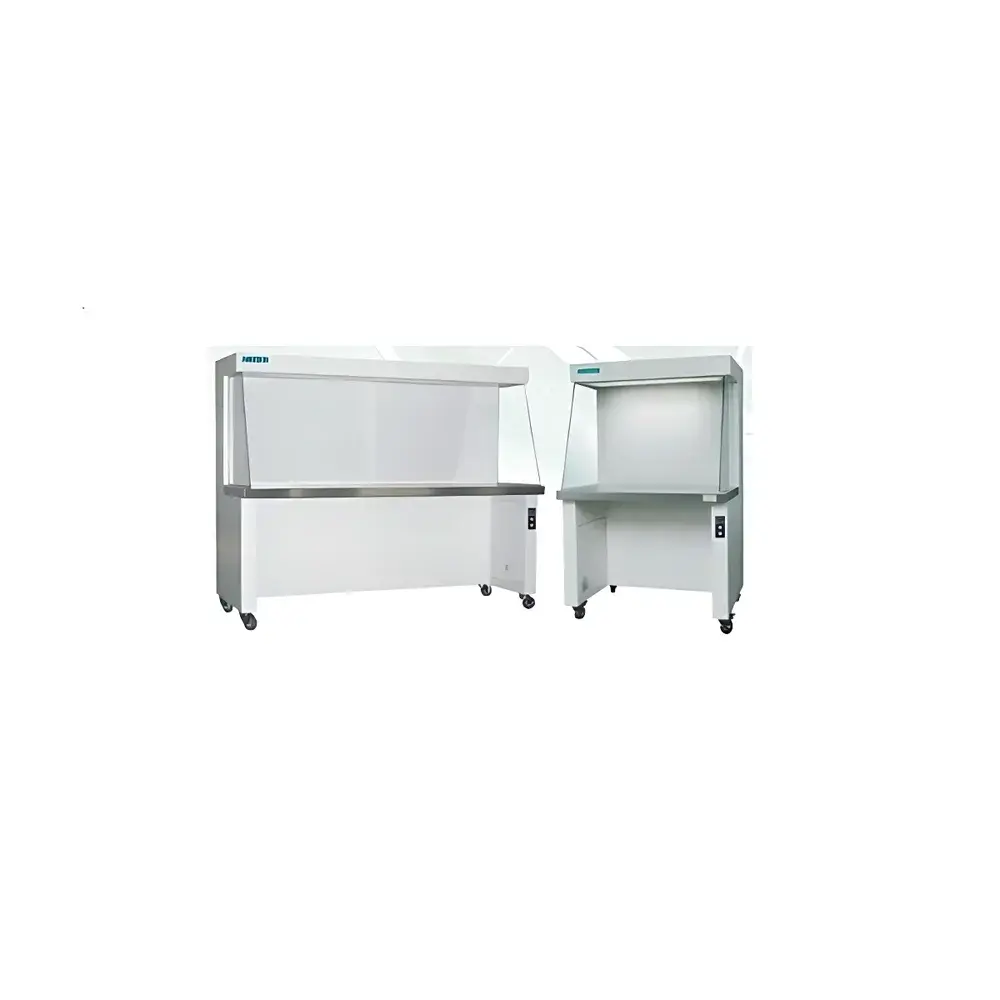
SW-CJ-1C Clean Bench (Horizontal Laminar Flow Workstation)
| Origin | Jiangsu, China |
|---|---|
| Manufacturer Type | Distributor |
| Origin Category | Domestic |
| Model | SW-CJ-1C |
| Price | USD 1,520 (approx.) |
| Instrument Category | Horizontal Laminar Flow Clean Bench |
| Cleanliness Class | ISO Class 5 (equivalent to US Federal Standard 209E Class 100) |
| Noise Level | ≤62 dB(A) |
| User Capacity | Dual-user, single-face configuration |
| Airflow Pattern | Horizontal laminar flow |
Overview
The SW-CJ-1C Clean Bench is a horizontally configured laminar flow workstation engineered for non-hazardous applications requiring particulate-free environments. It operates on the principle of unidirectional horizontal airflow—air drawn from the rear plenum passes through a high-efficiency particulate air (HEPA) filter (≥99.99% @ 0.3 µm) and exits across the work surface at a controlled, uniform velocity. This design ensures continuous sweeping of airborne contaminants away from the operator and sample zone, maintaining an ISO Class 5 (formerly US FED-STD-209E Class 100) clean environment within the work area. Unlike biological safety cabinets, the SW-CJ-1C does not provide personnel or environmental protection against biohazards; it is strictly intended for aseptic processing of non-infectious materials in laboratories where containment is not required.
Key Features
- Horizontal laminar airflow architecture optimized for ergonomic dual-user operation with single-face access.
- Integrated differential pressure gauge enabling real-time monitoring of HEPA filter loading and service timing.
- Variable-speed centrifugal blower system with soft-touch voltage control, maintaining consistent face velocity between 0.3–0.6 m/s across operational load conditions.
- Work surface fabricated from electropolished 304 stainless steel for corrosion resistance, ease of decontamination, and compliance with GLP cleaning protocols.
- Dual lighting system: 40 W fluorescent lamp for general illumination (≥300 lux at work surface) and optional UV germicidal lamp (254 nm, 40 W) for pre-use surface sterilization—interlocked to prevent accidental UV exposure during operation.
- Robust structural frame with powder-coated steel housing and tempered glass front sash for visibility and splash resistance.
Sample Compatibility & Compliance
The SW-CJ-1C supports a wide range of non-hazardous laboratory procedures including microbial culture handling, plant tissue culture, pharmaceutical formulation, sterile media preparation, and chemical synthesis under controlled particulate conditions. Its design conforms to ISO 14644-1:2015 for cleanroom performance classification and aligns with ASTM E2500-13 guidelines for equipment qualification in regulated environments. While not certified to NSF/ANSI 49 or EN 12469 (standards governing biological safety cabinets), the unit meets general laboratory infrastructure requirements for ISO Class 5 environments per ISO 14644-3:2019 testing methodology. It is suitable for use in facilities operating under GMP Annex 1 (EU) or USP sterile compounding guidelines—provided risk assessments confirm absence of hazardous agents and appropriate environmental monitoring is implemented.
Software & Data Management
The SW-CJ-1C is a standalone mechanical system without embedded microprocessor control or digital data logging capabilities. All operational parameters—including fan speed, lighting status, and UV activation—are managed via analog controls. For integration into quality management systems, users may employ external environmental monitoring systems (EMS) to log temperature, humidity, and particle counts adjacent to the unit. Audit trails for maintenance, filter replacement, and UV lamp usage must be manually recorded per GLP/GMP documentation standards. Optional third-party IoT sensor modules (e.g., particle counters, anemometers) can be deployed upstream/downstream for periodic validation per ISO 14644-2:2015 requirements.
Applications
- Aseptic transfer of cell cultures and microbial isolates in academic and industrial biotechnology labs.
- Preparation of sterile growth media, buffers, and reagents for microbiology and molecular biology workflows.
- Plant tissue culture initiation and subculturing under low-particulate conditions.
- Pharmaceutical dosage form development involving non-sterile active ingredients prior to final filtration or lyophilization.
- Chemical synthesis requiring inert atmosphere compatibility (when used with nitrogen purge accessories).
- Electronics prototyping and optical component handling where electrostatic discharge (ESD)-safe variants are selected.
FAQ
Does the SW-CJ-1C provide protection against biological hazards?
No. It offers product protection only. Personnel and environmental protection require a Class II biological safety cabinet compliant with NSF/ANSI 49.
What is the recommended HEPA filter replacement interval?
Typically every 12–24 months depending on ambient particulate load and usage frequency; validated by differential pressure monitoring and particle challenge testing.
Can the unit be installed in a positive-pressure room?
Yes—horizontal flow benches perform optimally in positively pressurized environments to prevent infiltration of unfiltered air.
Is UV lamp validation required for routine use?
Per USP , UV irradiance mapping and intensity verification must be performed quarterly if UV is used for surface decontamination.
What electrical specifications apply for international deployment?
Standard configuration is 200 V, 50 Hz, single-phase. Custom voltage transformers or 230 V/60 Hz variants are available upon request for CE or UL-compliant installations.



