
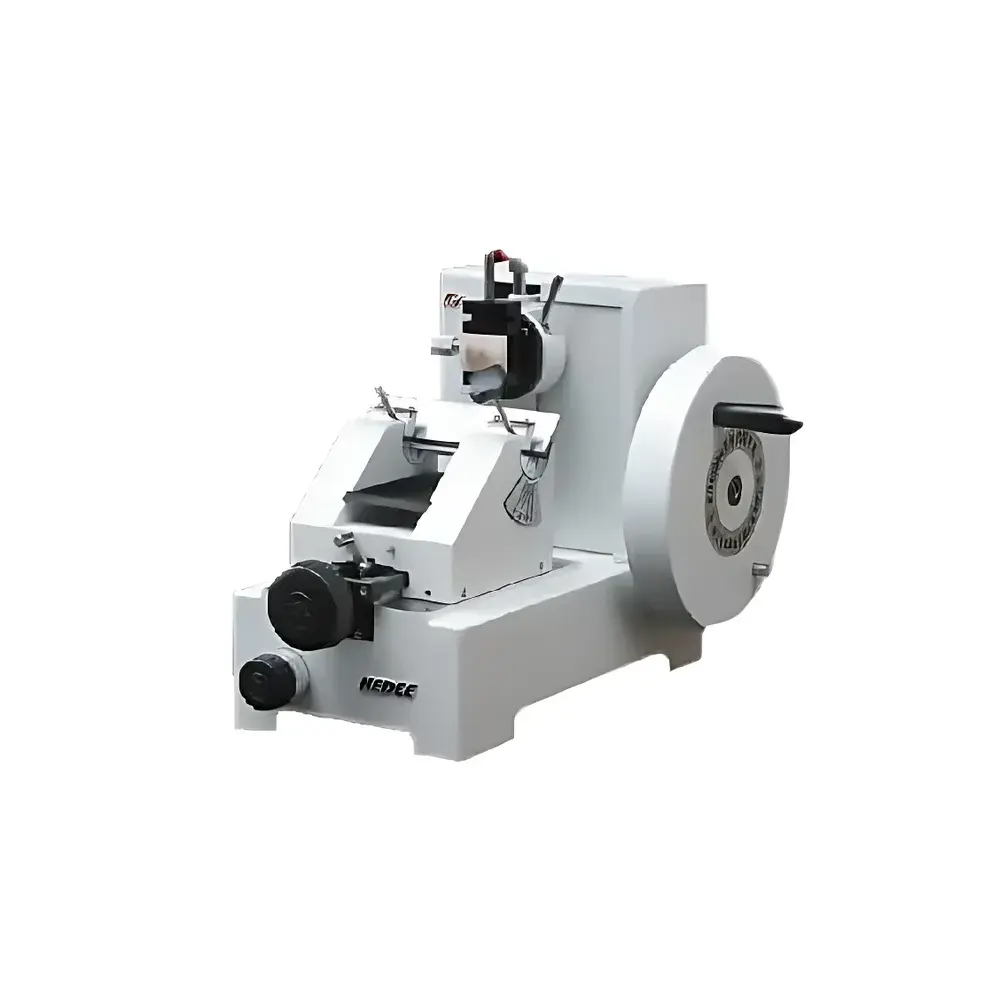
KDS Scientific KD-1508A Rotary Microtome
| Origin | Beijing, China |
|---|---|
| Manufacturer Type | Authorized Distributor |
| Product Category | Domestic (PRC-Made) |
| Model | KD-1508A |
| Price | USD 2,950 (FOB Beijing) |
| Cutting Thickness Range | 1–35 µm (continuous), >35 µm (stepwise) |
| Minimum Thickness Increment | 1 µm |
| Max Specimen Area (Paraffin) | 50 × 40 mm |
| Cutting Accuracy | ±5% |
| Overall Dimensions | 470 × 320 × 320 mm |
| Net Weight | 22.5 kg |
Overview
The KDS Scientific KD-1508A Rotary Microtome is a precision-engineered laboratory instrument designed for reproducible, high-fidelity sectioning of biological and plant tissues embedded in paraffin or resin. Based on the classical rotary microtome principle—where the specimen advances linearly toward a fixed knife during each rotational cycle—the KD-1508A delivers consistent slice geometry through mechanical stability, calibrated feed mechanisms, and rigid frame architecture. Its dual-mode capability (standard paraffin sectioning and optional integration with the KD-VI cryo-module) supports both routine histology workflows and time-sensitive frozen-section protocols in pathology and research laboratories. The device complies with fundamental mechanical safety standards for laboratory equipment (IEC 61010-1) and is engineered for long-term reliability under daily QC/QA and academic use.
Key Features
- Linear feed mechanism with micrometer-driven thickness adjustment, enabling precise sectioning from 1 µm to 35 µm in 1 µm increments; coarse adjustment beyond 35 µm supported via manual override
- Stainless-steel specimen stage with standardized 50 × 40 mm maximum mounting area, compatible with standard aluminum or brass specimen holders (OCT-compatible with optional adapters)
- Integrated knife holder accepting both reusable steel knives (with adjustable tilt angle) and disposable blade cassettes (B-type variant only)
- Robust cast-aluminum base and reinforced column structure minimizing vibration-induced artifacts during cutting
- Ergonomic handwheel with tactile feedback and dual-directional rotation for controlled advancement and retraction
- Tool-free specimen orientation system allowing rapid 360° rotational alignment and 15° incremental tilt adjustments
Sample Compatibility & Compliance
The KD-1508A accommodates a broad range of routinely processed specimens: formalin-fixed paraffin-embedded (FFPE) human and animal tissues, plant stems/roots, polymer-embedded materials, and low-melting-point resins (e.g., LR White). It supports standard histological embedding media including paraffin wax (melting point 56–60 °C), low-viscosity infiltration resins, and hydrophilic gels. When paired with the optional KD-VI cryo-module (sold separately), the system meets core operational requirements for frozen sectioning per CAP (College of American Pathologists) and CLIA guidelines—including thermal stability at –55 °C, rapid cooldown (<7 min), and independent cold knife/cold stage temperature monitoring. All mechanical components conform to ISO 8549-1:2021 (microtome terminology and classification) and are suitable for GLP-compliant environments where traceable calibration and maintenance logs are required.
Software & Data Management
The base KD-1508A operates as a fully manual, non-digital instrument—eliminating firmware dependencies and ensuring uninterrupted operation in resource-constrained or electromagnetically sensitive settings. Optional digital upgrades (e.g., KD-1508A-VI configuration) include an integrated LCD interface with dual-channel temperature display (cold stage + cold knife), programmable setpoint memory, auto-defrost cycling with audible alarm, and real-time thermal drift compensation. All temperature parameters comply with ASTM E2877-22 (Standard Guide for Validation of Cryostat Performance) and support audit-ready documentation when connected to external data loggers compliant with FDA 21 CFR Part 11 (electronic records and signatures). No proprietary software installation is required; configuration and calibration data may be exported via RS-232 serial output for LIMS integration.
Applications
- Routine diagnostic histopathology: Hematoxylin & eosin (H&E), special stains (e.g., Masson’s trichrome), and immunohistochemistry (IHC) on FFPE tissue blocks
- Botanical morphology studies requiring thin, artifact-free sections of lignified or sclerenchymatous plant tissues
- Pre-analytical sample preparation for downstream molecular assays (e.g., spatial transcriptomics, laser-capture microdissection)
- Quality control of tissue processing efficacy—assessing infiltration homogeneity, fixation integrity, and embedding shrinkage
- Academic research in developmental biology, neuroanatomy, and comparative histology where inter-laboratory reproducibility is critical
FAQ
What is the recommended knife type for optimal section quality with the KD-1508A?
Steel knives (e.g., Feather S35 or Leica KN35) are recommended for paraffin sections ≥3 µm; disposable blades (e.g., Sakura Super 40) are preferred for sections ≤2 µm or fragile tissues such as brain or embryonic samples.
Can the KD-1508A be used for semi-thin resin sections (0.5–2 µm)?
Yes—when equipped with a glass or diamond knife (via optional knife holder adapter) and operated at reduced speed with optimized clearance angle (1–2°), it achieves acceptable ribbons for light microscopy; however, ultramicrotomy (<0.1 µm) requires dedicated ultramicrotomes.
Is routine calibration required, and how is it performed?
Annual verification of feed accuracy using NIST-traceable step gauges is advised; users may perform in-house validation using calibrated micrometer stages and optical measurement of ribbon thickness under transmitted light microscopy.
Does the KD-1508A meet CE or UL certification requirements for export to the EU or North America?
The unit carries CE marking under the Low Voltage Directive (2014/35/EU) and EMC Directive (2014/30/EU); UL listing is available upon request for specific regional configurations, subject to third-party testing.
What maintenance intervals are recommended for long-term performance?
Lubrication of feed screw and handwheel bearings every 6 months; cleaning of debris traps and stage rails after each session; annual inspection of knife alignment and specimen clamp torque by certified service technician.



