
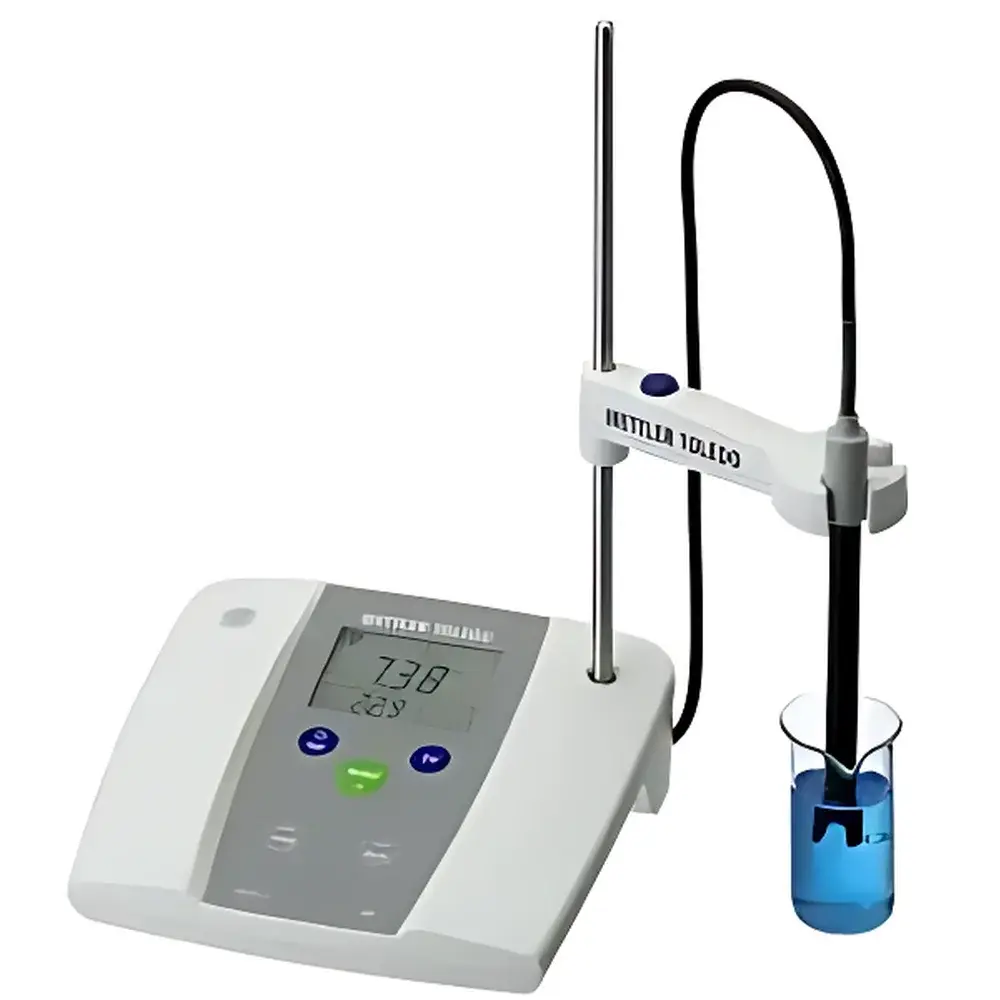
Metler Toledo FiveEasy pH FE20K Benchtop pH Meter
| Origin | Beijing, China |
|---|---|
| Manufacturer Type | Authorized Distributor |
| Origin Category | Domestic (China) |
| Model | FE20K |
| Price | USD 580 (approx.) |
| pH Range | 0.00–14.00 |
| Resolution | 0.01 pH |
| Accuracy | ±0.01 pH |
| mV Range | ±1999 mV |
| mV Accuracy | ±1 mV |
| Temperature Range | 0–100 °C |
| Calibration Points | Up to 3-point |
| Temperature Compensation | Automatic or Manual |
| Endpoint Detection | Automatic or Manual |
| Buffer Recognition | Yes |
| Electrode Status Indicator | Yes |
| Slope Display | Yes |
| Reference Electrode Input | Yes |
Overview
The Mettler Toledo FiveEasy pH FE20K is a rigorously engineered benchtop pH meter designed for routine electrochemical measurements in regulated and non-regulated laboratory environments. Built upon the proven FiveEasy platform, the FE20K operates on potentiometric measurement principles—detecting the potential difference between a pH-sensitive glass electrode and a stable reference electrode in aqueous solution—to deliver traceable, reproducible pH, mV, and ion concentration (via standard curve method) results. Its architecture adheres to fundamental electrochemical standards including ISO 7888 (water quality — determination of pH), ASTM D1293 (pH of water), and supports alignment with GLP documentation requirements through structured calibration logging and endpoint traceability. The instrument is optimized for stability under ambient lab conditions (20–25 °C, <80% RH) and features an integrated temperature sensor input for accurate compensation during pH assessment.
Key Features
- One-touch operation for calibration, measurement initiation, and mode switching (pH/mV/ion)—minimizing procedural errors and operator training time.
- Flexible calibration protocols: supports 1-, 2-, or 3-point calibration with automatic buffer recognition across three pre-programmed IUPAC/NIST-compliant buffer sets (e.g., pH 4.01, 7.00, 10.01 at 25 °C).
- Dual endpoint detection: automatic (based on signal stability threshold of ±0.01 pH/10 s) or manual override—critical for viscous, low-conductivity, or buffered biological samples where equilibrium kinetics vary.
- Temperature compensation options: automatic (with integrated Pt1000 probe input) or manual entry—ensuring thermodynamic correction per the Nernst equation without external calculation.
- Real-time electrode diagnostics: displays slope (%), offset (mV), and status icon (green/yellow/red) to verify electrode health prior to calibration—reducing out-of-spec measurements.
- Multi-parameter capability: measures pH, redox potential (ORP), and ion activity (e.g., Na⁺, F⁻, Cl⁻) using single- or multi-point calibration curves per ISE methodology.
Sample Compatibility & Compliance
The FE20K is validated for use with aqueous and mildly buffered solutions typical in academic teaching labs, QC release testing, clinical specimen screening (e.g., serum, urine dilutions), and bioprocess intermediate monitoring. It accepts standard BNC-input combination pH electrodes (e.g., LE438, InLab Expert Pro) and all common ISEs with BNC or mini-DIN connectors. While not certified for hazardous area use (ATEX/IECEx), it complies with IEC 61010-1 safety standards for laboratory electrical equipment and EMC Directive 2014/30/EU. Data integrity is supported via timestamped calibration records stored in non-volatile memory—enabling retrospective review per FDA 21 CFR Part 11 principles when paired with controlled access procedures.
Software & Data Management
The FE20K operates as a standalone instrument with no embedded PC software; however, all calibration and measurement data—including date/time stamps, buffer IDs, slope values, temperature readings, and user-entered sample IDs—are retained in internal memory (up to 200 entries). Data export is performed manually via RS232 interface (cable included) to terminal emulation software (e.g., Tera Term, PuTTY) for CSV-compatible logging. No proprietary drivers or cloud connectivity are required, preserving data sovereignty—a key requirement in GMP-aligned facilities handling proprietary formulations or clinical trial samples.
Applications
This instrument serves core functions across multiple sectors: in university chemistry and life sciences labs, it supports undergraduate titration labs and enzyme activity assays requiring precise pH control; in pharmaceutical manufacturing, it verifies buffer preparation consistency pre-sterilization; in food & beverage QA, it monitors fermentation pH stability in dairy and brewing processes; and in clinical research settings, it aids hematology labs in validating pH-sensitive reagent stability for coagulation assays. Its robustness, intuitive workflow, and compliance-ready calibration audit trail make it suitable for ISO 17025-accredited testing laboratories performing routine pH verification per SOPs.
FAQ
Does the FE20K support GLP-compliant calibration record keeping?
Yes—each calibration event stores buffer ID, date/time, slope, offset, and temperature. Records are immutable and retrievable via front-panel navigation or RS232 dump.
Can I use non-Mettler electrodes with the FE20K?
Yes, provided they feature standard BNC connectors and comply with pH electrode output specifications (±1999 mV, high-impedance input compatibility).
Is temperature compensation mandatory during pH measurement?
No—manual temperature entry is permitted, but automatic compensation using a compatible Pt1000 probe is recommended for accuracy above ±0.003 pH/°C deviation.
What is the memory capacity for measurement data?
The device stores up to 200 measurement entries with full metadata; older entries are overwritten on a first-in, first-out basis.
Does the FE20K meet USP requirements for pH measurement?
It satisfies instrumental criteria outlined in USP , including resolution (0.01 pH), accuracy (±0.01 pH), and calibration flexibility—though final method validation remains the user’s responsibility.
Related Products





