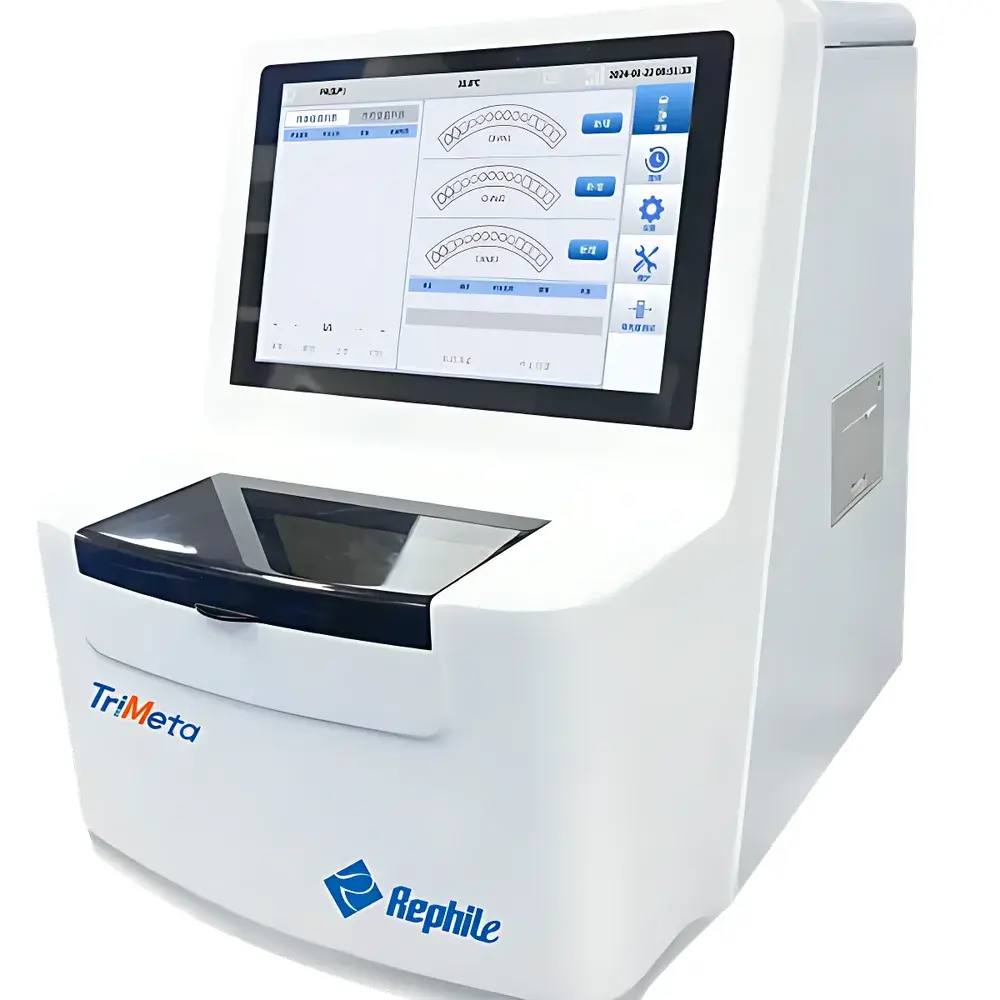
RephiLe TriMeta BioProcess Analyzer
| Brand | RephiLe |
|---|---|
| Model | TriMeta |
| Origin | Zhejiang, China |
| Manufacturer Type | Manufacturer |
| Instrument Type | Fully Automated Cell Culture Biochemical Analyzer |
| Detection Parameters | Glucose, Lactate, Glutamine, Ammonia, Glycerol, Total Protein (depending on cartridge) |
| Detection Channels | Multi-channel |
| Sample Types | Mammalian cells, Bacteria (e.g., E. coli), Yeast, Insect cells |
| Sample Capacity | 3 samples per run |
| Sample Volume | As low as 10 µL per test |
| Assay Time | 10 min/sample |
| Optical System | LED-based fixed-wavelength photometric array with post-dispersion optics |
| Data Storage | ≥100,000 records with audit-trail-compliant logging |
| Compliance | Supports 21 CFR Part 11, GLP/GMP data integrity requirements |
| Power Supply | AC 100–240 V, 50/60 Hz |
| Operating Temperature | 10–40 °C |
| Relative Humidity | ≤80% RH |
| Dimensions (L×W×H) | 387 × 293 × 379 mm |
| Weight | 12 ± 1 kg |
Overview
The RephiLe TriMeta BioProcess Analyzer is a fully automated, benchtop biochemical analyzer engineered for real-time monitoring of critical metabolites and nutrients in bioprocess workflows. Utilizing endpoint and kinetic photometric assays on single-use, pre-packaged reagent cartridges, the TriMeta delivers rapid, precise quantification of key analytes—including glucose, lactate, glutamine, ammonia, glycerol, and total protein—without manual calibration or fluidic maintenance. Its optical architecture employs a sealed, fixed-wavelength LED photometric array with post-dispersion optics, eliminating moving parts, optical alignment drift, and liquid-path contamination risks. Designed specifically for upstream process development and cell culture QC/QA, the TriMeta supports high-frequency sampling in fed-batch and perfusion systems while minimizing sample consumption and operator intervention.
Key Features
- Fully automated operation with zero liquid handling infrastructure—no pumps, valves, tubing, or waste reservoirs; eliminates carryover and reduces downtime.
- Pre-loaded, factory-calibrated reagent cartridges for defined analyte panels (e.g., mammalian: glucose + lactate; E. coli: glucose + glycerol + ammonia; yeast: glucose + lactate + glycerol + total protein).
- Ultra-low sample requirement: 10 µL per assay, enabling frequent monitoring from small-volume bioreactor samples without compromising culture integrity.
- High-precision dispensing with ≤±5% volumetric error and ≤2% coefficient of variation (CV) across repeated pipetting cycles.
- Integrated barcode scanner for automatic sample ID recognition and traceable assay assignment.
- Onboard touchscreen interface with optional external mouse/keyboard support; real-time display of reaction kinetics, status flags, and result validation indicators.
- Embedded thermal printer and USB/export-ready data interface for immediate hardcopy reporting and LIMS integration.
- Three-tier user account management (Administrator, Supervisor, Operator) with role-based access control and immutable audit trail logging per FDA 21 CFR Part 11 requirements.
Sample Compatibility & Compliance
The TriMeta accommodates diverse suspension cultures—including CHO, HEK293, Sf9, E. coli, and S. cerevisiae—with no sample pretreatment required beyond standard centrifugation or filtration. Cartridge-specific chemistries are validated for matrix tolerance across typical cell culture supernatants (0–20 × 10⁶ cells/mL, turbidity ≤200 NTU). All assay protocols comply with ISO 15197:2013 performance criteria for precision and linearity, and system software meets ALCOA+ principles for data integrity. The device supports full 3Q validation (IQ/OQ/PQ) documentation packages, including installation verification, operational boundary testing, and performance qualification against NIST-traceable reference standards.
Software & Data Management
TriMeta Control Software provides intuitive assay scheduling, result review, trend visualization, and customizable report generation. All analytical events—including user logins/logouts, assay initiation/completion, calibration updates (if applicable), and system alerts—are timestamped, digitally signed, and stored in an encrypted local database (≥100,000 entries). Export formats include CSV, PDF, and XML for seamless integration with ELN, MES, or PAT platforms. Audit trail records are write-once, read-many (WORM), non-erasable, and non-editable—fully aligned with 21 CFR Part 11 Subpart B and EU Annex 11 regulatory expectations for electronic records in GxP environments.
Applications
- Bioreactor process monitoring: Real-time tracking of nutrient depletion and byproduct accumulation during monoclonal antibody, viral vector, or recombinant protein production.
- Cell line selection and media optimization: High-throughput comparison of metabolic profiles across clone candidates or feed strategies.
- QC release testing: Rapid verification of harvest timepoints based on lactate/glucose ratios or ammonia thresholds.
- Perfusion system control: Feedback-driven medium exchange decisions using continuous metabolite trending.
- Academic and CMC labs: Method transfer support for DOE studies requiring robust, low-variance biochemical endpoints.
FAQ
Does the TriMeta require daily calibration or routine optical alignment?
No. All reagent cartridges are factory-calibrated and contain lot-specific calibration coefficients embedded in RFID tags. The fixed-wavelength LED array and sealed optical path eliminate the need for user-performed calibration or alignment.
Can I customize assay panels beyond the listed kits?
Cartridge chemistry is pre-formulated and not field-modifiable. Custom assay development services are available through RephiLe’s R&D partnership program under NDA.
Is the system compatible with sterile sampling workflows?
Yes. The 10 µL sample volume enables direct aspiration from sterile sampling ports using aseptic technique; disposable tips and cartridges ensure complete isolation between runs.
How is data backup and disaster recovery handled?
The internal database supports scheduled automated backups to external USB drives. Full system image export is available via service mode for IT-managed restore procedures.
What validation documentation is supplied with the instrument?
Each unit ships with a Factory Acceptance Test (FAT) report, IQ/OQ protocol templates, and a PQ-ready test script library aligned with USP , EP 2.2.44, and ASTM E2500-13 guidelines.
Related Products