
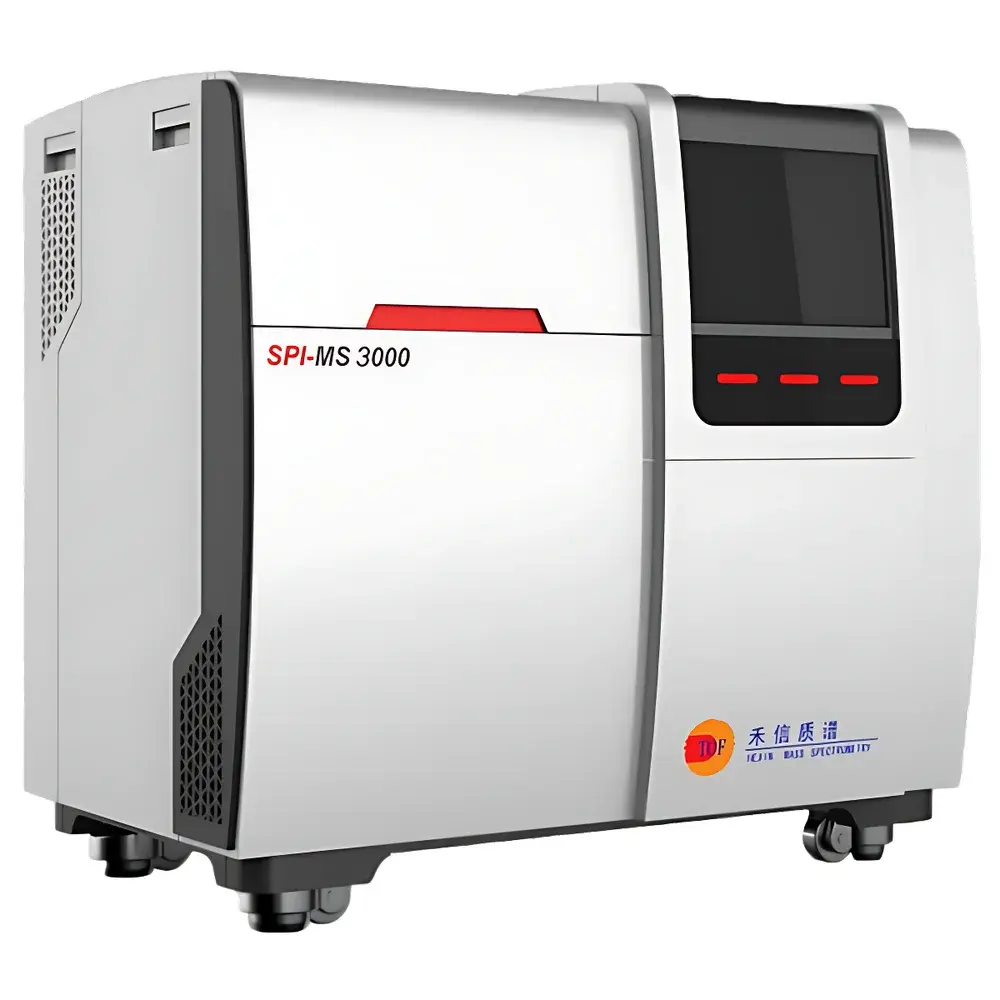
SPI-MS 3000 High-Sensitivity Online Time-of-Flight Mass Spectrometer for Volatile Organic Compounds
| Brand | HEXIN Mass Spectrometry |
|---|---|
| Origin | Guangdong, China |
| Manufacturer Type | Authorized Distributor |
| Product Origin | Domestic (China) |
| Model | SPI-MS 3000 |
| Pricing | Upon Request |
Overview
The SPI-MS 3000 is a high-sensitivity, real-time online time-of-flight mass spectrometer engineered for continuous, unattended detection of volatile and semi-volatile organic compounds (VOCs and SVOCs) in gaseous and liquid-phase process streams. It operates on the principle of single-photon ionization (SPI) coupled with orthogonal time-of-flight (TOF) mass analysis—a configuration optimized for molecular ion preservation, minimal fragmentation, and high mass resolution. The instrument integrates a polydimethylsiloxane (PDMS) membrane-based permeation interface, enabling direct, non-invasive sampling from pressurized or ambient gas lines or liquid headspace without chemical derivatization, solvent extraction, or thermal desorption. Ionization is performed using a vacuum ultraviolet (VUV) lamp emitting at 10.8 eV—sufficient to ionize most VOCs/SVOCs (ionization energies < 10.8 eV) while leaving common matrix gases (e.g., N₂, O₂, H₂O, CO₂) un-ionized, thereby delivering exceptional selectivity and signal-to-noise ratio. The vertical-reflection TOF analyzer, combined with microchannel plate (MCP) detection and low-noise signal amplification circuitry, ensures sub-nanosecond timing precision and high mass accuracy (< 5 ppm RMS over m/z 50–500).
Key Features
- Direct, zero-prep sampling via PDMS membrane interface—compatible with humid, particulate-laden, or corrosive gas streams (with optional conditioning)
- Soft 10.8 eV single-photon ionization source—preserves intact molecular ions; negligible in-source fragmentation
- Orthogonal injection + reflectron TOF architecture—achieving mass resolution > 3,000 (FWHM) and mass accuracy < 5 ppm
- Real-time acquisition at up to 10 Hz spectral rate—enabling second-scale process dynamics monitoring
- Mass range: m/z 10–500—covering C₁–C₃₀ hydrocarbons, oxygenates, halogenated organics, aromatics, and nitrogen-containing compounds
- Sub-pptv (parts-per-quadrillion by volume) detection limits for key VOCs (e.g., benzene, toluene, formaldehyde) under standard conditions
- Rugged, industrial-grade enclosure (IP54 rated) with temperature-stabilized optics and vacuum system—designed for 24/7 operation in plant environments
Sample Compatibility & Compliance
The SPI-MS 3000 accepts samples directly from ambient air, stack emissions, bioreactor off-gas, reactor headspace, or liquid-phase headspace (via heated sparge or diffusion probe). It supports integration with standardized sampling systems compliant with EPA Method TO-15/TO-17 equivalents and ISO 16000-6 for indoor air VOC profiling. Data integrity meets GLP and GMP-aligned workflows: audit trails, user access levels, electronic signatures, and raw data immutability are enforced in firmware. While not pre-certified for FDA 21 CFR Part 11, the system architecture supports validation packages—including IQ/OQ/PQ protocols—and is routinely deployed in pharmaceutical cleanroom monitoring, chemical process safety (PSM), and environmental compliance applications where trace VOC quantification must satisfy ISO/IEC 17025 laboratory accreditation requirements.
Software & Data Management
The proprietary SPI-MS Control & Analytics Suite provides a browser-based interface compatible with Windows and Linux clients. It features real-time spectral visualization, automated peak identification using NIST MS Library (with customizable custom libraries), multi-component quantification via internal standard or response factor calibration, and dynamic background subtraction. All raw .raw files are stored in open HDF5 format with embedded metadata (timestamp, pressure, temperature, lamp status, calibration history). The software supports OPC UA and Modbus TCP protocols for seamless integration into DCS/SCADA systems. Remote diagnostics, firmware updates, and method deployment are managed via secure TLS 1.2–encrypted channels. Custom algorithm development (e.g., PCA, PLS regression for emission fingerprinting) is supported through Python API bindings.
Applications
- Continuous emissions monitoring (CEMS) for fugitive VOC sources in petrochemical, refinery, and polymer manufacturing
- Real-time reaction pathway tracking in catalytic oxidation, hydrogenation, and fermentation processes
- Pharmaceutical residual solvent verification in lyophilization and drying cycles
- Indoor air quality (IAQ) surveillance in semiconductor cleanrooms and hospital HVAC systems
- Odor source identification and dispersion modeling in wastewater treatment plants and compost facilities
- Field-deployable environmental screening for soil vapor intrusion and landfill gas composition
FAQ
Does the SPI-MS 3000 require carrier gas or vacuum pumps on-site?
No—it uses a sealed, oil-free turbomolecular pumping station integrated into the main chassis; no external compressed gas supply is needed for ionization or transport.
Can it quantify compounds without certified standards?
Semi-quantitative analysis is possible using relative response factors from structural analogues; however, regulatory-grade quantification requires calibration with traceable standards per ISO 8573-7 or ASTM D6196.
Is the PDMS membrane compatible with hydrogen sulfide or chlorine-containing streams?
Standard PDMS exhibits limited resistance to oxidizing or strongly polar species; optional fluoropolymer-coated membranes or heated inert bypass lines are available for aggressive matrices.
What maintenance intervals are recommended for routine operation?
Lamp replacement every 12–18 months; MCP detector gain recalibration quarterly; full system performance verification annually per manufacturer’s PQ checklist.
Can the instrument be integrated with existing LIMS or MES platforms?
Yes—via RESTful API, CSV export triggers, or native OPC UA server mode with configurable data tags and alarm thresholds.




