
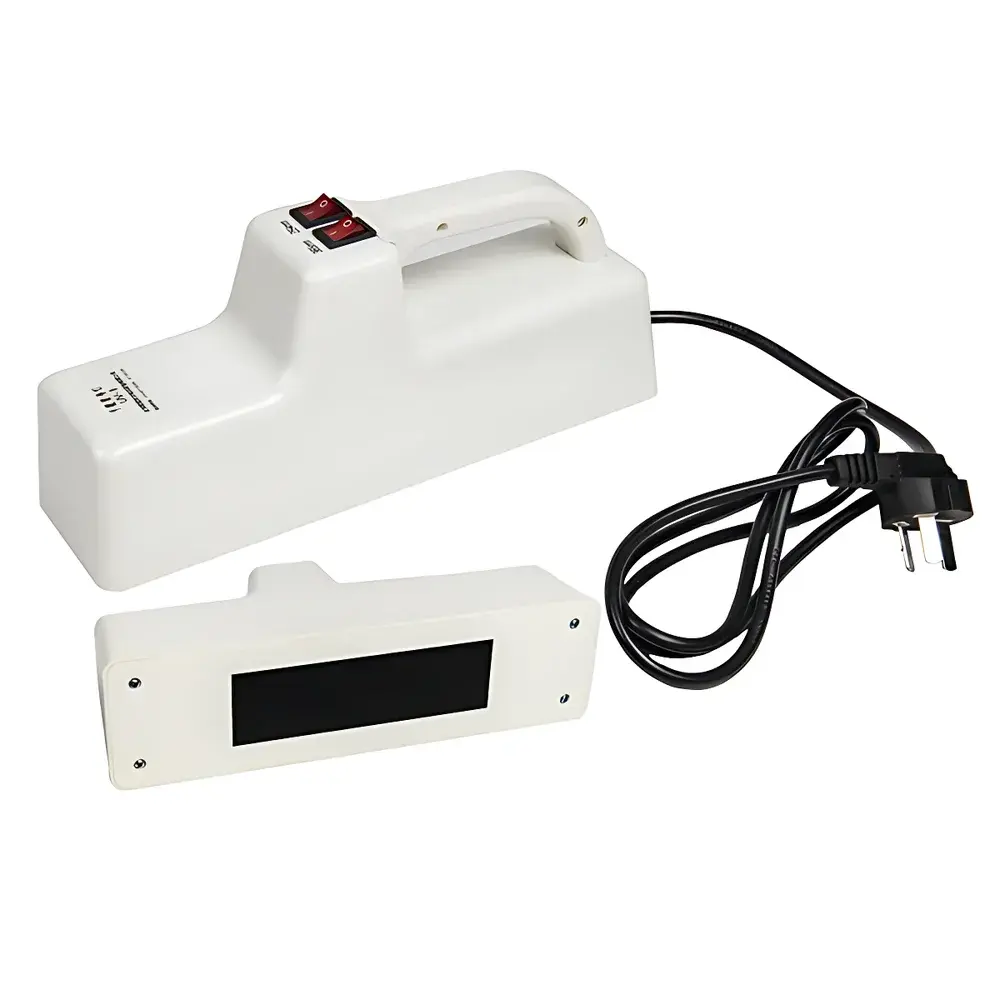
Junyi UV-II Portable Dual-Wavelength UV Transilluminator
| Brand | Junyi |
|---|---|
| Origin | Beijing, China |
| Model | UV-II |
| Instrument Type | Portable (Handheld) |
| Wavelengths | 254 nm and 365 nm |
| Total Power | 8 W (4 W per lamp) |
| Reflective Illumination Area (W × L) | 200 × 50 mm |
| Dimensions (L × W × H) | 270 × 78 × 110 mm |
| Net Weight | 0.55 kg |
| Compliance | CE-marked for laboratory use (IEC 61010-1), RoHS compliant |
Overview
The Junyi UV-II Portable Dual-Wavelength UV Transilluminator is an engineered solution for rapid, on-the-bench visualization of nucleic acid gels under ultraviolet illumination. Designed around a reflective transillumination principle—where UV light is directed onto the gel surface from above rather than transmitted through an illuminated base—it eliminates the need for darkroom conditions or integrated imaging systems. This configuration enables immediate post-electrophoresis inspection, band excision (gel cutting), and qualitative assessment without sample relocation. The device operates at two standardized UV wavelengths: 254 nm, optimal for high-sensitivity detection of ethidium bromide–stained DNA due to strong absorption by the intercalating dye; and 365 nm, which provides reduced photodamage to DNA while maintaining adequate fluorescence intensity for SYBR Safe, GelRed, and other safer nucleic acid stains. Its compact, handheld architecture supports field-deployable applications, teaching laboratories with limited infrastructure, and multi-station workflows where mobility and minimal footprint are critical.
Key Features
- True dual-wavelength capability: Independently selectable 254 nm and 365 nm UV emission via front-panel toggle switch—no lamp replacement or mechanical filter adjustment required.
- Reflective optical design: Uniform irradiance across a 200 × 50 mm active area ensures consistent band visibility without hotspots or edge falloff.
- Low-power, high-efficiency UV lamps: Each wavelength channel rated at 4 W (total 8 W), minimizing thermal load and enabling continuous operation without active cooling.
- Ergonomic handheld form factor: Weighing only 0.55 kg with dimensions of 270 × 78 × 110 mm—fits comfortably in one hand and integrates seamlessly into laminar flow hoods, biosafety cabinets, or mobile lab carts.
- Integrated safety shielding: Opaque black ABS housing with UV-blocking viewing window limits operator exposure to stray radiation, complying with IEC 62471 (Photobiological Safety of Lamps).
- No external power supply required: Operates directly from standard 100–240 V AC input with internal regulated ballast—no additional transformers or adapters needed.
Sample Compatibility & Compliance
The UV-II is validated for use with agarose and polyacrylamide gels stained with conventional and next-generation fluorescent dyes including ethidium bromide, SYBR Gold, SYBR Green I, GelRed, GelGreen, and FastBlast. It supports both horizontal and vertical mini-gel formats up to 12 cm in length. As a Class 3R UV radiation device (per IEC 60825-1), it requires standard PPE—UV-absorbing safety goggles (OD ≥ 3 at 254 nm) and nitrile gloves—during operation. The instrument meets CE marking requirements under Directive 2014/30/EU (EMC) and 2014/35/EU (LVD), and conforms to RoHS 2011/65/EU restrictions on hazardous substances. While not intended for quantitative densitometry, its stable output permits semi-quantitative band comparison when used with consistent exposure timing and staining protocols.
Software & Data Management
The UV-II is a standalone hardware-only instrument with no embedded microprocessor, firmware, or digital interface. It does not require software installation, driver configuration, or network connectivity. All operational control is manual via a single-pole double-throw (SPDT) switch for wavelength selection and a rocker power switch. This analog architecture ensures zero risk of firmware corruption, electromagnetic interference with sensitive electrophoresis equipment, or regulatory complications related to electronic recordkeeping. For documentation purposes, users may pair the device with any third-party digital camera or smartphone (using appropriate UV-blocking lens filters) to capture images compliant with GLP documentation standards—though image metadata (e.g., timestamp, exposure settings) must be manually recorded in lab notebooks per 21 CFR Part 11 Annex 11 guidelines for non-automated systems.
Applications
- Routine post-electrophoresis gel inspection in academic teaching labs and core facilities.
- Targeted excision of DNA bands for cloning, sequencing, or restriction analysis—especially where spatial precision is prioritized over throughput.
- Verification of PCR product size and amplification success prior to downstream purification.
- Field-based molecular diagnostics in resource-limited settings, including veterinary mobile units and environmental sampling stations.
- Training modules on nucleic acid visualization principles, UV safety protocols, and stain selection rationale (e.g., 254 nm vs. 365 nm trade-offs between sensitivity and DNA integrity).
FAQ
Is the UV-II suitable for viewing proteins stained with Coomassie or silver?
No. Coomassie Blue and silver nitrate do not fluoresce under UV illumination; they require visible-light transillumination or white-light reflectance. The UV-II is optimized exclusively for fluorescent nucleic acid stains.
Can I use this device with SYBR Safe without eye protection?
No. Even at 365 nm, prolonged direct exposure poses retinal and corneal risks. UV-absorbing safety goggles meeting ANSI Z87.1+ (UV rating) are mandatory for all operators.
Does the unit include a timer or automatic shutoff?
No. The UV-II has no built-in timing circuitry. Users must manually control exposure duration to prevent excessive UV-induced DNA damage or photobleaching of stains.
What is the expected lifetime of the UV lamps?
Rated for ≥ 1,000 hours of cumulative operation under normal laboratory conditions (25°C ambient, ≤ 60% RH). Output intensity declines gradually; replacement lamps (Junyi part #UV-LAMP-DUAL) are available separately.
Is calibration or annual verification required?
Not mandated by manufacturer or ISO/IEC 17025, as the device delivers fixed-wavelength emission without adjustable intensity or spectral tuning. Users may verify functionality using a calibrated UV radiometer (e.g., ILT950UV) at the gel plane if traceable intensity reporting is needed for SOP compliance.





