
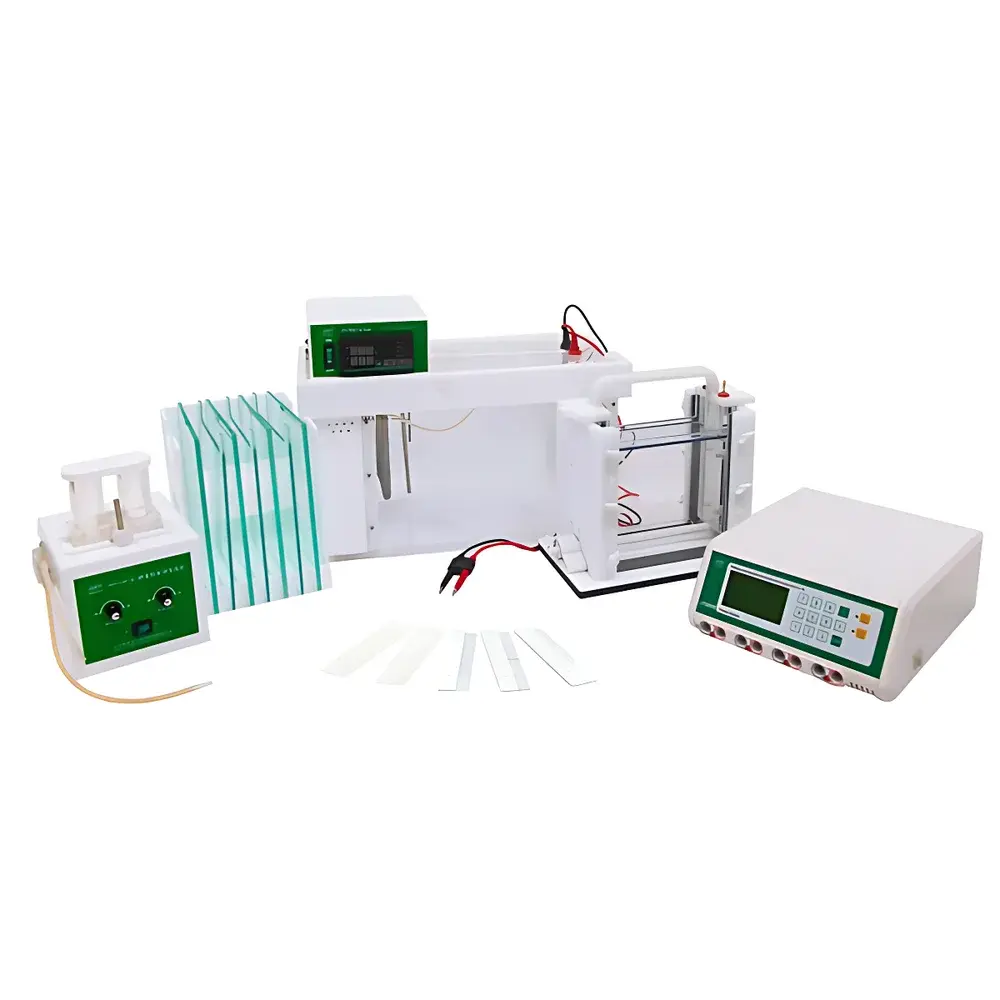
Junyi JY-TD331A Denaturing Gradient Gel Electrophoresis (DGGE) System
| Brand | Junyi |
|---|---|
| Origin | Beijing, China |
| Manufacturer Type | Authorized Distributor |
| Country of Origin | China |
| Model | JY-TD331A |
| Instrument Category | Electrophoresis Tank |
| Primary Configuration | Integrated Electrophoresis Unit (Power Supply + DGGE Tank) |
| Gel Dimensions (W×L) | 162 × 175 mm |
| Gel Thickness | 1.0 mm |
| Number of Gels Supported | 1–2 |
| Sample Capacity | 70 wells (1.0 mm thickness) |
| Max Output | 600 V / 500 mA / 300 W |
| Operating Voltage Range | 30–300 V (programmable) |
| Buffer Volume | ~10 L |
| Temperature Uniformity | ±0.5 °C (with integrated recirculation pump) |
| External Dimensions (L×W×H) | 458 × 230 × 285 mm |
| Net Weight | 23 kg |
| Timer Range | 1 min – 100 h |
| Stored Programs | 10 |
| Safety Features | Lid-open automatic power cutoff, buffer level sensor, over-voltage/over-current protection, insulated flame-retardant housing |
| Control Interface | Microprocessor-based digital display with real-time parameter monitoring and status feedback |
Overview
The Junyi JY-TD331A Denaturing Gradient Gel Electrophoresis (DGGE) System is a fully integrated, benchtop electrophoresis platform engineered for high-resolution separation of double-stranded DNA fragments based on sequence-dependent melting behavior. Unlike conventional agarose or polyacrylamide gel electrophoresis, DGGE exploits controlled denaturation gradients—typically urea/formamide—to resolve PCR-amplified DNA fragments of identical length but differing GC content or point mutations. This principle enables robust microbial community profiling without cultivation, supporting applications in environmental microbiology, clinical diagnostics, food safety validation, and genetic variant screening. The JY-TD331A integrates a precision gradient gel caster, temperature-stabilized electrophoresis tank, and microprocessor-controlled power supply into a single ergonomic unit, minimizing manual handling and thermal drift during extended runs (up to 100 hours). Its design conforms to standard laboratory safety protocols for high-voltage electrophoresis systems and supports reproducible, GLP-aligned workflows.
Key Features
- Integrated gradient gel casting system with adjustable flow-rate control for precise, reproducible denaturant gradient formation (urea/formamide range: 0–100% linear or sigmoidal)
- On-board buffer recirculation pump ensuring ±0.5 °C temperature uniformity across the gel surface—critical for maintaining denaturation profile fidelity
- Microprocessor-controlled power supply with real-time display of voltage, current, power, and elapsed time; supports programmable ramping and stepwise voltage protocols
- Side-hinged safety lid with interlocked power cutoff—prevents accidental exposure to high voltage during sample loading or gel retrieval
- Buffer level sensor and thermal probe with protective sheath prevent dry-run operation and probe damage
- Flame-retardant, injection-molded housing compliant with IEC 61010-1 electrical safety standards
- 10-user-programmable methods with auto-recall and non-volatile memory retention
- Compatible with standard vertical DGGE gel cassettes (162 × 175 mm active area, 1.0 mm thickness); accommodates 1–2 gels per run
Sample Compatibility & Compliance
The JY-TD331A is optimized for denaturing gradient electrophoresis of PCR amplicons ranging from 100 bp to 500 bp, particularly targeting hypervariable regions of 16S rRNA (bacteria/archaea), 18S rRNA (eukaryotes), ITS (fungi), and mitochondrial D-loop sequences. It supports direct analysis of environmental DNA extracts from soil, water, sediment, and food matrices—eliminating culture bias. The system meets essential requirements for ISO/IEC 17025-compliant laboratories conducting microbial diversity assessments, and its programmable parameters support audit-ready documentation under GLP and FDA 21 CFR Part 11 (when paired with validated LIMS or ELN integration). All electrical components comply with CE marking directives (EMC Directive 2014/30/EU and Low Voltage Directive 2014/35/EU).
Software & Data Management
While the JY-TD331A operates via an embedded microcontroller interface (no external PC dependency), it exports runtime logs—including voltage, current, temperature, timer status, and error codes—via RS-232 serial output for integration with laboratory information management systems (LIMS) or electronic lab notebooks (ELN). Parameter settings and method recalls are stored locally with timestamped metadata. For post-electrophoresis analysis, the system is compatible with industry-standard gel documentation platforms (e.g., Bio-Rad GelDoc, Azure Biosystems Sapphire) using UV transillumination at 302 nm. Digital image capture and band quantification workflows align with MIAME and MIGED guidelines for reproducible microbial fingerprinting.
Applications
- High-throughput profiling of bacterial, archaeal, fungal, and eukaryotic microbial communities in environmental samples (soil, freshwater, marine sediments, activated sludge)
- Detection of low-frequency somatic or germline mutations in clinical oncology and inherited disease screening
- Identification of heteroduplex DNA in heterozygote detection and SNP validation assays
- Monitoring shifts in gut, oral, or skin microbiota during dietary, pharmaceutical, or probiotic interventions
- Verification of PCR fidelity and amplification bias in metagenomic library preparation
- Food authenticity testing and pathogen strain differentiation (e.g., Listeria monocytogenes, Salmonella serovars)
FAQ
What gradient ranges can the JY-TD331A generate?
The integrated gradient generator supports linear or stepwise urea/formamide gradients from 0% to 100%, with flow rate adjustment enabling fine-tuned resolution of closely related amplicons.
Is the system compatible with SYBR Safe or ethidium bromide staining?
Yes—the gel matrix and UV-transparent tank construction support standard nucleic acid stains; optimal visualization occurs at 302 nm UV transillumination.
Can the JY-TD331A run non-denaturing gels?
While optimized for DGGE, the unit may be operated in native mode by omitting denaturants; however, temperature control and gradient casting features remain inactive.
Does the system meet regulatory requirements for clinical or food testing labs?
It satisfies core electrical safety and operational traceability criteria for ISO/IEC 17025 and GLP environments; full compliance requires site-specific validation per ISO 15197 or AOAC Official Methods.
How is temperature stability verified during long-duration runs?
The embedded PT100 sensor continuously monitors buffer temperature, triggering audible/visual alerts if deviation exceeds ±0.5 °C; data logging supports post-run thermal profile reconstruction.
Related Products




