
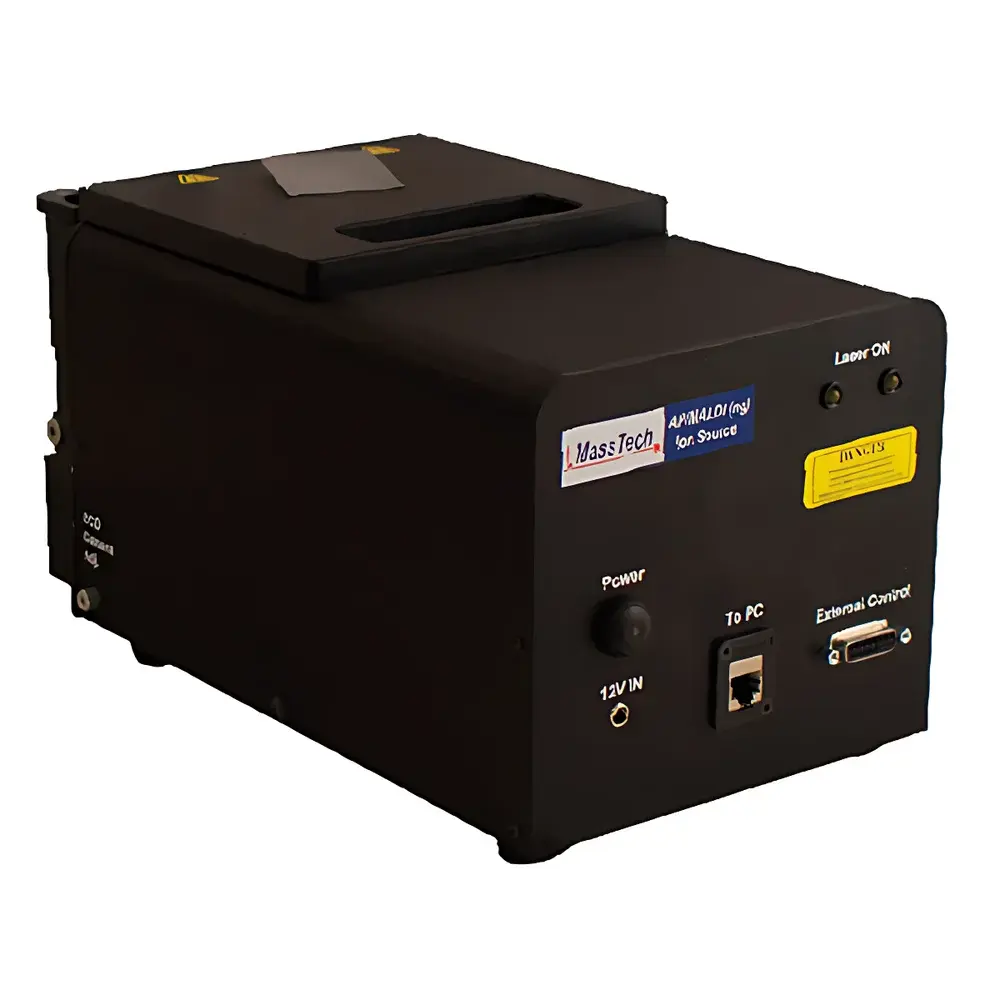
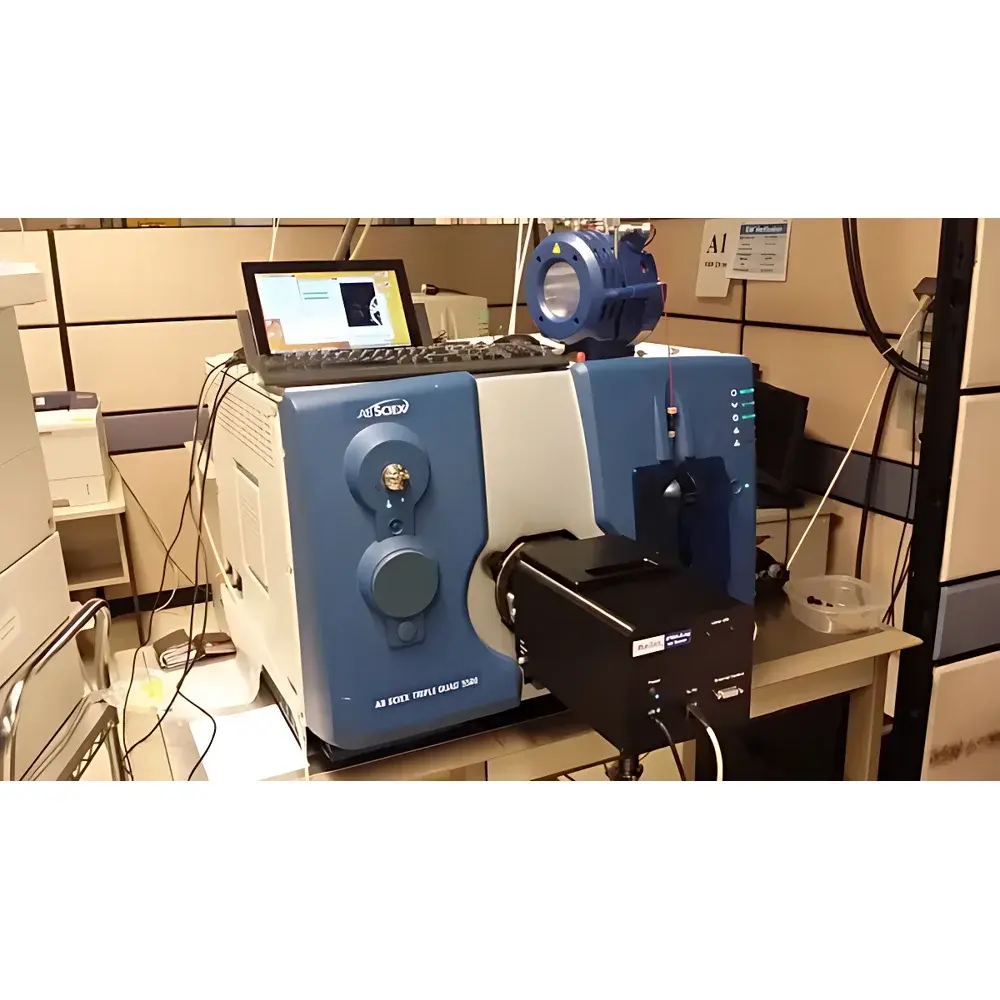
MassTech AP/MALDI Atmospheric Pressure Matrix-Assisted Laser Desorption/Ionization Source
| Brand | MassTech |
|---|---|
| Origin | USA |
| Model | UHR, HR |
| Instrument Type | Atmospheric Pressure Ion Source |
| Sensitivity | Attomole-level (sub-fmol/µL) |
| Spatial Resolution | <5 µm |
| Mass Range | Determined by Coupled Mass Analyzer |
| Accurate Mass Capability | Dependent on Host Mass Spectrometer |
Overview
The MassTech AP/MALDI Atmospheric Pressure Matrix-Assisted Laser Desorption/Ionization Source is a high-performance, externally mounted ionization interface engineered for direct, label-free, in situ analysis of biomolecules and synthetic compounds under ambient pressure conditions. Unlike conventional vacuum-based MALDI, AP/MALDI operates at atmospheric pressure, enabling rapid sample exchange without vacuum cycling and facilitating seamless integration with diverse mass spectrometers—including quadrupole, ion trap, time-of-flight (TOF), Q-TOF, Orbitrap, and FT-ICR systems. The source employs a solid-state, diode-pumped Nd:YAG laser (1–10 kHz repetition rate) to induce soft desorption and ionization via proton transfer or electron capture in the gas phase. This atmospheric-pressure environment promotes efficient thermal equilibration of nascent ions through collisions with ambient gas molecules, yielding stable, continuous ion currents and reduced fragmentation—particularly advantageous for thermally labile species such as glycolipids, sialylated gangliosides, oligosaccharides, and post-translationally modified peptides.
Key Features
- Atmospheric-pressure operation eliminates vacuum lockout, enabling sub-minute sample turnover and real-time source switching with ESI, APCI, or nano-ESI sources.
- Sub-5 µm spatial resolution in mass spectrometry imaging (MSI), validated on tissue sections including rodent brain, liver, and tumor models.
- Patented DPSS laser architecture with adjustable pulse frequency and optimized beam profile ensures uniform ablation, reproducible signal intensity, and extended operational lifetime (>1 billion shots).
- Compatibility with volatile and non-volatile matrices—including α-cyano-4-hydroxycinnamic acid (CHCA), 2,5-dihydroxybenzoic acid (DHB), and ionic liquid formulations—enabling flexible method development for small molecules and polymers.
- Integrated hardware interlocks and real-time diagnostics safeguard source integrity, mass spectrometer optics, and operator safety per IEC 61010-1 standards.
- No degradation of host instrument performance: preserves native mass resolving power, mass accuracy, and dynamic range when coupled to high-end analyzers.
Sample Compatibility & Compliance
The AP/MALDI source supports direct analysis of complex biological specimens—including frozen tissue sections, microbial colonies, polymer films, and thin-layer chromatography plates—without matrix crystallization optimization or vacuum-compatible derivatization. It accommodates aqueous, organic, and mixed-solvent matrix preparations, and tolerates trace salts and detergents commonly present in crude extracts. The system complies with GLP-aligned data acquisition workflows and supports audit-trail-enabled software logging required for regulated environments (e.g., FDA 21 CFR Part 11 when deployed with compliant LIMS or CDS platforms). While not certified to ISO/IEC 17025 as a standalone device, its operational consistency has been verified against ASTM E2981-21 (Standard Guide for MALDI-MS Imaging) and USP Analytical Instrument Qualification protocols.
Software & Data Management
Controlled via ImageQuest™—a dedicated, vendor-neutral acquisition and visualization platform—the source delivers intuitive workflow management for both single-spot analysis and raster-scanned MSI experiments. The software enables real-time spectral preview, automated peak alignment across adjacent pixels, and export of ion density maps in standard formats (imzML, mzML, TIFF). All raw data files retain full metadata—including laser fluence, pixel coordinates, dwell time, and matrix application parameters—for retrospective reprocessing and cross-platform interoperability. Integration with third-party tools (e.g., SCiLS Lab, MSiReader, Cardinal) is supported via open API and standardized spectral file schemas.
Applications
- Spatially resolved lipidomics and metabolomics in FFPE and cryosections, with detection of phosphatidylcholines, sulfatides, and ceramide species at attomole sensitivity.
- Top-down and middle-down proteomics of intact proteins directly from tissue surfaces, preserving labile PTMs such as phosphorylation and O-GlcNAcylation.
- High-throughput screening of synthetic polymers, surfactants, and dendrimers using non-volatile ionic liquid matrices.
- In situ characterization of plant cell wall polysaccharides (e.g., xylooligosaccharides) and microbial exopolysaccharides without enzymatic digestion.
- Quantitative MSI of drug distribution and metabolites in pharmacokinetic studies, validated per EMA/CHMP/ICH guidelines for bioanalytical method validation.
FAQ
Is AP/MALDI compatible with my existing mass spectrometer?
Yes—the source is mechanically and electrically agnostic, supporting standard flange interfaces (e.g., API, IonMax, Z-Spray) and communication via RS-232 or Ethernet. Verified compatibility includes Thermo Scientific Orbitrap Exploris, Sciex TripleTOF 6600+, Waters SYNAPT G2-Si, Bruker timsTOF fleX, and Agilent 6550 Q-TOF.
Does AP/MALDI require vacuum system modifications?
No—it functions as an external ion source; no vacuum pump upgrades, differential pumping stages, or aperture replacements are needed.
Can I use the same matrix protocols as vacuum MALDI?
Most conventional MALDI matrices are applicable, though solvent volatility must be adjusted for atmospheric pressure. DHB and CHCA remain optimal for peptides; ionic liquids improve reproducibility for lipids and glycans.
What maintenance is required?
Annual laser energy calibration and quarterly optical path inspection are recommended. No consumable parts beyond standard target plates and matrix solutions.
Is imaging data compliant with imaging mass spectrometry standards?
Yes—data export conforms to imzML 1.3 specification, ensuring compatibility with NIH-supported repositories (e.g., MetaboLights, GNPS) and peer-reviewed publication requirements.







