
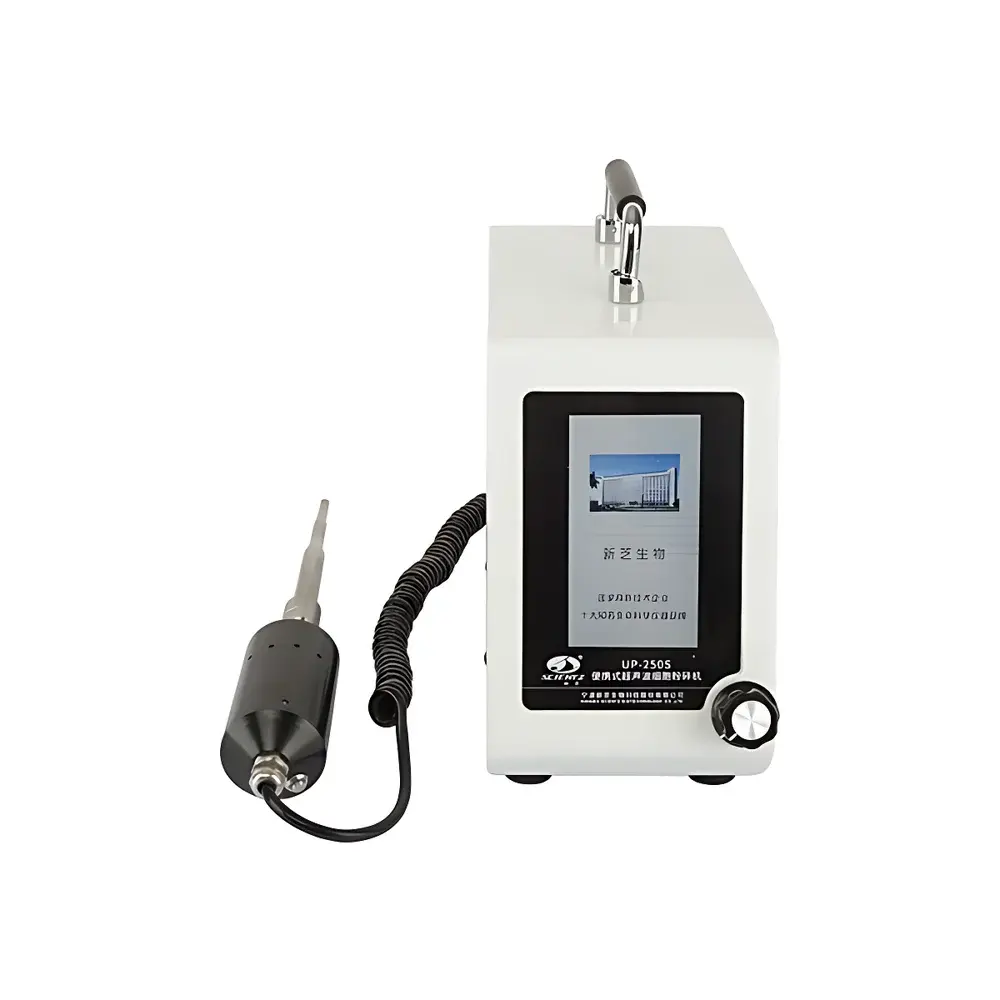
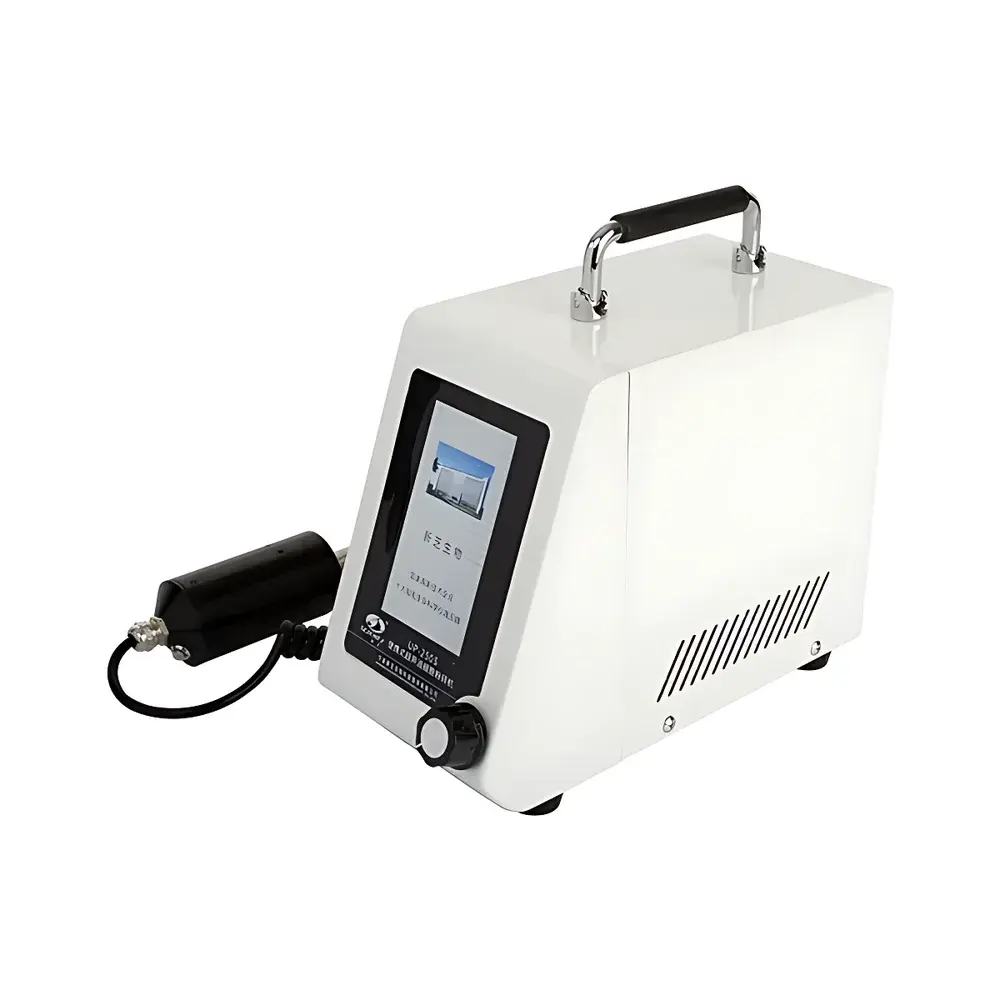
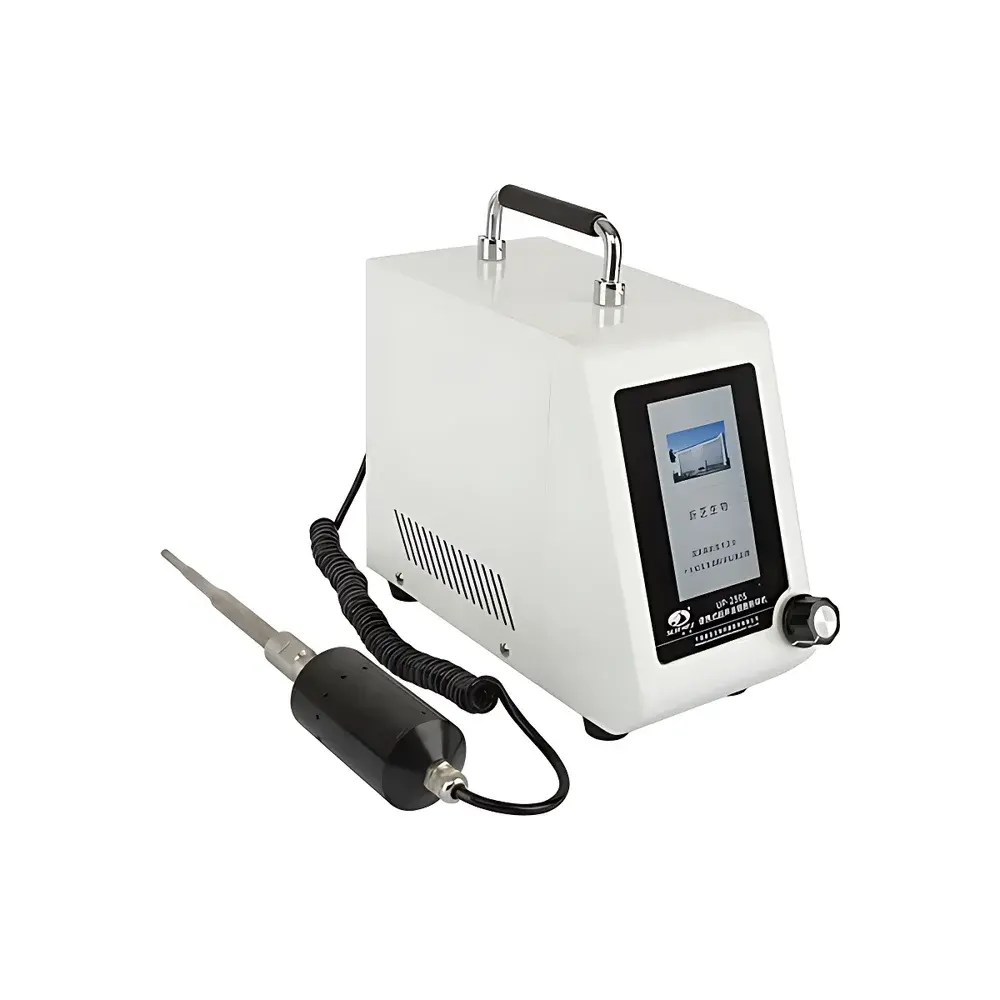
Scientz UP-250S Handheld Ultrasonic Cell Disruptor
| Brand | Scientz |
|---|---|
| Origin | Zhejiang, China |
| Manufacturer Type | Direct Manufacturer |
| Instrument Type | Ultrasonic Cell Disruptor |
| Ultrasonic Power | 250 W |
| Operating Frequency | 19–25 kHz |
| Sample Volume Range | 100 µL – 100 mL |
| Power Source | Integrated Rechargeable Lithium Battery (4 h continuous operation) |
| Control Modes | Manual (foot switch) and Automatic |
| Temperature Monitoring | Real-time display with over-temperature alarm |
| Sample Compatibility | Microtubes, PCR tubes, 96-well plates (direct immersion), vials up to 10 mL capacity |
| Adjustable Parameters | Output amplitude (0–100%), pulse duration (0.1–9.9 s), cycle time (0.1–9.9 s) |
Overview
The Scientz UP-250S Handheld Ultrasonic Cell Disruptor is an engineered solution for rapid, reproducible, and field-deployable cell lysis and sample homogenization in life science laboratories, clinical diagnostics, and environmental monitoring applications. It operates on the physical principle of acoustic cavitation: high-frequency ultrasonic energy (19–25 kHz) is transmitted via a titanium alloy probe into liquid media, generating transient microbubbles that collapse violently under alternating pressure cycles. This implosive collapse produces localized shockwaves, microstreaming, and intense shear forces—sufficient to disrupt cellular membranes, dissociate protein complexes, fragment chromatin, and disperse nanoparticles without significant thermal degradation when operated under pulsed mode. Unlike benchtop sonicators, the UP-250S integrates a compact transducer, variable-amplitude generator, and sealed lithium-ion battery into a lightweight handheld form factor (<1.2 kg), enabling direct immersion into microcentrifuge tubes, PCR strips, or 96-well plates without cross-contamination risk or sample transfer losses.
Key Features
- 250 W peak ultrasonic output with digitally adjustable amplitude (0–100%) and precise pulse control (0.1–9.9 s on/off cycles) for optimized lysis efficiency across diverse biological matrices
- Integrated temperature sensor with real-time digital display and programmable over-temperature cutoff (threshold user-configurable between 25–70 °C) to prevent thermal denaturation of labile biomolecules
- Dual operational modes: foot-switch-triggered manual mode for precise point-of-use activation; automatic timed mode for unattended batch processing
- Field-ready architecture: rechargeable lithium battery supports up to 4 hours of continuous operation at 50% amplitude—validated under ISO 13849-1 functional safety guidelines for portable medical-grade equipment
- Ergonomic, autoclavable titanium probe (standard Φ3 mm tip; optional Φ2/Φ6 mm tips available) with IP54-rated housing for resistance to splashes and particulate ingress
- No external cooling required for standard protocols; compatible with ice-water baths or Peltier-cooled adapters for thermosensitive applications (e.g., ChIP, native co-IP)
Sample Compatibility & Compliance
The UP-250S accommodates sample volumes from 100 µL (single well in 96-well plate) to 100 mL (in beaker with optional large-tip probe), supporting direct lysis in common consumables including 0.5–2.0 mL microtubes, 0.2 mL PCR tubes, and flat-bottom 96-well plates. It complies with IEC 61000-6-3 (EMC emission limits) and IEC 61000-6-2 (immunity to electrostatic discharge and RF fields). For regulated environments, instrument logs—including timestamped amplitude settings, total sonication time, and thermal events—are exportable via USB-C for audit trails aligned with GLP and FDA 21 CFR Part 11 data integrity requirements. All firmware updates are digitally signed and version-locked to ensure traceability.
Software & Data Management
While the UP-250S operates as a standalone instrument, its embedded controller stores up to 20 user-defined protocols with parameter recall (amplitude %, pulse width, duty cycle, max temperature limit). Protocol data—including start/end timestamps, cumulative runtime, and thermal alerts—is retained in non-volatile memory and exportable as CSV via USB-C interface. No proprietary software installation is required; exported logs integrate natively with LIMS platforms (e.g., LabWare, STARLIMS) and electronic lab notebooks (e.g., Benchling, LabArchives) using standard UTF-8 encoding. Firmware updates are delivered via encrypted OTA packages compliant with NIST SP 800-193 guidelines for firmware integrity verification.
Applications
- Cell lysis for downstream extraction of genomic DNA, total RNA, and soluble proteins from bacterial, yeast, mammalian, and plant tissues
- Chromatin shearing in native and crosslinked ChIP-seq workflows—achieving fragment sizes of 200–1000 bp with minimal RNA contamination
- Nanoparticle dispersion and deagglomeration in drug delivery formulation (e.g., liposomes, polymeric micelles, exosome isolation buffers)
- Rapid enzymatic reaction acceleration (e.g., restriction digestion, ligase cycling) through enhanced mass transfer and conformational destabilization
- Food safety testing: pathogen lysis (Salmonella, Listeria) directly in enrichment broths prior to PCR/qPCR analysis
- Environmental field sampling: on-site disruption of biofilm or sediment-associated microbes for metagenomic DNA recovery
FAQ
Is the UP-250S suitable for RNA extraction without RNase contamination?
Yes—the probe is autoclavable (121 °C, 20 min), and all wetted parts are titanium or PTFE-coated stainless steel, eliminating leachable RNases. Pre-treatment with RNaseZap® or 0.1% DEPC water is recommended for high-sensitivity applications.
Can the instrument be calibrated per ISO/IEC 17025 requirements?
Yes—calibration certificates for acoustic output power (traceable to NIM, China) and temperature sensor accuracy (±0.5 °C) are provided with each unit. Annual recalibration services are available through Scientz-certified service centers.
What is the expected probe lifetime under routine use?
At 70% amplitude and 5 s/pulse duty cycle, the standard Φ3 mm titanium probe demonstrates >500 hours of operational life before measurable erosion (>5% tip diameter reduction), verified per ASTM E1815-20 ultrasonic probe wear testing protocol.
Does the UP-250S support remote triggering via TTL or RS-232?
No—only foot-switch input and onboard keypad control are supported. For automated integration, third-party relay modules with dry-contact output can be interfaced via the foot-switch port.
Is the battery replaceable by the end user?
Yes—the Li-ion pack is field-replaceable using standard Torx T8 tools; replacement batteries (model SC-BAT-UP250S) are supplied with CE/UN38.3 certification and 500-cycle minimum charge retention.



