
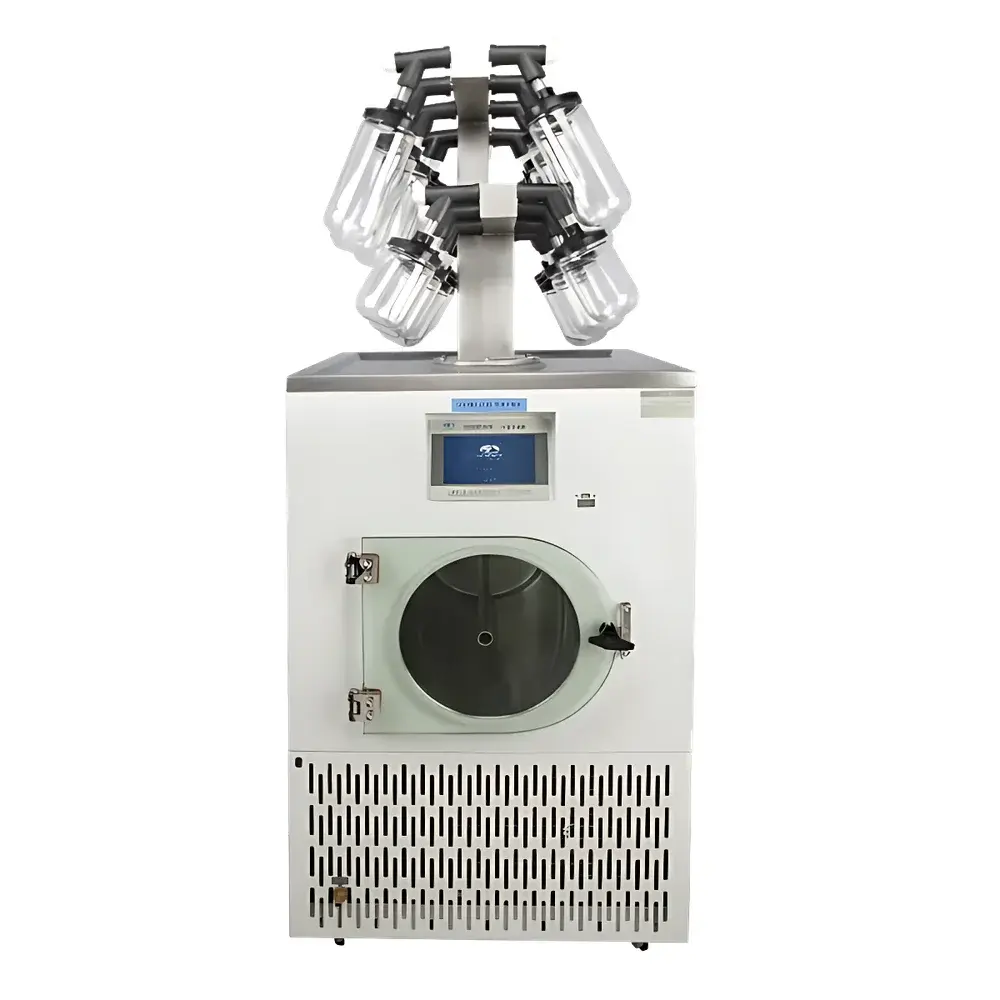
Ningbo Scientz SCIENTZ-25T T-Frame Laboratory Freeze Dryer
| Brand | Ningbo Scientz |
|---|---|
| Origin | Zhejiang, China |
| Manufacturer Type | Direct Manufacturer |
| Instrument Type | Standard Shelf-Type Freeze Dryer |
| Application Scale | Pilot-Scale |
| Lyophilization Area | 0.21 m² |
| Ultimate Vacuum (No Load) | ≤5 Pa |
| Condensate Capacity (24 h) | 4 kg/24 h |
| Cold Trap Temperature (No Load) | ≤−70 °C |
| Dimensions (L×W×H) | 750 × 640 × 1200 mm |
Overview
The Ningbo Scientz SCIENTZ-25T is a T-frame configuration laboratory freeze dryer engineered for pilot-scale lyophilization of heat-sensitive biological and pharmaceutical samples. It operates on the fundamental principle of sublimation—removing water from frozen materials under deep vacuum while maintaining sample integrity through precise thermal control. Designed for reproducible, contamination-controlled processing, the SCIENTZ-25T integrates a dual-path refrigeration architecture with independent sample conduits, enabling simultaneous drying of up to 24 vials without cross-contamination. Its compact footprint (750 × 640 × 1200 mm) optimizes space utilization in regulated lab environments, while its modular construction supports seamless integration into GLP-compliant workflows. The system meets essential operational prerequisites for bacterial culture preservation, fungal spore stabilization, peptide formulation development, and microbial strain banking—applications demanding strict adherence to low-temperature integrity and vacuum stability.
Key Features
- T-frame mechanical architecture with reinforced stainless-steel frame and borosilicate glass drying chamber for chemical resistance and visual process monitoring
- 24 independently controllable silicone-sealed isolation valves—each actuated manually or via optional vacuum-regulated solenoid interface—to enable sequential or parallel vial processing
- Dual-stage refrigeration system: standard single-stage self-recuperative cascade compressor achieves ≤−70 °C cold trap temperature (no load); optional −80 °C ultra-low-temperature compressor available for enhanced ice capture efficiency
- Intelligent vacuum management: PLC-controlled vacuum pump activation only after cold trap reaches preset temperature (e.g., −60 °C), preventing oil backstreaming and condenser overload
- Integrated safety subsystems including over-temperature alarm, power-failure data retention, auto-defrost cycle optimization, and optional oil mist filter + anti-backflow valve for vacuum line protection
- Touchscreen HMI with real-time graphical display of shelf temperature, chamber pressure, cold trap temperature, and elapsed time; supports multi-step program editing with ramp/soak profiles
Sample Compatibility & Compliance
The SCIENTZ-25T accommodates standard 10–30 mL serum vials, 50–100 mL Erlenmeyer flasks, and custom-shaped lyophilization vessels via adaptable rubber stopper adapters. Its independent conduit design ensures physical separation between sample pathways—critical for preserving genetic fidelity in microbial strain banks and avoiding formulation carryover in multi-product R&D labs. The system complies with core elements of ISO 22033 (lyophilization equipment qualification), ASTM F2375 (sterile barrier integrity testing), and supports audit-ready documentation when paired with optional 21 CFR Part 11-compliant software modules. All wetted surfaces are electropolished 316L stainless steel or USP Class VI-certified elastomers, meeting material compatibility requirements for GMP-grade bioprocess intermediates.
Software & Data Management
Equipped with an embedded PLC-based controller and 7-inch TFT color touchscreen, the SCIENTZ-25T logs timestamped records of all critical process variables—including chamber pressure (capacitance manometer), cold trap temperature (PT100 sensor), and vacuum pump status—at user-defined intervals (1–60 s). Data export is supported via USB 2.0 port in CSV format for offline analysis in MATLAB, Python Pandas, or LIMS platforms. Optional firmware upgrade enables encrypted data storage, electronic signature capability, and automated report generation aligned with ALCOA+ principles (Attributable, Legible, Contemporaneous, Original, Accurate, Complete, Consistent, Enduring, Available). Audit trails record all parameter modifications, user logins, and system alerts—fully traceable for FDA inspection readiness.
Applications
- Long-term preservation of bacterial and fungal cultures under cryogenic desiccation conditions
- Stabilization of synthetic peptides, monoclonal antibody fragments, and enzyme formulations prior to analytical characterization
- Preparation of reference standards for pharmacopeial testing (USP , EP 2.9.40)
- Routine lyophilization of cell lysates, plasmid DNA solutions, and CRISPR reagent cocktails in molecular biology labs
- Process development for scalable freeze-drying cycles—bridging benchtop feasibility studies to clinical manufacturing protocols
FAQ
What is the maximum batch capacity for vial-based lyophilization?
The SCIENTZ-25T supports up to 24 standard 22 mm neck vials using the included T-frame manifold and silicone stopper valves.
Can the system operate continuously beyond 24 hours?
Yes—the 4 kg/24 h condensate capacity allows uninterrupted operation across extended cycles; automatic defrost scheduling minimizes downtime between batches.
Is remote monitoring supported out of the box?
Standard configuration includes local HMI only; Ethernet-enabled remote access requires optional communication module and dedicated server-side software.
Does the unit meet electrical safety standards for international laboratories?
It conforms to IEC 61010-1:2010 for laboratory equipment and carries CE marking; UL/cUL listing available upon request for North American deployment.
How is calibration traceability maintained for temperature and pressure sensors?
Factory calibration certificates (NIST-traceable PT100 and capacitance manometer) are supplied; users may perform field verification using external reference probes per ISO/IEC 17025 guidelines.



