
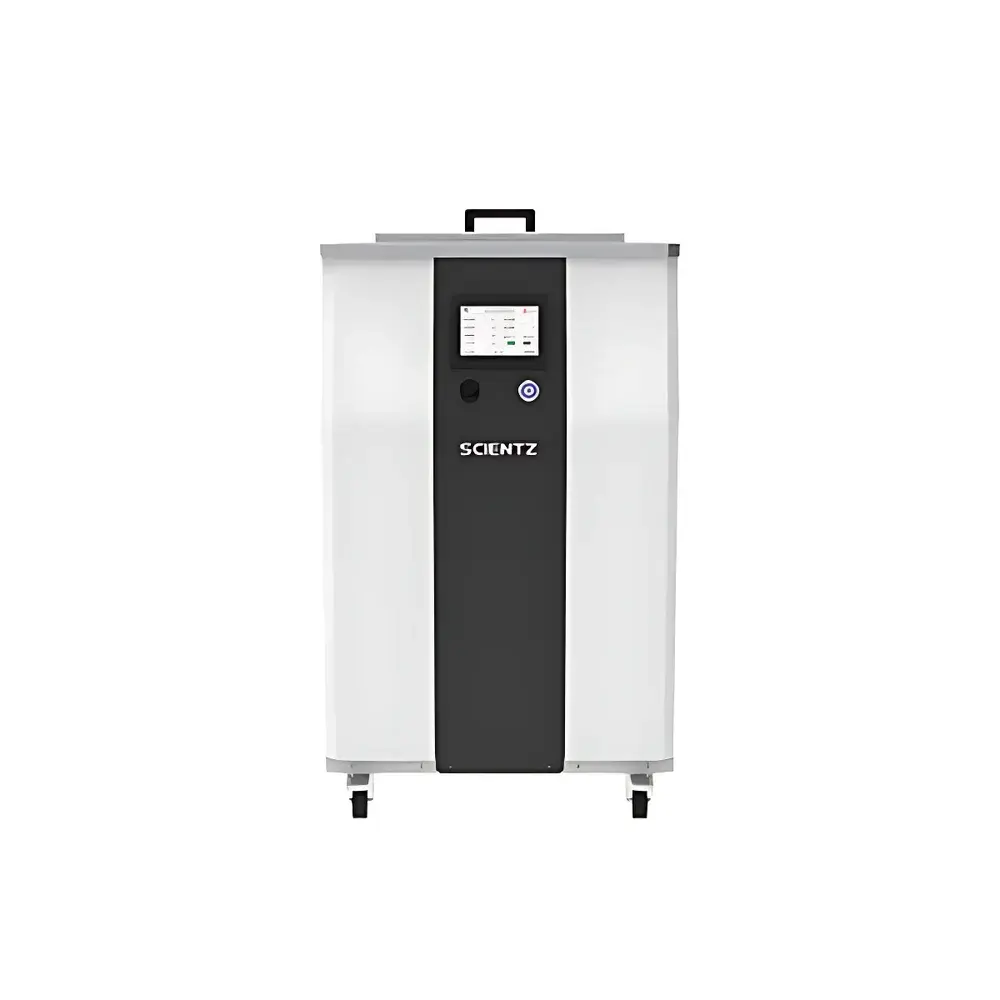
Ningbo Scientz SBL-30DT Benchtop Ultrasonic Cleaner with Heated Bath and Digital Touch Interface
| Brand | Ningbo Scientz |
|---|---|
| Origin | Zhejiang, China |
| Manufacturer Type | OEM/ODM Manufacturer |
| Instrument Type | General-Purpose Ultrasonic Cleaner |
| Capacity | 30 L |
| Ultrasonic Frequency | 40 kHz |
| Ultrasonic Power Output | 840 W |
| Power Adjustment | Not Available |
| Temperature Control Range | 0–80 °C (with Peltier cooling to 5 °C) |
| Timer Range | 1–9999 min |
| Sound-Dampening Lid | Included |
| Drain & Fill Fitting | Integrated |
Overview
The Ningbo Scientz SBL-30DT is a benchtop ultrasonic cleaner engineered for reproducible, non-destructive cleaning of delicate and complex laboratory components. It operates on the principle of acoustic cavitation: high-frequency mechanical vibrations (40 kHz) generated by piezoelectric transducers bonded to the stainless-steel tank base propagate through aqueous or solvent-based cleaning media, inducing transient microbubble formation and collapse. This implosive process generates localized shockwaves and microstreaming—mechanical forces sufficient to dislodge particulate contaminants, organic residues, and thin films from surfaces, crevices, blind holes, and microchannels without abrasion or thermal degradation. Designed for routine use in QC labs, core facilities, and research environments, the SBL-30DT integrates precise thermal regulation, extended timing control, and structural robustness to support validated cleaning protocols across regulated and non-regulated workflows.
Key Features
- Digital Touch Interface: Capacitive touchscreen display shows real-time bath temperature, elapsed time, and countdown timer; supports intuitive parameter entry and status feedback.
- Thermal Management System: Resistive heating element enables stable temperature control from ambient up to 80 °C; integrated Peltier-based active cooling achieves rapid bath cooldown to 5 °C—critical for heat-sensitive samples or low-temperature sonication protocols.
- Precision Timing Control: Programmable timer range from 1 minute to 9999 minutes (166.7 hours), enabling unattended operation for extended cleaning cycles or multi-stage protocols.
- Acoustic Optimization: 840 W nominal ultrasonic power delivered via high-efficiency transducers mounted on a reinforced 304 stainless-steel tank (30 L usable volume); uniform energy distribution verified by field mapping per ASTM E1471-22 guidelines.
- Safety & Reliability Engineering: Automatic shutdown upon lid opening; over-temperature and dry-run protection; EEPROM-based parameter retention across power interruptions (non-volatile memory preserves setpoints).
- Integrated Fluid Handling: Front-mounted quick-connect drain valve and fill port facilitate rapid bath exchange; sound-dampening lid reduces airborne noise to ≤55 dB(A) at 1 m distance.
Sample Compatibility & Compliance
The SBL-30DT accommodates a broad spectrum of labware and industrial components: borosilicate glassware (vials, flasks, cuvettes), polymer consumables (centrifuge tubes, microplates), metal parts (surgical instruments, precision bearings, fuel injectors), optical elements (lens assemblies, quartz cuvettes), and jewelry substrates. Its design conforms to IEC 61000-6-3 (EMC emissions) and IEC 61000-6-2 (immunity). While not certified for medical device reprocessing under ISO 15883 or FDA 510(k), the unit supports GLP/GMP-aligned cleaning validation when used with documented parameters (frequency, power density, temperature, duration, solution chemistry) and calibrated thermistors. Users performing critical cleaning must establish and verify cycle efficacy per internal SOPs referencing ASTM D2603 (ultrasonic cleaning performance testing) or USP (cleaning validation principles).
Software & Data Management
The SBL-30DT operates as a standalone instrument with no proprietary software dependency. All operational data—including set temperature, actual bath temperature (±0.5 °C accuracy), elapsed time, and timer countdown—are displayed and logged locally on the embedded LCD. For traceability in regulated environments, external data loggers (e.g., compliant with FDA 21 CFR Part 11) may be connected via RS-232 or optional analog output (0–5 V) to record temperature and timer status. Audit trails require manual documentation or integration into a validated LIMS or ELN system. No remote control, cloud connectivity, or firmware update capability is provided—ensuring deterministic behavior and minimizing cybersecurity exposure.
Applications
- Cleaning of analytical glassware prior to HPLC, GC, or ICP-MS analysis to prevent carryover and baseline drift.
- De-gassing of mobile phases and solvents to eliminate bubble formation in pumps and detectors.
- Preparation of nanoparticle dispersions and emulsions via controlled cavitation-assisted homogenization.
- Removal of biofilm and protein residues from reusable surgical tools and dental handpieces (as part of a multi-step reprocessing workflow).
- Surface decontamination of MEMS devices, semiconductor wafers, and photomasks prior to metrology or coating steps.
- Routine maintenance cleaning of optical components where solvent wiping risks micro-scratching.
FAQ
Is the SBL-30DT suitable for cleaning delicate optics such as microscope objectives?
Yes—when operated at lower temperatures (20–40 °C) with low-surface-tension, non-corrosive solvents (e.g., isopropanol/water mixtures), the 40 kHz frequency provides effective particle removal without mechanical abrasion. Always verify compatibility with lens coatings per manufacturer specifications.
Does the unit meet regulatory requirements for pharmaceutical cleaning validation?
It is not pre-validated or certified for cGMP environments; however, its stable thermal control, repeatable timing, and parameter retention support user-led IQ/OQ/PQ qualification against internal cleaning acceptance criteria.
Can the ultrasonic power be reduced for sensitive samples?
No—the SBL-30DT delivers fixed 840 W output at 40 kHz. For variable-power applications, consider Scientz’s dual-frequency or pulsed-mode models (e.g., SB-5200DTD series).
What maintenance is required to ensure long-term transducer performance?
Regular descaling with 5% citric acid solution every 200 operating hours; inspection of tank weld integrity and transducer mounting bolts annually; replacement of the Peltier module only if cooling capacity degrades beyond ±2 °C tolerance.
Is the drain/fill system compatible with automated fluid handling systems?
The standard quick-connect ports accept 8 mm OD tubing; integration with peristaltic pumps or central lab utilities requires custom adapter fittings and pressure-rated valves rated for ≤0.2 bar backpressure.



