
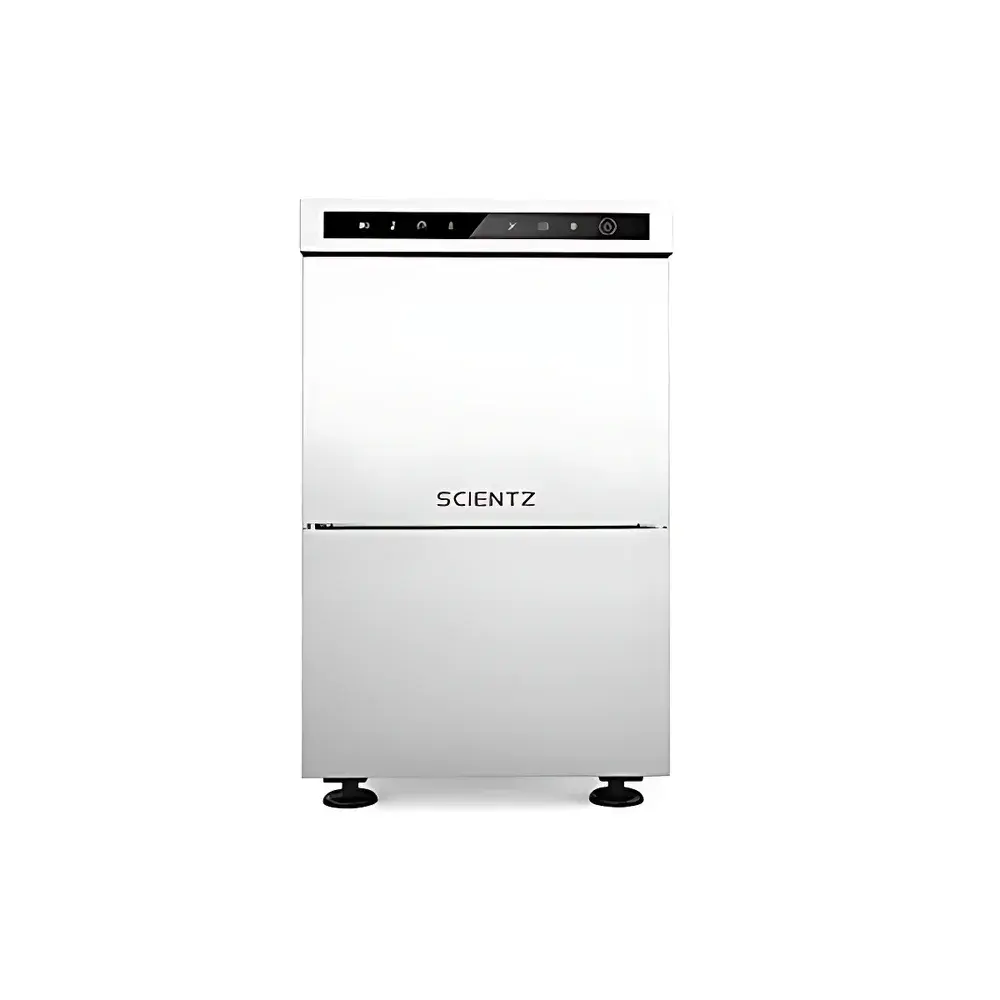
Scientz XB-40II Automatic Flake Ice Machine
| Brand | Scientz |
|---|---|
| Model | XB-40II |
| Ice Production Capacity | 40 kg/24h |
| Ice Storage Capacity | 15 kg |
| Cooling Method | Air-Cooled |
| Ice Type | Irregular Flake Ice |
| Compressor | High-Efficiency International Brand |
| Control System | Microprocessor-Based Fully Automatic Control |
| Water Filtration | Integrated OEM Water Purifier |
| Drainage | Active Gravity-Assisted Elevated Drainage |
| Origin | Zhejiang, China |
| Manufacturer | Ningbo Scientz Biotechnology Co., Ltd. |
Overview
The Scientz XB-40II Automatic Flake Ice Machine is an engineered solution for laboratories, clinical facilities, and industrial environments requiring consistent, high-purity flake ice with low moisture content and rapid on-demand availability. It operates on a mechanical rotary extrusion principle: filtered feed water flows into a spiral evaporator maintained at −18 °C; phase change occurs via direct contact heat exchange, forming thin ice layers on the evaporator surface. A gear-reduced auger-driven ice cutter rotates continuously within the evaporator chamber, mechanically shearing and compressing the nascent ice into irregular, porous flakes (typically 1–3 mm in nominal dimension). The resulting flake ice—characterized by high surface area-to-volume ratio, rapid thermal transfer capability, and minimal free water—freely cascades under gravity into the insulated 15 kg storage bin. This thermodynamically efficient process eliminates reliance on refrigerant-phase-change cycles alone, delivering stable output without ice bridging or compaction issues common in plate-type or cube ice systems.
Key Features
- Rapid Ice Generation: Achieves first ice discharge within 5 minutes of startup—optimized for time-sensitive applications such as biological sample chilling, PCR pre-cooling, or histology tissue embedding.
- Low-Moisture Flake Output: Produces dry, non-clumping flake ice with <15% residual surface moisture—critical for minimizing dilution during cold chain maintenance or cryopreservation workflows.
- Integrated Water Purification: Factory-installed OEM water filter removes particulates, chlorine, and scale-forming ions, extending evaporator service life and ensuring compliance with CLSI GP26-A3 and ISO 15195:2018 requirements for laboratory-grade water quality in cooling applications.
- Self-Diagnostic Control System: Microprocessor-based controller performs real-time monitoring of evaporator temperature, compressor current, condenser airflow, and water level; displays fault codes (e.g., E1 = low water, E3 = high head pressure) on LED interface for rapid troubleshooting.
- Elevated Drainage Architecture: Active gravity-assisted drainage enables installation in locations without floor-level floor drains—supports flexible placement in ISO Class 7 cleanrooms, mobile lab units, or retrofit installations where plumbing infrastructure is constrained.
- Air-Cooled Condensing System: Uses high-efficiency scroll compressor and aluminum-fin copper-tube condenser with intelligent fan speed modulation—reducing ambient heat rejection by up to 22% compared to fixed-speed equivalents per AHRI 1250-2022 test protocol.
Sample Compatibility & Compliance
The XB-40II is compatible with deionized water, distilled water, and municipal tap water (when used with integrated filtration). Its flake ice output meets ASTM D4178-22 specifications for laboratory-grade flake ice morphology and thermal stability. The unit complies with IEC 61000-3-12 (harmonic current emissions), EN 60335-1:2012+A11:2014 (safety of household and similar electrical appliances), and GB 4706.1–2005 (Chinese national safety standard for refrigerating appliances). All electrical components are rated IPX4 for splash resistance. No hazardous refrigerants (e.g., R22) are employed; R290 (propane) refrigerant is used in accordance with ISO 5149-2:2014 for low-GWP systems.
Software & Data Management
While the XB-40II operates via embedded microcontroller without external software dependency, its control firmware supports audit-ready operational logging: cycle start/stop timestamps, cumulative runtime hours, total ice mass dispensed (calculated via duty-cycle integration), and fault event history (retained for ≥1000 entries). Data export is enabled via optional RS-485 Modbus RTU interface (add-on module), permitting integration into LabVantage LIMS or Siemens Desigo CCMS for GLP-compliant environmental monitoring records. Firmware updates follow secure signed-binary protocol compliant with NIST SP 800-193 guidelines.
Applications
- Life Science Laboratories: Cold preservation of primary cell isolates, enzyme stock chilling prior to assay setup, and gel electrophoresis buffer cooling.
- Clinical Diagnostics: Maintenance of specimen integrity during transport from phlebotomy stations to central labs; stabilization of urine sediment analysis samples.
- Food Safety Testing: Rapid cooling of homogenized food matrices prior to microbial enumeration (ISO 6887-1:2017), and temperature control during toxin extraction protocols.
- Pharmaceutical QC: Temperature-sensitive reagent conditioning before HPLC mobile phase preparation; controlled cooling during dissolution testing per USP <711>.
- Field Research & Mobile Units: Deployable in marine biology vessels (fishery sample preservation), veterinary field clinics, and disaster-response mobile labs where portability and zero-floor-drain dependency are essential.
FAQ
What is the typical flake ice particle size distribution?
Flake thickness ranges from 0.8–1.5 mm with lateral dimensions of 2–5 mm; size variation is inherent to mechanical extrusion and optimized for maximum surface contact area.
Can the unit operate continuously for 24/7 duty cycles?
Yes—designed for uninterrupted operation with automatic defrost cycling every 6–8 hours based on evaporator frost load detection; compressor duty cycle remains ≤75% under nominal ambient conditions (25 °C, 60% RH).
Is validation documentation available for GxP environments?
IQ/OQ templates compliant with ASTM E2500-13 and Annex 15 are provided upon request; full validation support—including thermocouple mapping of storage bin and ice delivery chute—is available through Scientz’s certified Field Service Engineers.
Does the machine require periodic descaling?
No—integrated water filtration reduces scale formation by >92%; however, annual inspection of evaporator surface integrity and filter replacement (per manufacturer schedule) is recommended for sustained performance.
What ambient temperature range supports optimal performance?
Rated for continuous operation between 10 °C and 32 °C ambient; condenser airflow must remain unobstructed, with minimum clearance of 15 cm on all sides per EN 60335-2-74:2013.



