
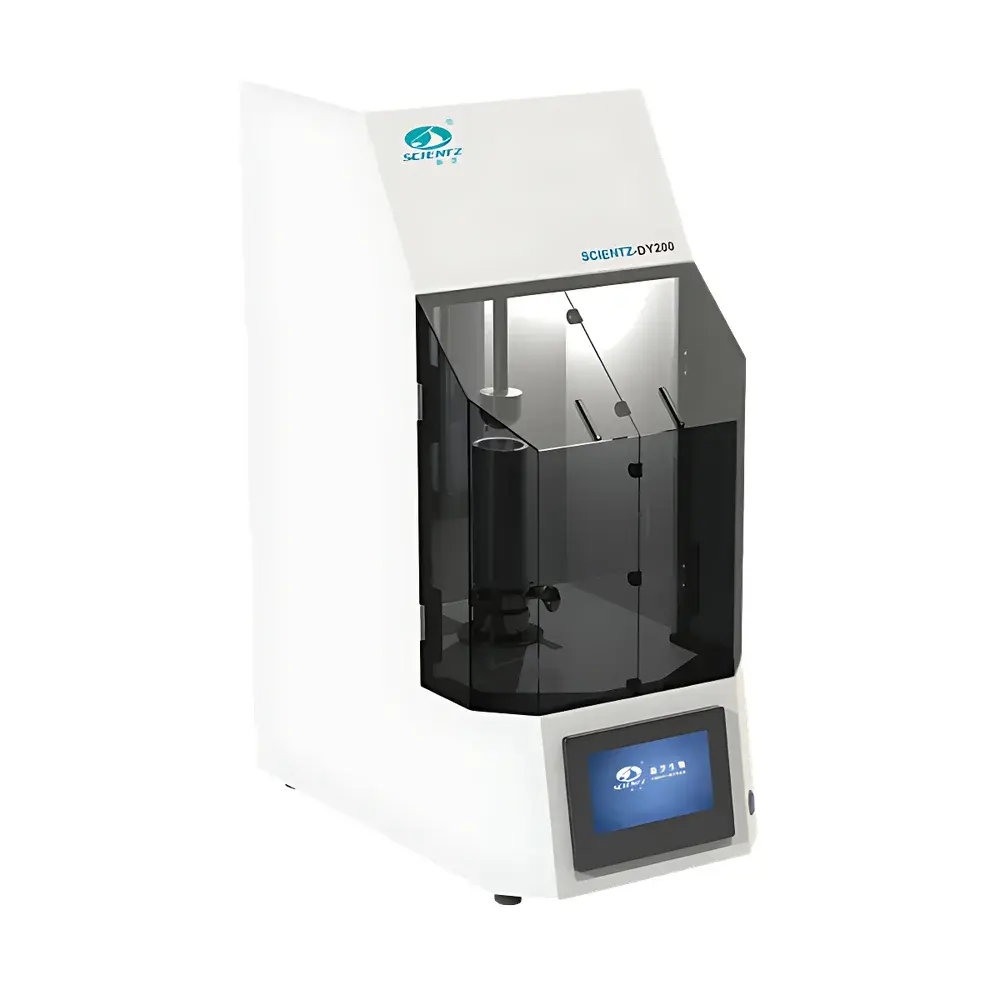
Ningbo Scientz Scientz-DY200 Benchtop Automated Homogenizer
| Brand | Ningbo Scientz |
|---|---|
| Origin | Zhejiang, China |
| Manufacturer Type | Direct Manufacturer |
| Instrument Type | Benchtop Homogenizer |
| Instrument Subtype | Adjustable High-Speed Disperser |
| Sample Volume Capacity | 100 mL |
| Output Power | 200 W |
Overview
The Ningbo Scientz Scientz-DY200 is a benchtop automated homogenizer engineered for gentle yet effective mechanical disruption of biological tissues—primarily animal and plant samples—using controlled rotational grinding mechanics. Unlike high-shear rotor-stator or ultrasonic systems, the Scientz-DY200 employs a precision-engineered PTFE-coated pestle-and-mortar configuration driven by a low-speed, high-torque motor. This design replicates manual glass homogenization while eliminating operator variability, fatigue, and contamination risk. Its core principle centers on shear-controlled tissue disintegration under defined rotational speed and axial displacement, enabling selective release of subcellular components—including intact mitochondria, nuclei, and membrane-bound organelles—without denaturing labile proteins or nucleic acids. As such, it serves as a critical pre-analytical tool in proteomics, mitochondrial isolation protocols, and primary cell lysate preparation where structural integrity and biochemical activity preservation are paramount.
Key Features
- Gentle, low-shear homogenization optimized for subcellular organelle recovery—minimizing membrane rupture and protein degradation
- PTFE-coated homogenizing pestle and mortar assembly: chemically inert, non-metallic, abrasion-resistant, and autoclavable (up to 121°C)
- Intelligent motor control with programmable speed ramping and torque-limiting logic to prevent sample overheating or over-processing
- 7-inch capacitive touchscreen interface with one-touch start/stop, real-time status feedback, and error logging (e.g., overload, overtravel, stall detection)
- Modular design supporting interchangeable PTFE homogenizing vessels (10–100 mL nominal capacity), facilitating scalability across sample batch sizes
- Low-noise operation (<65 dB(A) at 1 m) and vibration-damped chassis suitable for shared laboratory environments and laminar flow hoods
Sample Compatibility & Compliance
The Scientz-DY200 is validated for soft-to-medium density biological matrices including liver, brain, muscle, leaf tissue, cultured cells, and microbial pellets. It is not intended for fibrous, calcified, or highly viscous samples requiring cryogenic or bead-beating methods. All wetted parts comply with USP Class VI biocompatibility standards and meet ISO 10993-5 cytotoxicity requirements. The device supports Good Laboratory Practice (GLP) workflows through timestamped operation logs and user-accessible event history. While not certified to FDA 21 CFR Part 11 out-of-the-box, its audit trail functionality (including operator ID tagging and parameter change records) aligns with GMP-aligned documentation practices for regulated life science labs.
Software & Data Management
The embedded firmware enables full local control without external PC dependency. All operational parameters—including speed setpoint (0–12,000 rpm, adjustable in 100-rpm increments), run time (1–999 s), and pause intervals—are stored in non-volatile memory with up to 99 user-defined protocols. Event logs capture timestamps, motor load profiles, and fault codes for traceability. Data export is supported via USB-C port in CSV format for integration into LIMS or ELN platforms. Firmware updates are delivered via encrypted USB stick, ensuring version control and cybersecurity compliance in network-isolated lab settings.
Applications
- Isolation of functional mitochondria and synaptosomes from neural tissue for respirometry assays (e.g., Seahorse XF analysis)
- Preparation of native membrane protein extracts for cryo-EM or affinity purification
- Homogenization of food matrices (e.g., dairy, fruit pulp, meat) for microbiological enumeration or allergen testing per ISO 6887 and AOAC guidelines
- Environmental sample processing: lysis of biofilm aggregates or activated sludge flocs prior to DNA extraction
- QC/QA workflows in contract research organizations performing GLP-compliant toxicokinetic tissue distribution studies
FAQ
What types of tissue are compatible with the Scientz-DY200?
Soft and moderately structured tissues—including rodent liver, spleen, brain cortex, plant leaves, and cultured mammalian cells—are routinely processed. Avoid bone, cartilage, seeds, or dried fungal mycelia.
Can the homogenizing vessel be sterilized?
Yes—the PTFE mortar and pestle are autoclavable at 121°C for 20 minutes; repeated cycles do not compromise dimensional stability or surface finish.
Is method validation support available?
Scientz provides application notes and SOP templates aligned with ISO/IEC 17025 method verification principles, including repeatability data (CV <4.2% for mitochondrial yield across n=6 replicates).
Does the instrument meet electrical safety standards for international use?
It complies with IEC 61010-1:2010 for laboratory electrical equipment and carries CE marking; optional 230 V / 50 Hz or 115 V / 60 Hz configurations are available upon order.
How is maintenance performed?
No scheduled lubrication or calibration is required; routine cleaning with ethanol or 0.5% SDS suffices. Pestle alignment is factory-set and does not require field adjustment.
Related Products



