
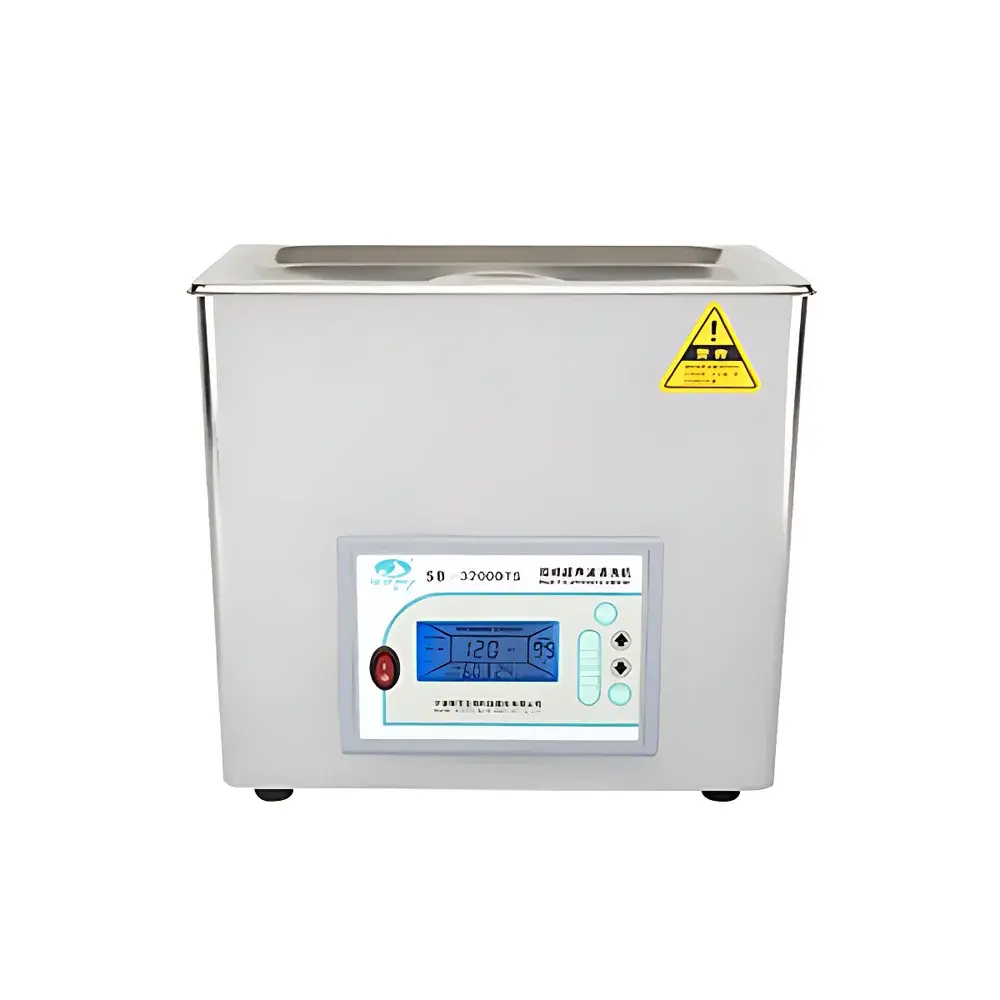
Ningbo Scientz SB-3200DTS Dual-Frequency Ultrasonic Cleaner
| Brand | Ningbo Scientz |
|---|---|
| Origin | Zhejiang, China |
| Manufacturer Type | Direct Manufacturer |
| Instrument Type | General-Purpose Ultrasonic Cleaner |
| Tank Capacity | 6 L |
| Ultrasonic Frequencies | 25 kHz / 40 kHz |
| Total Ultrasonic Power | 180 W |
| Power Adjustment | Not Adjustable |
| Temperature Range | Ambient to 80 °C |
| Timer Range | Not Adjustable |
| Sound-Dampening Lid | Included |
| Drain & Fill Fitting | Equipped |
Overview
The Ningbo Scientz SB-3200DTS Dual-Frequency Ultrasonic Cleaner is an engineered laboratory-grade cleaning system designed for reproducible, non-invasive removal of particulate, organic, and oily contaminants from complex geometries—including blind holes, narrow lumens, microchannels, and delicate optical surfaces. It operates on the physical principle of acoustic cavitation: high-frequency sound waves (25 kHz and 40 kHz) propagate through a liquid medium, inducing transient microbubble formation, growth, and violent collapse. This implosive event generates localized shockwaves (~1,000 atm), microstreaming, and intense shear forces at solid–liquid interfaces—enabling efficient decontamination without mechanical abrasion or thermal degradation. Unlike single-frequency systems, dual-frequency operation mitigates standing-wave node formation and improves cleaning uniformity across heterogeneous loads, particularly critical for multi-component labware such as centrifuge tubes, microtiter plates, capillary arrays, and precision optics.
Key Features
- Dual-frequency transduction (25 kHz and 40 kHz) with independent frequency selection—optimized for both heavy-duty degreasing (25 kHz) and fine particulate removal from sensitive substrates (40 kHz)
- Integrated heating system with precise digital PID temperature control (ambient to 80 °C), enhancing solvent activity and accelerating contaminant solubilization
- Large-capacity 6-liter stainless steel tank (304 grade) with rounded corners to minimize dead zones and ensure consistent acoustic field distribution
- Digital LED display showing real-time bath temperature and remaining cycle time—supports operational traceability in GLP-compliant environments
- Acoustically damped hinged lid with integrated safety interlock—reduces airborne noise by >15 dB(A) and prevents operator exposure to ultrasonic energy
- Standard drain valve and fill port for rapid solution exchange and compatibility with aqueous, ethanol-, or isopropanol-based cleaning media
- Automatic shutdown with power-loss memory function—retains last-used settings (frequency, temperature, timer) after unexpected interruption
Sample Compatibility & Compliance
The SB-3200DTS accommodates a broad range of laboratory and industrial specimens: borosilicate glassware (vials, cuvettes, pipette tips), polymer-based consumables (PCR tubes, filter housings), metal components (surgical instruments, watch gears, fuel injectors), quartz optics (lens elements, spectroscopic cells), and jewelry-grade alloys (gold, platinum, titanium). Its cleaning efficacy aligns with ASTM D2603 (Standard Test Method for Sonic Shear Stability of Lubricants) and ISO 13406-2 (for optical surface cleanliness verification). While not certified as a medical device under FDA 510(k) or EU MDR, its design supports sterilization-prep workflows compliant with AAMI ST79 and CDC/NIH guidelines when used with validated disinfectant solutions and documented process parameters.
Software & Data Management
This model operates via embedded firmware without external PC dependency. All operational parameters are stored in non-volatile memory and retain calibration integrity across power cycles. The digital interface logs timestamped temperature and runtime data—sufficient for internal audit trails under ISO/IEC 17025 or CAP-accredited laboratories. For regulated environments requiring electronic records, integration with third-party Lab Information Management Systems (LIMS) is achievable via optional RS-232 or USB-to-serial adapters (sold separately), enabling automated capture of run metadata—including start/stop timestamps, setpoints, and fault codes—for 21 CFR Part 11–compliant audit trails when paired with appropriate validation protocols.
Applications
- Routine decontamination of analytical glassware prior to HPLC, ICP-MS, or trace-metal analysis to prevent carryover and spectral interference
- Pre-sterilization cleaning of reusable surgical tools, dental handpieces, and endoscope channels per AAMI TIR12 recommendations
- Removal of polishing residues and hydrophobic films from microscope slides, grating substrates, and photomask blanks
- Deagglomeration and dispersion of nanomaterial suspensions (e.g., TiO₂, SiO₂ colloids) for stable formulation development
- Ultrasonic degassing of mobile phases, cell culture media, and polymer precursor solutions to eliminate nucleation sites affecting viscosity and homogeneity
- Maintenance cleaning of precision mechanical assemblies where solvent immersion and agitation must avoid dimensional distortion or surface pitting
FAQ
Is the SB-3200DTS suitable for cleaning delicate MEMS devices or semiconductor wafers?
Yes—when operated at 40 kHz with low-temperature aqueous surfactant solutions and short cycle durations (≤5 min), it achieves sub-micron particle removal while minimizing acoustic erosion risk. Validation per SEMI F20 is recommended for production use.
Does the unit comply with CE or UL safety standards?
The SB-3200DTS meets IEC 61000-6-3 (EMC emission) and IEC 61010-1 (safety for laboratory equipment) requirements. CE marking is applied per manufacturer’s EU Representative declaration; UL listing is not held but conforms to equivalent construction criteria.
Can the heater be disabled independently of ultrasonic operation?
Yes—the temperature control is fully decoupled from ultrasonic activation, allowing cold sonication for thermally labile samples such as protein-coated surfaces or enzymatic assay plates.
What maintenance is required for long-term reliability?
Annual inspection of transducer bonding integrity, periodic descaling of the tank using 5% citric acid solution, and verification of lid interlock functionality constitute the recommended preventive maintenance protocol.
Is distilled water mandatory for optimal performance?
Deionized or distilled water is strongly advised—especially above 50 °C—to prevent mineral deposition on transducers and tank walls, which attenuates acoustic output and reduces service life.



